Survey Uncovers Hidden Traces of Early Visitors (Image Credits: Images.newscientist.com)
North-west Greenland – Paleo-Inuit seafarers reached the isolated Kitsissut Islands more than 4500 years ago by crossing over 50 kilometres of open Arctic water.[1][2]
Survey Uncovers Hidden Traces of Early Visitors
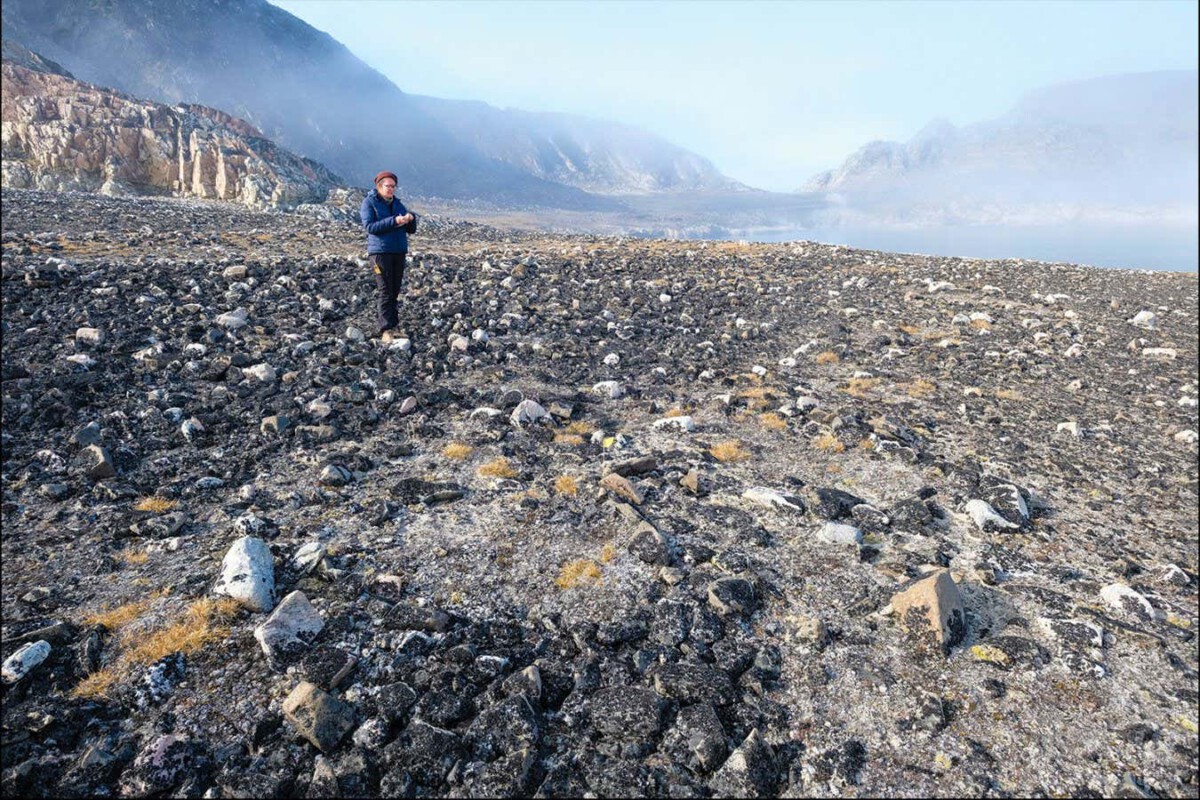
In 2019, researchers led by Matthew Walls at the University of Calgary conducted a survey of the three central Kitsissut Islands, known as Isbjørne, Mellem, and Nordvest.[1] They documented 297 archaeological features concentrated along beach terraces, primarily on Isbjørne Island. Among these stood out 15 circular bilobate tent structures, each divided into two halves by stones surrounding a central hearth. Such designs marked the distinctive architecture of the Paleo-Inuit, the first Indigenous peoples to arrive in northern Canada and Greenland.
A key artifact emerged from one tent ring: the wing bone of a thick-billed murre seabird. Radiocarbon dating placed it between 4400 and 3938 years old, confirming human presence shortly after the formation of the nearby Pikialasorsuaq polynya.[1] Marine sediment studies had previously shown the polynya – an area of open water amid sea ice – opened around 4500 years ago, creating a viable crossing route.
Mastering Open-Water Crossings in the Arctic
The Paleo-Inuit likely departed from mainland Greenland, facing a minimum distance of 52.7 kilometres to the islands.[1] Walls noted that currents and winds would have extended the actual journey. Ellesmere Island lay farther west, separated by treacherous waters, making Greenland the probable origin.
No boat remains surfaced, a common scarcity in Arctic archaeology due to perishable materials. Experts inferred the use of skin-on-frame watercraft, larger than kayaks to transport entire families, including children and elders. Susan Rowley Darwent, an archaeologist at the University of California, Davis, who was not involved in the study, emphasized this point: “They did have to have some sophisticated watercraft in order to cross that stretch of water… Instead, the Paleo-Inuit must have used larger craft that could carry perhaps nine or 10 people.”[1]
Sustaining Life on Barren Shores
Thick-billed murre colonies dotted Isbjørne Island, drawing the visitors for eggs and meat. Walls observed: “There’s a nesting colony of thick-billed murre. People would have collected their eggs and hunted them for meat.” Seals likely supplemented their diet in the nutrient-rich polynya.[1]
Human activity left a lasting mark. Waste and marine nutrients fertilized the thin soils, fostering vegetation growth uncommon on such remote outposts. This cycling between sea and land highlighted the seafarers’ integral role in the island ecosystems from the outset.
- 297 archaeological features identified across three islands.
- 15 bilobate tent rings with central hearths.
- Radiocarbon-dated murre bone: 4400–3938 years old.
- Minimum 52.7 km open-water crossing.
- Skin-on-frame boats inferred for family transport.
- Evidence of murre egg collection and seal hunting.
Reshaping Views of Ancient Arctic Exploration
This discovery ranks among the longest pre-contact sea voyages by Arctic Indigenous peoples, rivaling the 82-kilometre Bering Strait crossing from 20,000 years ago, which included a stopover island. Earlier oceanic feats, like those to Malta or Australia, predated compasses and sails, underscoring early human navigational prowess.
The findings, detailed in the journal Antiquity, challenge assumptions about Paleo-Inuit mobility and expand the known scope of their maritime reach.[1]
Key Takeaways
- Paleo-Inuit first visited Kitsissut Islands ~4500 years ago via open-water voyage.
- Sophisticated family-sized watercraft enabled crossings over 50 km.
- Human presence boosted island vegetation through nutrient transfer.
These ancient journeys reveal the boldness of early Arctic explorers and their deep ties to the sea. What lessons do they hold for understanding human adaptation in extreme environments? Share your thoughts in the comments.