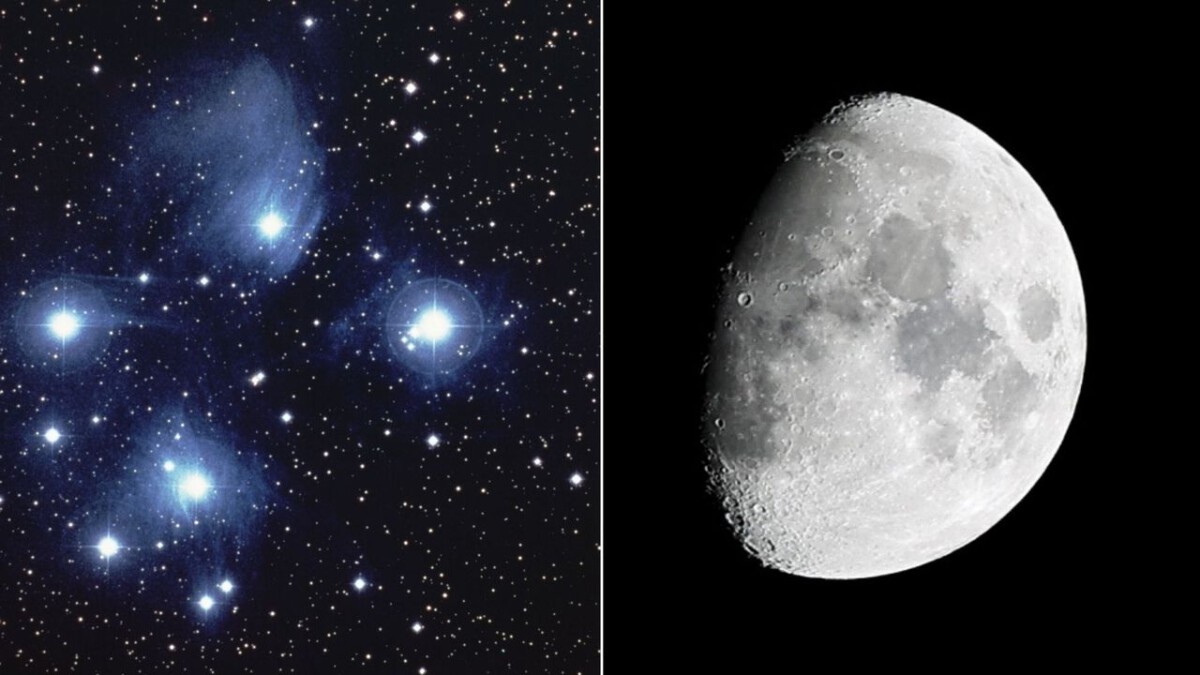
A Sparkling Pair Emerges After Dusk (Image Credits: Cdn.mos.cms.futurecdn.net)
A waxing gibbous moon draws near the famed Pleiades open star cluster in Taurus after sunset on January 27, 2026, offering a captivating sight for skywatchers worldwide.[1][2]
A Sparkling Pair Emerges After Dusk
Picture a cluster of blue-white stars resembling a miniature dipper, positioned just a few degrees from the moon’s glowing orb high in the southeast. This setup unfolds as twilight deepens, with the moon at about 72 to 76 percent illumination dominating the scene.[1][3]
The Pleiades, often called the Seven Sisters, stand out against the winter backdrop. Their soft collective glow persists even against the moon’s brilliance, rewarding patient observers. As the night progresses, the moon drifts eastward, widening the gap by dawn.[2]
Nearby, the orange star Aldebaran in Taurus adds a reddish contrast, while faint Uranus lurks southwest of the action for telescope users.[4][3]
Discovering the Seven Sisters
The Pleiades cluster lies roughly 440 light-years distant, harboring around 1,000 stars born from the same gaseous cloud. Only a handful shine bright enough for naked-eye detection, earning the nickname from ancient lore.[1]
Key members include:
- Alcyone, the brightest
- Asterope
- Celaeno
- Electra
- Merope
- Maia
- Taygete
Light from these stars left in the late 1500s, a reminder of cosmic timescales. Binoculars reveal dozens more faint companions, transforming the view into a stellar beehive.[2]
Prime Viewing Strategies
Step outside shortly after sunset, when the moon rises high in the southeast. The pair remains visible well past midnight in many locations, setting around 3 a.m. local time.[1]
Essential tips include:
- Seek clear, dark skies away from city lights.
- Use peripheral vision to spot fainter stars amid moonlight.
- Employ 10×50 binoculars to frame both moon and cluster together.
- A 6-inch telescope unveils deeper cluster layers and lunar craters like Tycho near the terminator.
- Check local rise/set times via reliable astronomy sites.
The moon’s glare challenges naked-eye views initially, but patience yields rewards as stars pop against the fading dusk.[2]
Europe’s Unique Occultation Bonus
Viewers in Europe witness an extra thrill: the moon occults several Pleiades stars, briefly hiding them behind its dark limb. In places like Munich or Oslo, Taygeta vanishes around 10:30 p.m. local time, reemerging after 30 minutes, followed by Maia.[2]
North Americans see the moon northeast or east of the cluster, separated by 1 to 5 degrees, still a beautiful pairing without the cover-up. This regional variance highlights the moon’s orbital path across our sky.[3]
Key Takeaways
- Waxing moon nears Pleiades after sunset in Taurus; binoculars enhance the scene.
- Europe enjoys occultation of stars like Taygeta; Americas get a close pass.
- Cluster’s 440 light-year distance offers a glimpse into stellar youth.
This fleeting alignment serves as a perfect entry for novice astronomers into winter’s celestial wonders. Grab your optics and step outside – the night sky awaits. What catches your eye in this display? Share in the comments.