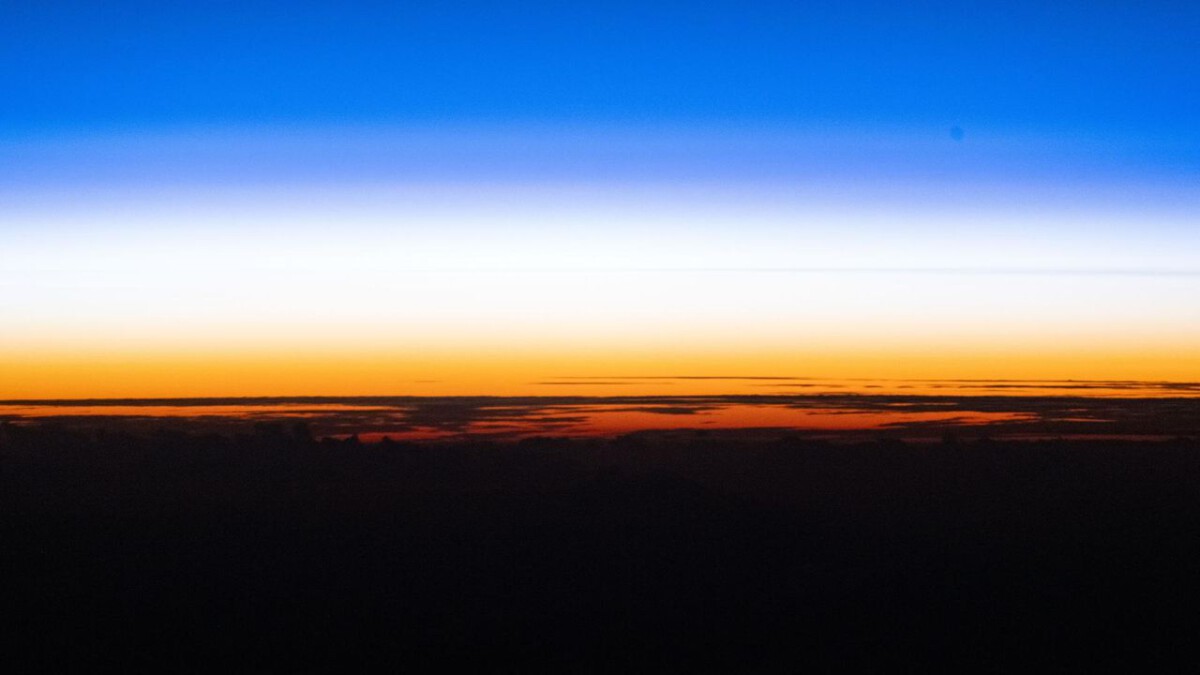
A Celestial Display Beyond Imagination (Image Credits: Cdn.mos.cms.futurecdn.net)
High above the Pacific Ocean, an astronaut aboard the International Space Station snapped a captivating image of a sunset in early January 2026, where golden light edged the planet’s dark curve.[1]
A Celestial Display Beyond Imagination
Astronauts witness the sun vanish behind Earth’s full horizon every 90 minutes, a spectacle far grander than any terrestrial vista. The recent photograph revealed clouds sharply outlined against a thin band of sunlight, transitioning abruptly to the blackness of space. This view underscored the station’s relentless pace through light and shadow.
Station crew members endure this cycle 15 or 16 times daily, as the ISS hurtles into Earth’s shadow in mere minutes. The image, credited to NASA photographer Chris Williams, captured the moment precisely over the Pacific.[1]
How Sunsets Differ in Low Earth Orbit
Unlike ground-based sunsets that unfold over hours, orbital ones compress into seconds due to the station’s high velocity. The sun does not descend gradually; instead, the spacecraft plunges into the planet’s umbra. This rapid shift produces vivid colors viewed tangentially through the atmosphere.
Earth’s air layer acts as a prism here, bending sunlight along the horizon’s arc. Blues scatter away efficiently, while longer wavelengths like reds and oranges dominate the glow. The result forms a slender luminous band spanning thousands of miles, a phenomenon impossible from the surface.[1]
Unlocking Atmospheric Secrets from Above
Such images illustrate fundamental optics on a global scale. Sunlight undergoes scattering, refraction, and selective absorption as it traverses denser atmospheric paths near the limb. Observers from orbit gain a unique vantage, seeing the terminator line where day meets night slice cleanly across continents and oceans.
Astronauts leverage these moments for both awe and science. The photographs document airglow, twilight phenomena, and even subtle weather patterns illuminated in profile. This particular shot highlighted Pacific cloud formations etched in gold against the void.
- Rapid transition: Full sunset in under a minute.
- Enhanced colors: Tangential atmospheric filtering intensifies hues.
- Planetary scale: Glow encircles half the globe.
- Shadow entry: ISS speed dictates the brevity.
- Daily frequency: 15-16 cycles per 24 hours.
Perspective from the Edge of Space
These sunsets erase borders, presenting Earth as a singular, interconnected sphere. No political lines mar the seamless curve; oceans and clouds blend indifferently. For crew members isolated hundreds of miles up, the display reinforces planetary unity amid their routine.
The full image appears on NASA’s media archive, inviting public appreciation of orbital photography’s artistry.[1]
Key Takeaways
- ISS orbits Earth every 90 minutes, yielding 16 sunsets daily.
- Orbital views showcase atmospheric optics like never before.
- Sunsets remind viewers of Earth’s delicate, borderless beauty.
Orbital sunsets not only dazzle but also deepen our grasp of atmospheric dynamics and human fragility on a spinning world. What captures your imagination most about life in orbit? Share your thoughts in the comments.