
A Cosmic Legacy from Millennia Past (Image Credits: Cdn.mos.cms.futurecdn.net)
Astronomers predict that Venus will cross paths with a trail of cosmic dust originating from an asteroid breakup thousands of years ago, setting the stage for a potentially massive meteor shower on the planet this summer.[1]
A Cosmic Legacy from Millennia Past
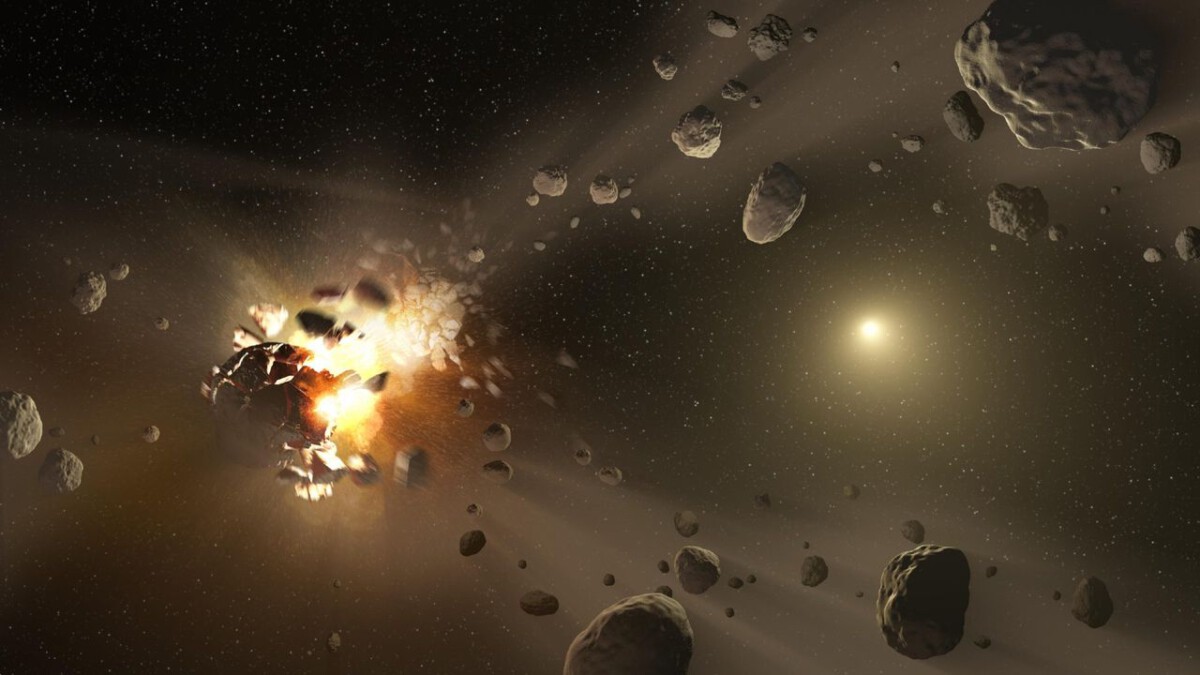
Long ago, an asteroid shattered into fragments, releasing a stream of dust that has orbited the sun ever since. This debris trail persisted through time, evolving into a potential hazard for planetary encounters.
Researchers identified the stream through orbital modeling, tracing its origins back thousands of years. The breakup likely occurred when gravitational forces or collisions disrupted the asteroid’s structure.[1]
Venus, with its orbit closer to the sun, now aligns perfectly to intersect this dusty path during July 2026. Such alignments remain rare, highlighting the dynamic nature of solar system debris.
Intensity of the Expected Display
The planet could experience a dramatic influx of meteors as it plows through the concentrated dust. Unlike typical showers, this event might qualify as a meteor storm due to the density of particles.
Modeling suggests the shower could produce rates far exceeding standard Earth-based displays, though exact numbers depend on the dust’s distribution. Venus’s thick atmosphere would cause particles to burn up brightly, creating a fiery spectacle high above the surface.[1]
- Dust from asteroid fragmentation spreads into elongated trails over centuries.
- Venus encounters the core of the stream around mid-July.
- Particles vary in size, leading to a range of meteor brightnesses.
- Similar events have been predicted for other planets in past studies.
- Orbital resonances help maintain the stream’s integrity.
Challenges in Observing from Earth
Earth observers face disappointment, as Venus’s position and opaque atmosphere block any visible effects. The planet appears as a brilliant evening star, but no shooting stars will streak across its disk from our vantage.
Spacecraft like Japan’s Akatsuki orbiter might detect indirect signs, such as atmospheric disturbances from incoming material. However, no missions currently position instruments to capture the light show directly.[1]
Still, the prediction underscores ongoing efforts to map meteoroid streams across the solar system. Future probes to Venus could equip for such phenomena.
Broader Implications for Planetary Science
This forecast revives interest in interplanetary dust dynamics. Streams from disrupted asteroids influence atmospheres on multiple worlds, potentially delivering water or organics over eons.
Scientists continue refining models to predict encounters accurately. Past simulations have successfully anticipated Earth showers, building confidence in Venus projections.
| Planet | Known Meteor Streams | Recent Predictions |
|---|---|---|
| Earth | Perseids, Geminids | Annual peaks tracked |
| Venus | Rare modeled events | July 2026 candidate |
| Mars | Annual showers noted | Comet-linked streams |
Key Takeaways:
- Venus nears a dust trail from an ancient asteroid split.
- Peak activity expected in July 2026.
- Earth views remain impossible due to distance and clouds.
As Venus hurtles through this celestial relic, it reminds us of the solar system’s hidden fireworks. What cosmic encounters await other planets? Share your thoughts in the comments.