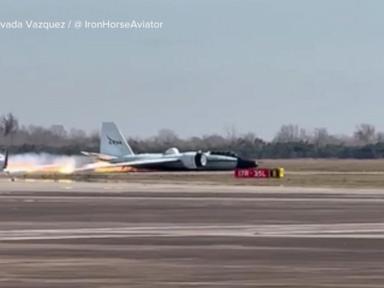
Shocking Footage Captures the Moment of Impact (Image Credits: S.abcnews.com)
Houston, Texas – A NASA research aircraft skidded across the runway in a shower of sparks and flames Tuesday after a mechanical failure prevented its landing gear from deploying.
Shocking Footage Captures the Moment of Impact
Video from the scene showed the distinctive WB-57 high-altitude plane descending slowly toward Runway 17R-35L at Ellington Field Airport around 11:30 a.m. The aircraft jolted upon touchdown, its wings bouncing as bursts of yellow fire and white smoke erupted from underneath.[1]
The plane, known for its thin fuselage and two-seat cockpit, slid along its belly for several moments before coming to a halt. Emergency responders rushed to the site with fire trucks flashing. Responders assisted the crew as the cockpit hatch opened, confirming no injuries occurred.[2]
NASA’s Johnson Space Center, located nearby, houses the fleet of these specialized aircraft. The incident prompted an immediate runway closure until crews could remove the damaged plane.
Mechanical Issue Blamed for Gear Failure
Officials attributed the emergency landing to a mechanical malfunction with the landing gear. NASA spokesperson Bethany Stevens addressed the event on social media shortly after.[3]
“Today, a mechanical issue with one of NASA’s WB-57s resulted in a gear-up landing at Ellington Field. Response to the incident is ongoing, and all crew are safe at this time. As with any incident, a thorough investigation will be conducted by NASA into the cause.”
Jim Szczesniak, director of aviation for Houston Airports, noted the aircraft encountered problems upon landing. First responders from a military subcontractor handled the initial response.
The WB-57 program supports scientific research worldwide, offering flights lasting up to 6.5 hours at altitudes exceeding 63,000 feet. NASA has relied on these planes since the 1970s for advanced missions.[4]
WB-57’s Role in NASA’s Research Arsenal
These aircraft serve government agencies, universities, and private firms for high-altitude testing and data collection. Their unique capabilities make them irreplaceable for certain experiments.
The fleet operates from Ellington Field, facilitating quick access to launch sites. Tuesday’s event highlighted the risks inherent in such demanding operations, even for veteran platforms.
- High-altitude endurance: Over 63,000 feet for extended periods.
- Crew configuration: Two seats for pilot and mission specialist.
- Mission focus: Scientific payloads, technology testing, and atmospheric studies.
- Base location: Ellington Field, near Johnson Space Center.
- Service history: Active since the 1970s with ongoing upgrades.
Investigation Promises Clarity on Causes
NASA pledged a comprehensive review to pinpoint the failure’s origin. Aviation experts anticipate analysis of flight data, maintenance records, and wreckage.
Similar incidents often reveal issues like hydraulic failures or structural wear. Results could influence future inspections across the WB-57 fleet.
Ellington Airport authorities coordinated with NASA throughout the response. The runway reopened after safe aircraft removal, minimizing disruptions.
Key Takeaways
- All crew members emerged unharmed from the belly landing.
- A mechanical gear issue forced the dramatic skid, captured on video.
- NASA’s investigation will examine causes and preventive measures.
This close call underscores the precision required in aviation research, where cutting-edge science meets unforgiving physics. Crew skill turned potential disaster into a safe outcome. What lessons will emerge from the probe? Share your thoughts in the comments.