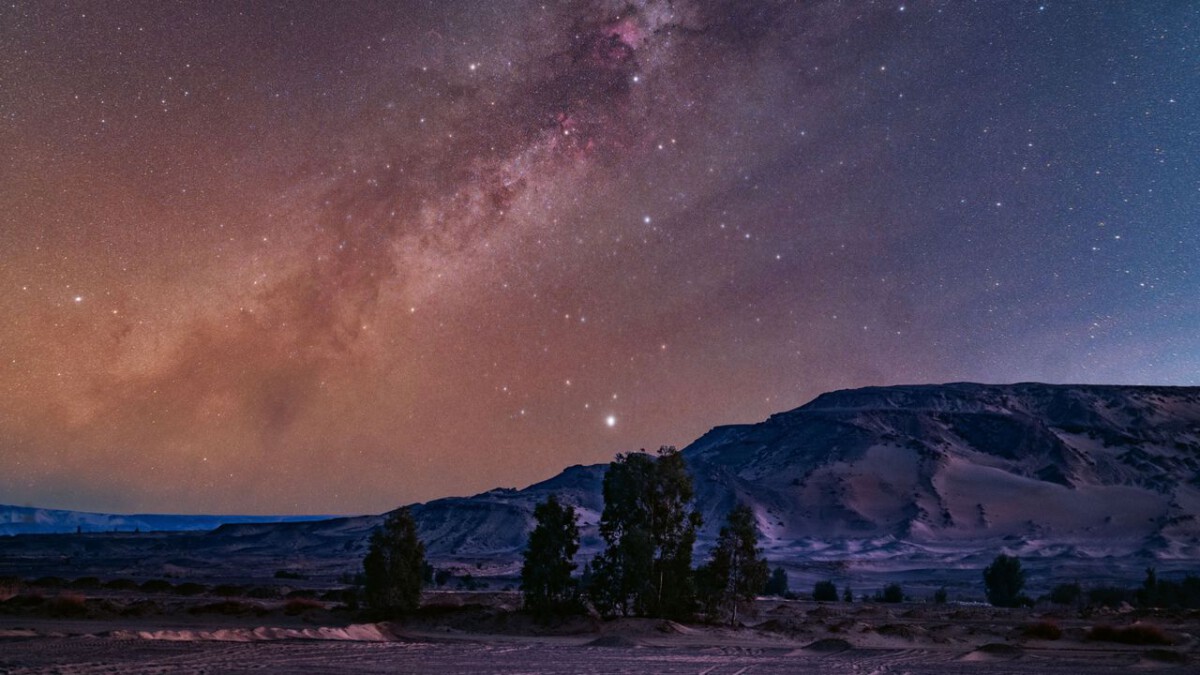
Photographer Captures Desert’s Cosmic Wonder (Image Credits: Cdn.mos.cms.futurecdn.net)
Egypt’s Black Desert – A captivating celestial display unfolded above the volcanic landscape, where the Milky Way’s luminous band intertwined with the prominent stars of the Summer Triangle.
Photographer Captures Desert’s Cosmic Wonder
Astrophotographer Osama Fathi seized a breathtaking moment on December 20, 2025, when clear skies revealed the Milky Way’s dense starfields and dark dusty lanes over the remote Black Desert.
The composite image showcased the galaxy’s core glowing intensely against a pristine, moonless backdrop. Fathi highlighted the site’s advantages. “The exceptionally low light pollution and dry atmospheric conditions of the desert allow for high contrast between the Milky Way’s bright core regions and the surrounding stellar background,” he explained in correspondence with Space.com.
This setup preserved the subtle textures of the foreground terrain under natural starlight alone, linking earthly geology to galactic vastness.
Decoding the Summer Triangle Asterism
Deneb stood out prominently, marking the tail of the swan in the constellation Cygnus and nestled within the Milky Way’s ribbon.
Vega gleamed near the horizon, known as a past and potential future North Star due to Earth’s precession cycle. Altair, the brightest star in Aquila, balanced the formation on the opposite side. These three luminaries formed the Summer Triangle, a familiar asterism visible worldwide.
Northern Hemisphere observers noted its low position during winter evenings, rising higher in summer skies. The configuration offered an accessible entry point for stargazers tracing the galaxy’s path.
Why Egypt’s Black Desert Excels for Stargazing
The Black Desert’s volcanic features created a stark foreground that complemented the overhead spectacle.
Its isolation ensured minimal artificial light interference, while arid air minimized atmospheric distortion. Such conditions sharpened views of faint cosmic details that often eluded urban viewers.
- Negligible light pollution preserved faint Milky Way structures.
- Dry climate enhanced image clarity and contrast.
- Moonless nights amplified galactic visibility.
- Ancient volcanic rocks provided a timeless earthly anchor.
Behind the Lens: Gear and Technique
Fathi employed a modified Nikon Z6 camera paired with a Nikkor 14-24 mm lens for the six-minute exposure.
This setup captured both sky and ground without supplemental lighting. “Foreground features were recorded under natural starlight, preserving the desert’s subtle textures without artificial illumination, emphasizing the connection between Earth’s ancient geological formations and the vast structure of our galaxy,” Fathi noted.
The approach yielded a seamless blend of terrestrial and celestial elements, inviting viewers to ponder humanity’s place in the cosmos.
Key Takeaways
- Seek dark-sky sites like deserts for optimal Milky Way views.
- Spot the Summer Triangle using Deneb, Vega, and Altair as guides.
- Use wide-angle lenses and long exposures for Milky Way photography.
The image from Egypt’s Black Desert reminds us that extraordinary skies await in remote corners of Earth, bridging our world with the universe’s grandeur. What celestial sights have you chased lately? Share in the comments.