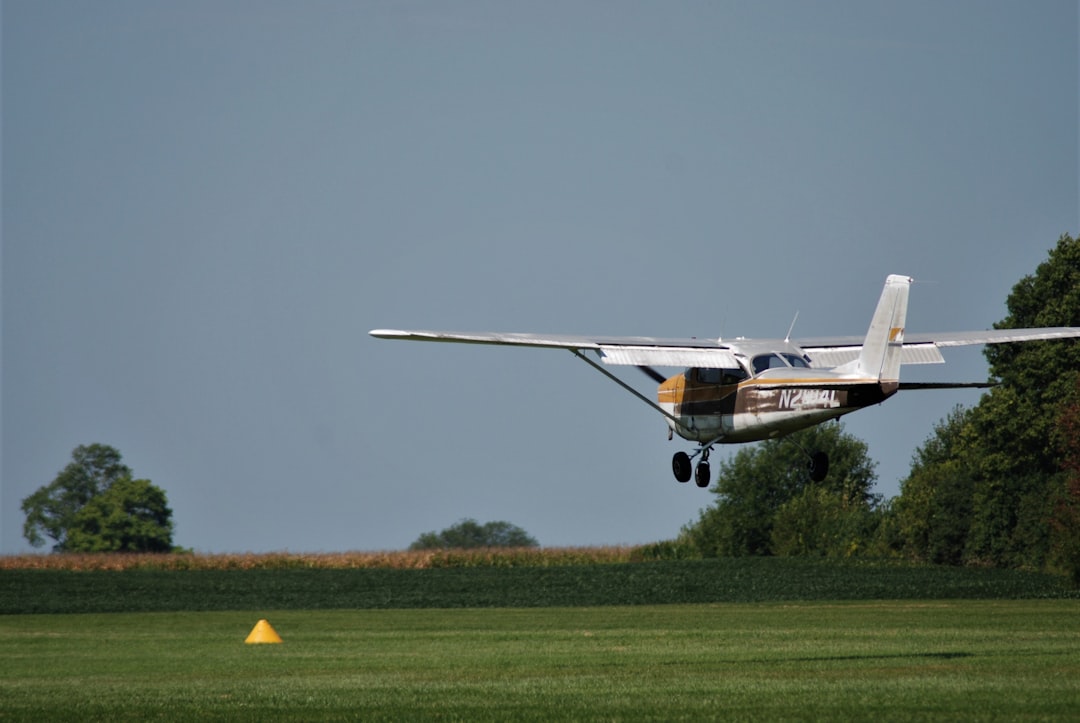
Sudden Malfunction Turns Routine Flight Tense (Image Credits: Unsplash)
A high-altitude NASA research aircraft touched down without its landing gear at Ellington Field on Tuesday, producing a trail of fire and smoke as it skidded along the runway, yet both crew members walked away unscathed.[1][2]
Sudden Malfunction Turns Routine Flight Tense
The WB-57 departed Ellington Field around 10:19 a.m. CST for a standard training mission. Approximately an hour later, at about 11:25 a.m., a mechanical problem prevented the landing gear from deploying on Runway 17R-35L.[2][3]
Pilots executed a controlled gear-up landing, sliding the aircraft on its belly. Video footage captured sparks erupting from the fuselage as it decelerated, with emergency crews rushing to the scene.[1] First responders from a military subcontractor secured the area while the runway closed temporarily for aircraft removal.
WB-57: Backbone of NASA’s Aerial Science Efforts
This incident involved tail number NASA 927, one of three WB-57s operated from NASA’s Johnson Space Center at Ellington Field. Derived from the 1950s Martin B-57 Canberra bomber, the platform has supported research missions since the 1970s.[2]
Engineered for extreme altitudes exceeding 63,000 feet, the jet enables prolonged observations critical to atmospheric studies and Earth science. It boasts a 6.5-hour endurance, 2,500-nautical-mile range, and capacity for 8,800-pound payloads at speeds around 410 knots. Typically crewed by a pilot and sensor operator, the WB-57 has aided astronomy pursuits, such as probing the sun’s corona during the April 2024 total solar eclipse for over six minutes of totality – far longer than ground-based views.[1]
- High-altitude flights up to 63,000 feet for unobstructed data collection.
- Support for infrared-to-visible light observations in solar research.
- Versatile payload bays for instruments testing future space missions.
- Historical role in eclipse chasing and atmospheric chemistry analysis.
- Routine use in training to maintain operational readiness.
Crew Safety and NASA’s Immediate Actions
Both crew members, NASA employees, underwent medical evaluations at the site and received clearance with no injuries reported. NASA spokesperson Bethany Stevens confirmed their well-being shortly after the event.[2]
“Today, a mechanical issue with one of NASA’s WB-57s resulted in a gear-up landing at Ellington Field,” Stevens stated on X. “Response to the incident is ongoing, and all crew are safe at this time.”[4] The agency pledged a thorough investigation into the gear failure, promising public updates as details emerge. The Federal Aviation Administration also joined the probe.
Implications for NASA’s Research Fleet
Two other WB-57s remain grounded for inspections, leaving this aircraft as the sole recent flyer. Officials emphasized no disruption to key programs like Artemis II, thanks to backup assets such as Gulfstream jets.[2]
The event underscores the risks of operating aging yet vital platforms. Damage to the airframe awaits full assessment, but the successful belly landing highlights pilot training effectiveness.
Key Takeaways
- All crew safe; no injuries from the gear-up landing.
- WB-57 vital for high-altitude science, including astronomy observations.
- NASA investigation underway; fleet operations continue uninterrupted.
This close call reinforces the resilience of NASA’s high-altitude research program, where innovation meets the challenges of extreme flight. What lessons might this incident yield for future missions? Share your thoughts in the comments.