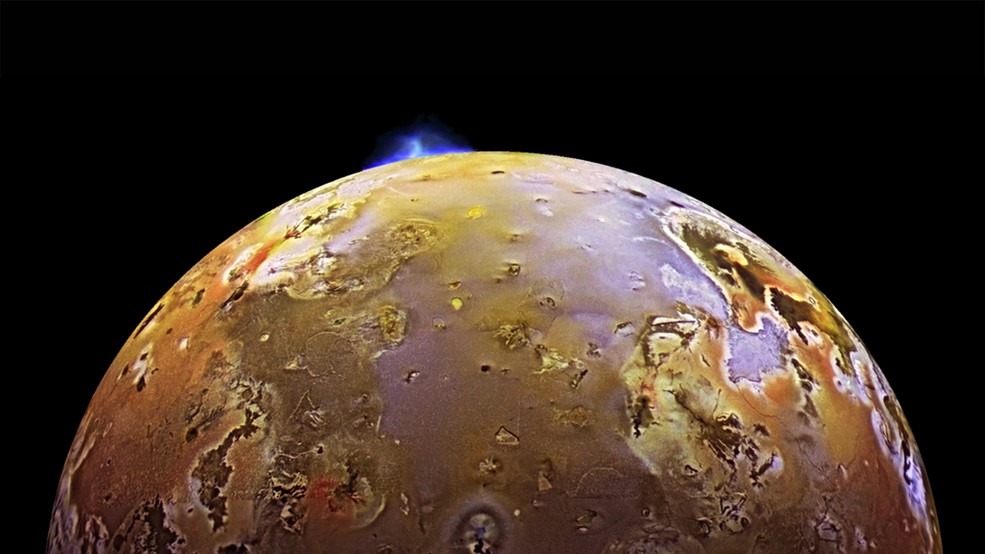
A Detection That Overwhelmed Instruments (Image Credits: Upload.wikimedia.org)
NASA’s Juno spacecraft revealed the solar system’s most intense volcanic event during a flyby of Jupiter’s moon Io on December 27, 2024.[1]
A Detection That Overwhelmed Instruments
The Juno spacecraft’s Jovian Infrared Auroral Mapper, or JIRAM, captured an extraordinary infrared signature in Io’s southern hemisphere, just right of the south pole. This massive hotspot spanned 40,000 square miles – larger than Earth’s Lake Superior – and released radiance exceeding 80 trillion watts, equivalent to six times the output of all global power plants combined.[1] The sheer intensity saturated JIRAM’s detector, marking it as the most powerful eruption ever recorded on Io.
Alessandro Mura, a Juno co-investigator from Italy’s National Institute for Astrophysics, described the finding. “JIRAM detected an event of extreme infrared radiance – a massive hot spot – in Io’s southern hemisphere so strong that it saturated our detector,” he said. “However, we have evidence what we detected is actually a few closely spaced hot spots that emitted at the same time, suggestive of a subsurface vast magma chamber system. The data supports that this is the most intense volcanic eruption ever recorded on Io.”[1]
Io’s Relentless Volcanic Engine
Scientists have long known Io as the most volcanically active body in the solar system, home to around 400 volcanoes that spew lava fountains miles high.[2] The moon’s surface renews itself rapidly through eruptions, outpacing crater formation from impacts. This activity dwarfs previous records, such as the Loki Patera lava lake, which covered only 7,700 square miles.[1]
Tidal forces drive Io’s fury. Jupiter’s massive gravity, combined with pulls from neighboring moons Europa and Ganymede, flexes Io’s interior during its 42.5-hour orbit. The resulting friction generates immense heat, melting rock into magma.
- Gravitational tug-of-war deforms Io constantly.
- Frictional heating sustains a global magma ocean.
- Eruptions eject sulfur-rich plumes and silicate lava.
- Surface features include pyroclastic deposits and fissure-fed flows.
- Volcanic gases form a thin atmosphere.
Clues to a Hidden Magma Network
Analysis of the JIRAM data pointed to multiple hot spots firing simultaneously, hinting at a vast subsurface magma chamber feeding the eruption.[3] Earlier Juno flybys in December 2023 and February 2024, which approached within 930 miles, provided context through visible surface changes near the south pole.
Scott Bolton, Juno’s principal investigator at the Southwest Research Institute, highlighted the significance. “This is the most powerful volcanic event ever recorded on the most volcanic world in our solar system – so that’s really saying something,” he stated.[1] Such events could reshape understanding of volcanism across the solar system.
Tracing the Eruption’s Lasting Marks
JunoCam images from 2024 flybys showed darkening and color shifts around the south pole between orbits 66 and 68, signs of fresh volcanic deposits.[1] The recent outburst likely produced solidified lava flows, sulfur dioxide plumes, and rocky ejecta that will persist on Io’s tortured surface.
Mission teams anticipate enduring scars from this eruption, similar to past ones. A follow-up flyby on March 3, 2025, aimed to monitor landscape evolution, though lower resolution limited details from the December pass.[3]
Key Takeaways
- Io’s new hotspot exceeds prior records by size and energy.
- Tidal heating powers continuous global volcanism.
- Juno data suggests interconnected magma reservoirs.
This landmark observation underscores Io’s dynamic geology and Juno’s extended mission value since 2016. As scientists pore over the data, it promises broader insights into planetary interiors. What do you think about Io’s explosive power? Tell us in the comments.