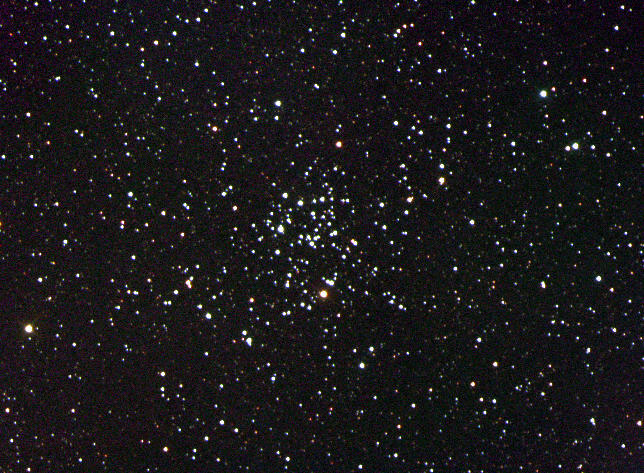
A Cluster Bursting with Stellar Variety (Image Credits: Upload.wikimedia.org)
Amateur astronomers tonight can target the open cluster M50 in the constellation Monoceros for a rewarding view amid winter’s starry backdrop.[1]
A Cluster Bursting with Stellar Variety
Observers often describe M50 as a hazy patch that resolves into dozens of stars under magnification. This open cluster spans 16 arcminutes across the sky. Its brightest member, a slightly golden-hued star of around 8th magnitude, sits just south of the center. The entire group glows at a combined magnitude of about 6, making it accessible to backyard telescopes and even steady binoculars.[1]
Astronomers estimate M50 lies roughly 3,200 light-years from Earth. The cluster formed about 78 million years ago. Such groupings offer glimpses into the life cycles of stars in our galaxy’s disk. Tonight’s clear winter conditions in many regions enhance its appeal despite the Moon’s phase.[1]
Locating M50: Start with the Night’s Brightest Star
Sirius dominates the southern sky after dusk, serving as the perfect jumping-off point. This brilliant star in Canis Major anchors the view. M50 resides 9.4 degrees northeast of Sirius, within the faint outlines of Monoceros the Unicorn.[1]
Follow these steps to pinpoint it:
- Face south and identify Sirius low in the sky.
- Sweep northeast with binoculars, covering about the width of a fist at arm’s length.
- Scan southern Monoceros; M50 appears upper left of Sirius in early evening.
- Center your finder scope there for telescopes.
- Increase power to separate the stars from the glow.
Patience pays off, especially from urban areas where light pollution dims fainter members.[1]
Winter Triangle: M50’s Grand Backdrop
The Winter Triangle asterism provides context for M50’s position. Astronomy contributor Phil Harrington highlights this shape formed by Betelgeuse in Orion, Sirius in Canis Major, and Procyon in Canis Minor. Monoceros nestles between these luminaries, hiding clusters like M50.[1]
This triangle guides viewers through winter’s deep-sky offerings. Betelgeuse glows red-orange to the east, Procyon sparkles higher west. Sirius anchors the base. Together, they frame a region rich in targets for all skill levels.[1]
Timing Your Observation on January 29
Sunset arrives around 5:16 P.M. local time from mid-northern latitudes, ushering in darkness. The waxing gibbous Moon, at 90 percent illumination by 10 P.M., rises earlier in the afternoon but leaves the early evening relatively dark. Visibility improves as Monoceros climbs higher after 8 P.M.[1]
Check these key times for 40° N, 90° W locales:
| Event | Local Time |
|---|---|
| Sunrise | 7:11 A.M. |
| Sunset | 5:16 P.M. |
| Moonrise | 1:29 P.M. |
| Moonset | 4:39 A.M. |
Adjust for your location using apps or almanacs. Dark skies favor the faintest stars.[1]
- M50 offers a compact, starry glow 9.4° northeast of Sirius.
- Best viewed with binoculars or small telescopes in early evening.
- Winter Triangle aids navigation amid the Moon’s glow.
M50 reminds us of the galaxy’s dynamic neighborhoods, waiting just beyond city lights. Step outside tonight and connect with this ancient stellar family. What have you seen in Monoceros lately? Tell us in the comments.[1]