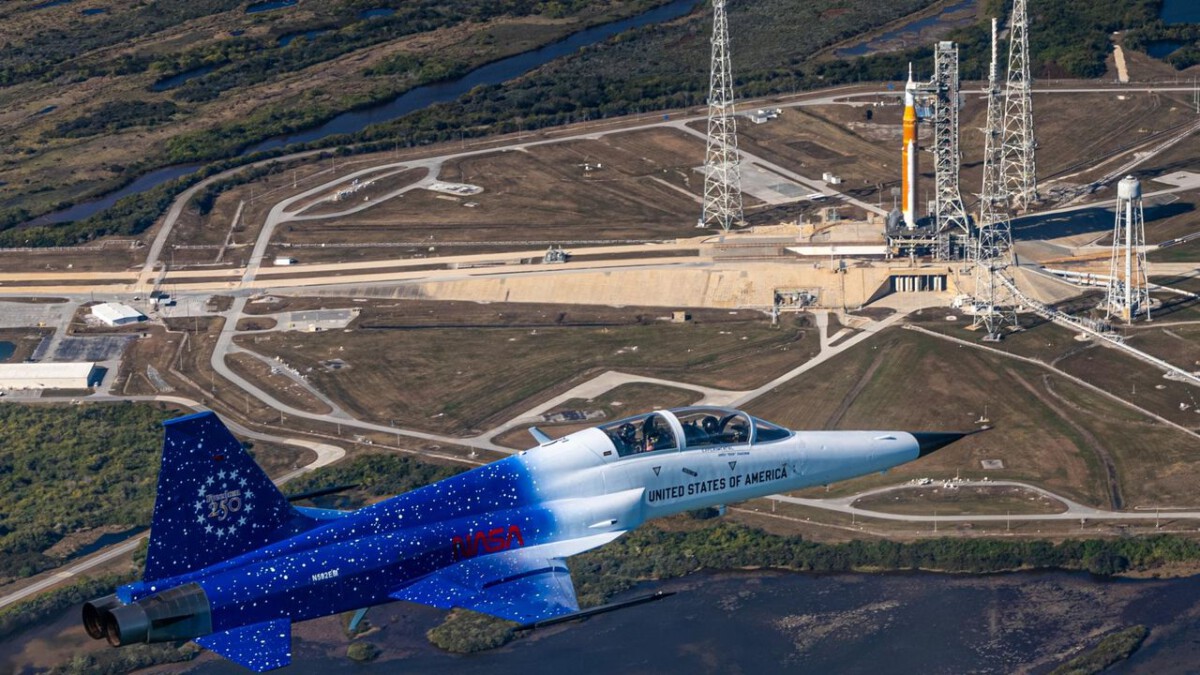
A Commanding Aerial Inspection (Image Credits: Cdn.mos.cms.futurecdn.net)
Kennedy Space Center, Florida – NASA Administrator Jared Isaacman recently piloted his personal F-5 aircraft over the agency’s massive Artemis 2 rocket, providing a dramatic aerial perspective on preparations for humanity’s return to lunar orbit.
A Commanding Aerial Inspection
Newly confirmed NASA Administrator Jared Isaacman chose a hands-on approach to assess progress on the Artemis 2 mission. He invited Secretary of Defense Pete Hegseth aboard his F-5 jet for a low flyover of Launch Pad 39B. The maneuver highlighted the rocket’s imposing presence against Florida’s coastal landscape.
Photographers captured the moment as the sleek blue-and-white jet streaked past the orange-and-white Space Launch System stack. This personal tour underscored Isaacman’s enthusiasm for the program, drawing from his experience as a private astronaut.
The flyover occurred amid heightened activity at the Kennedy Space Center. Teams had just completed a critical prelaunch test, fueling anticipation despite minor setbacks.
Artemis 2: The Crewed Lunar Frontier
Artemis 2 marked a pivotal advancement following the uncrewed Artemis 1 flight in late 2022. Four astronauts prepared to embark on a 10-day journey around the moon, testing the Orion spacecraft’s capabilities in deep space.
The mission followed a free-return trajectory, leveraging gravitational forces to guide the crew back to Earth without propulsion. Engineers aimed to validate life-support systems and operations far beyond low-Earth orbit.
Though the crew stopped short of a lunar landing, the flight paved the way for subsequent missions. Artemis 3 targeted a surface touchdown, while Artemis 4 promised expanded exploration infrastructure.
Navigating Prelaunch Hurdles
Ground crews conducted a wet dress rehearsal shortly before the flyover. The exercise simulated a full countdown, loading the rocket with cryogenic propellants to synchronize systems.
A liquid hydrogen leak emerged during fueling, prompting NASA to postpone the launch. Officials targeted no earlier than March to review data and perform additional tests.
Such challenges echoed past rehearsals, including those for Artemis 1. Engineers addressed the issue methodically, ensuring crew safety remained paramount.
- The Space Launch System stood fully stacked on Pad 39B, ready for final checks.
- Orion spacecraft integration proved seamless after rollout from the Vehicle Assembly Building.
- Cryogenic loading timelines refined communication between rocket and ground control.
- Delay allowed deeper analysis of propulsion systems.
- Backup opportunities scheduled through spring if needed.
Broader Implications for Space Exploration
The Artemis program extended beyond the moon, building skills for Mars voyages. Operations demanded sustained presence farther from Earth than the International Space Station.
Isaacman’s leadership brought fresh momentum. His background in commercial spaceflight bridged government and private sectors.
The flyover symbolized unity across agencies. Collaboration with the Department of Defense highlighted national priorities in space.
Key Takeaways
- Artemis 2 launches four astronauts on Orion’s debut crewed flight around the moon.
- A hydrogen leak delayed liftoff to March, following wet dress rehearsal.
- Isaacman’s F-5 flyover with Hegseth captured the rocket’s readiness from above.
As NASA refined its path to the moon, this aerial snapshot encapsulated the blend of innovation and caution defining the effort. The rocket loomed as a testament to decades of engineering, poised for history. What are your thoughts on the Artemis delays and this unique flyover? Share in the comments below.