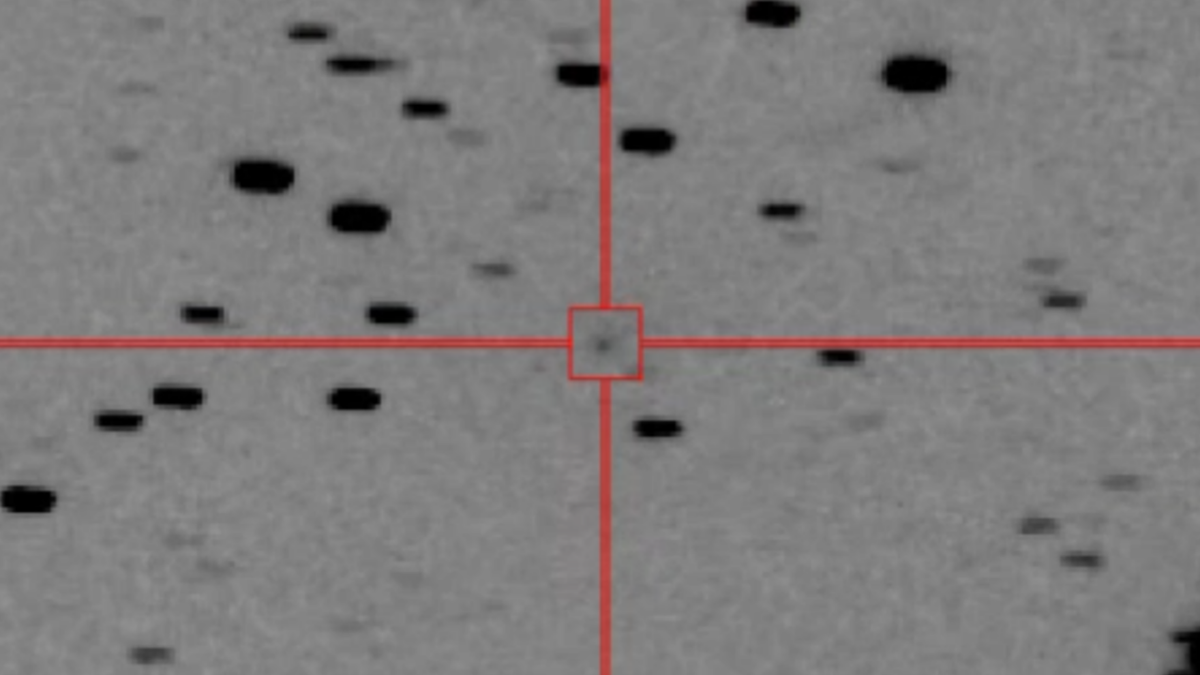
A Groundbreaking Discovery (Image Credits: Cdn.mos.cms.futurecdn.net)
San Pedro de Atacama, Chile – Astronomers discovered a distant icy wanderer last month that now promises one of the most dramatic celestial events of 2026.[1])[2]
A Groundbreaking Discovery
A team of four astronomers – Alain Maury, Georges Attard, Daniel Parrott, and Florian Signoret – spotted the comet on January 13 through their MAPS survey program.[1]) Operating a 0.28-meter Schmidt telescope at the AMACS1 Observatory, they captured the faint object at magnitude 17.8 in the constellation Columba. This marked the farthest-ever detection of a Kreutz sungrazer, at over 2 astronomical units from the Sun.[2]
Precovery images traced it back to December 18, 2025, when it shone at magnitude 20. The Minor Planet Center confirmed its cometary nature on January 20, designating it C/2026 A1 (MAPS) after 154 observations revealed a coma and tail.[3] Reports noted a 12-arcsecond coma and tails up to 40 arcseconds long in early images. Such an early find, three months before perihelion, thrilled observers worldwide.[1])
The Storied Kreutz Sungrazer Legacy
This comet belongs to the Kreutz family, fragments of a massive progenitor that shattered millennia ago, possibly the Great Comet of 371 B.C. observed by Aristotle.[2] Named after Heinrich Kreutz, who linked them in the late 1800s, these comets follow highly eccentric orbits with perihelia mere solar radii from the Sun’s surface.
While thousands disintegrate unseen – over 4,500 spotted by SOHO – rarer survivors have dazzled skywatchers. Notable examples include:
- The Great Comet of 1843, which reached magnitude -6 to -8 and appeared in daylight.
- C/1963 R1 (Pereyra), peaking at magnitude 2 with a striking tail.
- C/1965 S1 (Ikeya-Seki), a daytime spectacle in 1965.
- C/2011 W3 (Lovejoy), which survived to show a magnificent tail from SOHO views.
C/2026 A1 traces to the “Pe” subgroup, kin to the 1843 great comet and Pereyra, fueling hopes for similar brilliance.[1])
A Razor-Thin Solar Encounter
The comet’s orbit carries it to perihelion on April 4, 2026, at just 0.0054 AU – about 748,000 kilometers above the Sun’s surface.[1])[4] Its path spans a 1,158-year loop with 144.5-degree inclination to the ecliptic and near-unity eccentricity. Currently hovering at magnitude 17 in Eridanus, it holds a nucleus possibly 2.4 kilometers across – large for its kin.[2]
Extreme heat and tides threaten fragmentation, as noted by the Central Bureau for Astronomical Telegrams, which cited its faint absolute magnitude as a poor survival omen. Yet its size offers optimism for endurance and rapid brightening to magnitude 13 by late March, potentially -4 or better at peak.[2]
Tracking the Celestial Fireworks
Observers in the Southern Hemisphere hold the best cards, with the comet low in the western evening sky from late March. It tracks through Cetus, Caelum, and Pyxis, staying near the Sun until mid-April.
| Date | Predicted Magnitude | Visibility Notes |
|---|---|---|
| Late March | 13 | 8-10″ telescopes, southwest twilight |
| April 4 | -4? | 2° from Sun, possible tail in twilight |
| Mid-April | 4-14 | Naked eye if survives, Southern skies |
Northern viewers face challenges from low elevation and glare. Space telescopes like SOHO may capture the show regardless.[2]
Key Takeaways
- C/2026 A1 (MAPS) stands out as the farthest-discovered Kreutz sungrazer with survival potential.
- Perihelion on April 4 risks destruction but could yield a turquoise-tailed wonder.
- Southern Hemisphere skywatchers: Prepare scopes for late March evenings.
As Comet MAPS races sunward, it reminds us of the sky’s unpredictability – one moment faint, the next a blazing beacon. Will it join the ranks of greats or fade into solar fire? Grab binoculars and check the western horizon this spring. What do you think its fate will be? Tell us in the comments.