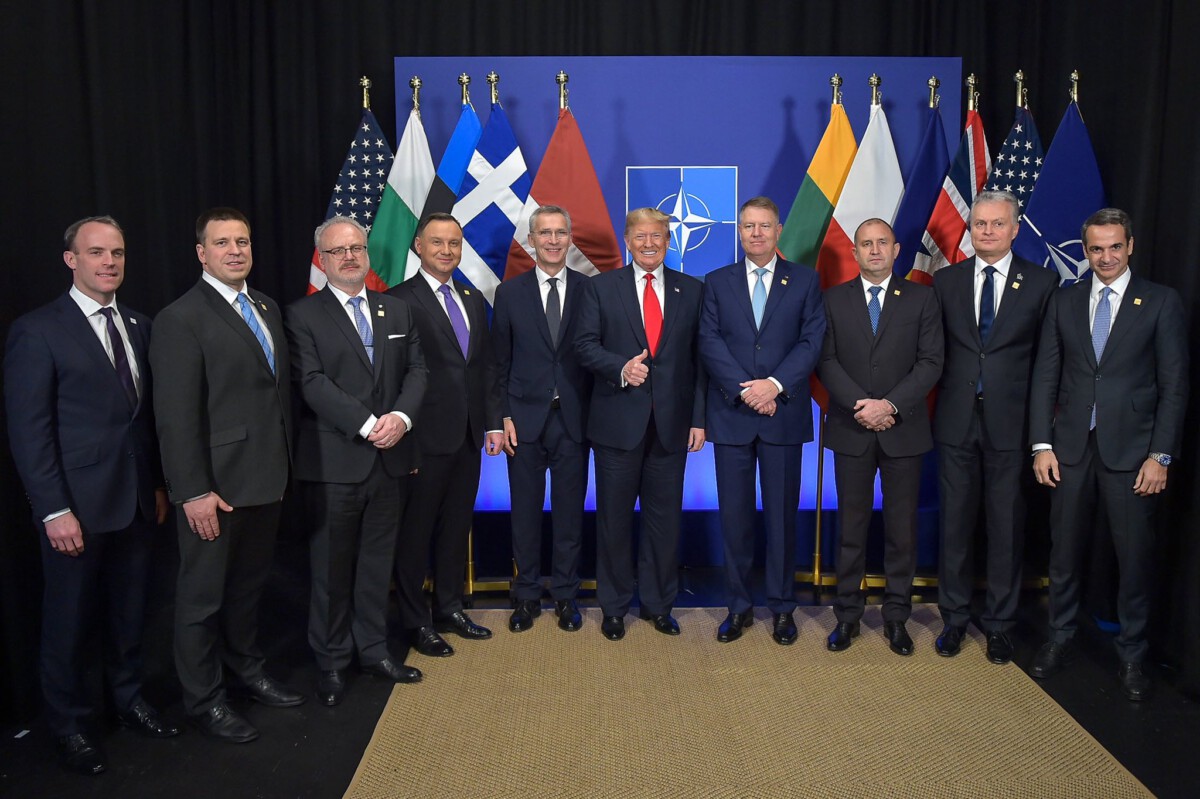
A Conservative Historian’s Unexpected Rise (Image Credits: Upload.wikimedia.org)
A British scholar’s blueprint for reimagining NATO has gained traction in Washington, signaling a potential pivot in America’s longstanding commitment to Europe’s defense.
A Conservative Historian’s Unexpected Rise
Sumantra Maitra, a realist military historian based in the United Kingdom, first outlined his “Dormant NATO” concept in a 2023 white paper published by the Center for Renewing America, a think tank aligned with former President Donald Trump.[1]
Maitra’s work quickly circulated among Trump’s foreign policy advisors and evolved into an essay for Foreign Affairs. He argued that structural shifts, including China’s emergence as a peer competitor and U.S. fiscal strains from two decades of war, demanded a new approach.[1]
Unlike traditional voices calling for full withdrawal, Maitra proposed a middle path. His ideas positioned NATO not as a perpetual U.S.-led force but as a contingency alliance, dormant until a true existential threat arose.
Breaking Down the ‘Dormant NATO’ Pillars
The doctrine rests on three interconnected principles designed to realign responsibilities across the Atlantic.
- Burden shifting: Europe assumes control of conventional forces, including logistics, intelligence, army, and infantry, while the U.S. retains its nuclear umbrella and naval superiority.
- Command transfer: Key NATO combatant commands move from American to European generals and admirals.
- No further expansion: The alliance freezes membership to maintain focus and avoid dilution.
Maitra coined “burden shifting” to distinguish it from mere “burden sharing,” emphasizing a fundamental handover rather than incremental contributions.[1]
He drew historical parallels to NATO’s early years from 1949 to 1991, when it functioned as a “break-glass” emergency pact rather than a daily operational entity.
Evidence of White House Adoption
Trump administration documents have begun mirroring Maitra’s framework. The National Security Strategy and National Defense Strategy explicitly reference burden shifting and reject further enlargement.[1]
Under Secretary of Defense Elbridge Colby echoed the sentiment during a recent Munich speech, stating that Europe must take primary responsibility for its conventional defense. Defense Secretary Pete Hegseth publicly opposed NATO’s potential expansion into Ukraine.
Practical steps followed suit. Commands previously under U.S. leadership shifted to British, German, Polish, and Italian officers. Though troop reductions remain modest for now, strategic signals point to larger drawdowns by 2028, post-Ukraine contingencies.
European Reactions and Roadblocks Ahead
European leaders expressed a mix of optimism and concern over the changes. Some welcomed command handovers as steps toward greater autonomy, yet others worried about Article 5’s credibility.
Maitra dismissed fears of NATO’s demise, insisting the alliance would reactivate against hegemonic powers like a resurgent Soviet Union but not regional actors such as Russia. “Putin’s Russia is not capable of being a hegemonic threat to the European continent,” he noted in a recent interview.[1]
Critics argued the approach risked weakening collective defense, but proponents saw it as pragmatic realism amid shifting global priorities.
Key Takeaways
- Maitra’s “Dormant NATO” promotes burden shifting over sharing, freeing U.S. resources for Asia.
- Policy echoes appear in official strategies and command changes, pressuring Europe to rearm.
- The doctrine views Russia as a manageable threat, reserving U.S. might for larger dangers.
As transatlantic ties evolve under this influence, the true test will come in how Europe responds to the call for self-reliance. Will allies step up, or fracture the alliance further? What do you think about ‘Dormant NATO’? Share your views in the comments.