Flawless Docking Restores Orbital Outpost (Image Credits: Upload.wikimedia.org)
Cape Canaveral, Florida – Four astronauts aboard a SpaceX Dragon spacecraft docked with the International Space Station on February 14, marking a key step in ongoing human spaceflight efforts.
Flawless Docking Restores Orbital Outpost
The Dragon capsule linked up to the Harmony module’s space-facing port at 3:15 p.m. EST, following a 34-hour journey from launch.[1]
Hatches between the spacecraft and station opened around 5 p.m. EST, allowing the new arrivals to float inside and join Expedition 74.[2]
This arrival brought the station back to its standard seven-person crew after the previous team departed ahead of schedule due to health issues.[3]
Station commander Chris Williams and two Roscosmos cosmonauts greeted the newcomers, ensuring seamless handover of operations.[4]
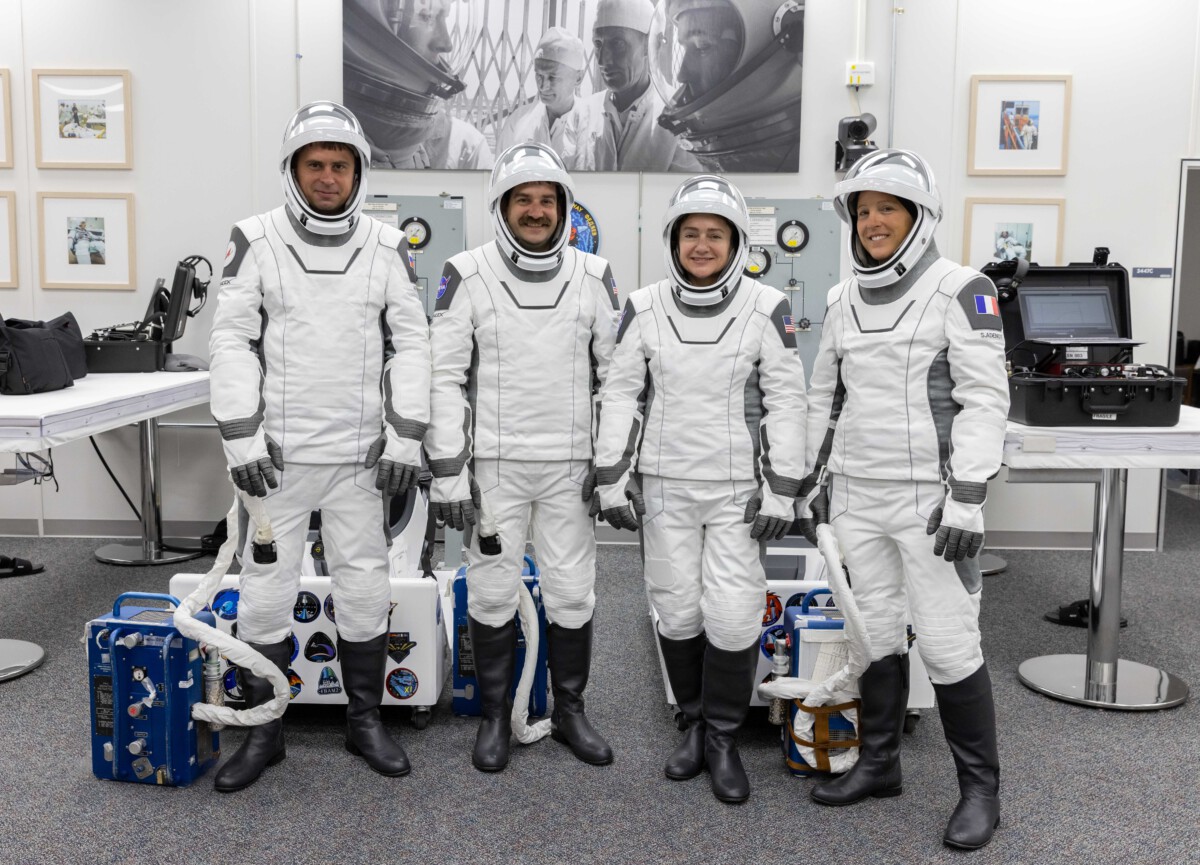
Meet the International Crew-12 Team
NASA selected a diverse group for this rotation mission, blending experience from multiple space agencies.
Commander Jessica Meir, a veteran astronaut, leads the team alongside pilot Jack Hathaway, both from NASA.
French astronaut Sophie Adenot represents the European Space Agency as a mission specialist, while Roscosmos cosmonaut Andrey Fedyaev brings Russian expertise in the same role.[5][6]
| Astronaut | Agency | Role |
|---|---|---|
| Jessica Meir | NASA | Commander |
| Jack Hathaway | NASA | Pilot |
| Sophie Adenot | ESA | Mission Specialist |
| Andrey Fedyaev | Roscosmos | Mission Specialist |
Launch Followed Precedent-Shattering Events
The Crew-12 mission lifted off from Cape Canaveral Space Force Station at 5:15 a.m. EST on February 13 atop a Falcon 9 rocket.[4]
That ascent came weeks after Crew-11’s unscheduled early return, prompted by a medical emergency that reduced station staffing to three members.[7]
NASA accelerated preparations to maintain research continuity, showcasing the Commercial Crew Program’s flexibility.[8]
The rapid turnaround highlighted partnerships with SpaceX, ESA, and Roscosmos amid evolving orbital operations.
Science Mission Takes Center Stage
Crew-12 members now settle in for an eight-month stay focused on experiments advancing deep-space exploration.
Research priorities include human adaptation to microgravity, technology testing, and biological studies to support future missions beyond low Earth orbit.[5]
Daily tasks will involve station maintenance, scientific payloads, and international collaboration on Expedition 74 objectives.
- Conduct microgravity experiments on human physiology.
- Test new technologies for lunar and Mars preparation.
- Perform Earth observation and space environment studies.
- Maintain life support systems and conduct spacewalks if needed.
- Share data with ground teams for real-time analysis.
Key Takeaways
- Crew-12 docked successfully on February 14, hatches opened shortly after.
- Team includes astronauts from NASA, ESA, and Roscosmos for diverse skills.
- Mission restores ISS to seven crew members post-medical evacuation.
The arrival of Crew-12 underscores the resilience of international space cooperation, ensuring uninterrupted science from 250 miles above Earth. What are your thoughts on this milestone in human spaceflight? Share in the comments below.