A Retro-Futuristic Portal to the Past (Image Credits: Images.fastcompany.com)
Researchers at MIT unveiled a groundbreaking machine that transforms ordinary photographs into bespoke fragrances, bridging the gap between visual archives and sensory experiences.
A Retro-Futuristic Portal to the Past
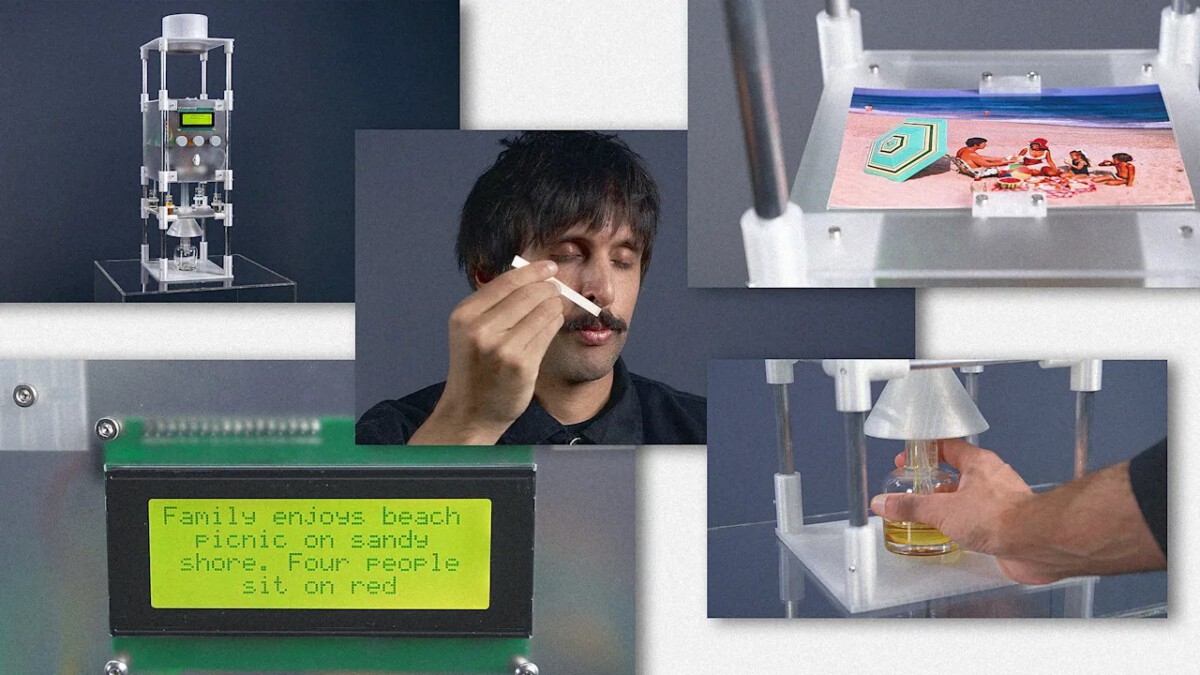
Users encounter a sleek apparatus reminiscent of vintage science fiction, complete with a glowing green screen and three tactile dials poised above a collection of scent vials.
A glass beaker sits ready at the base, prepared to receive the machine’s output. Cyrus Clarke, the MIT scientist leading the project, designed this physical interface to make generative AI accessible and intuitive. The device targets “anemoia,” a term coined by author John Koenig to describe nostalgia for eras or places one never knew firsthand.
Clarke explained his motivation: “I’m personally very interested in inventing new physical interfaces for generative AI. Generative AI usually starts with a blank prompt. The dials replace that with a physical, easy-to-understand grammar. You’re not trying to ‘say the right thing’ to an algorithm; it’s more akin to tuning an instrument.”
How the Machine Analyzes and Interprets Images
The process begins when a user slides a photo into the device. A vision-language model scans the image and crafts a concise description, such as one depicting tourists at the Great Wall of China amid stone steps and mountains.
Three dials then allow customization: the first selects the focal subject, like a person or landmark; the second adjusts the perceived age; and the third sets the emotional tone of the scene. These inputs refine the initial caption into a poetic narrative via a language model based on GPT-4o.
For instance, focusing on the Great Wall itself might yield: “For centuries, from the Warring States to the Ming, I’ve joyfully observed time’s march and countless travelers along my path of stone, brick, and wood.”
- Insert photo for automatic caption generation.
- Turn dial 1 to choose subject (e.g., child, wall, landscape).
- Adjust dial 2 for age (young, ancient, timeless).
- Set dial 3 for mood (joyful, melancholic, serene).
- Generate narrative blending all elements.
Crafting Scents from Stories
The narrative feeds into the core innovation: an AI that maps words to smells. Trained on a library of 39 fragrances – now expanded to 50 – the model selects notes like old books, leather, dirt, campfire, cedar, or bamboo, each tagged with emotional and conceptual descriptors.
Four pumps precisely mix the liquids into the beaker, creating scents evoking diverse scenes, from a sunbaked ’80s beach to a garden pear shared by a couple. Studies support this approach, noting how memories form through shared stories, now extended by AI-generated proxies.
The full technical details appear in the team’s research paper, which outlines the olfactory display’s mechanics. A demo video showcases the device in action.Watch here.
Redefining Memory in the AI Era
This invention probes “extended memory,” where digital media stores personal histories outside the brain. The Anemoia Device challenges users to question generated recollections: what does it mean to remember a fabricated past, feel machine-coauthored emotions, or remain human amid artificial narratives?
By making abstract AI tangible through scent – a potent memory trigger – the project opens doors to interactive storytelling and sensory design. Fragrance selection balances olfactory accuracy with emotional resonance, ensuring the output stirs genuine sentiment.
Key Takeaways
- The device uses AI to caption photos, customize narratives, and mix 50+ scents on demand.
- Physical dials simplify AI interaction, mimicking instrument tuning over text prompts.
- It explores anemoia, blending nostalgia with technology for “pasts we never lived.”
The Anemoia Device stands as a provocative step toward multisensory AI, inviting reflection on how machines might one day scent our shared histories. What forgotten photo would you turn into a fragrance? Share your thoughts in the comments.