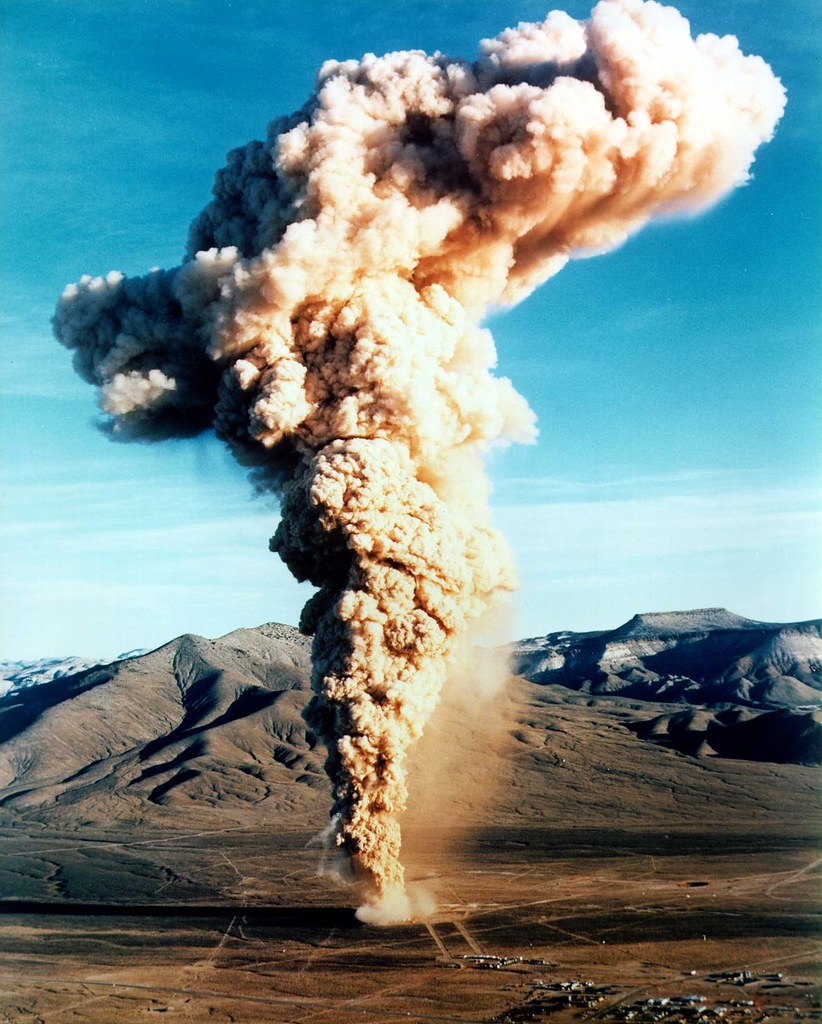
A Tiny Quake with Explosive Implications (Image Credits: Flickr)
Washington, D.C. – American officials presented compelling seismic data pointing to a covert nuclear detonation by China at its remote Lop Nur facility back in June 2020.
A Tiny Quake with Explosive Implications
On June 22, 2020, a seismic station in Kazakhstan picked up a faint 2.75-magnitude event. The signal traced back approximately 450 miles to China’s primary nuclear testing ground at Lop Nur.[1]
Christopher Yeaw, assistant secretary for arms control and nonproliferation at the State Department, addressed the matter at a Hudson Institute event. He asserted that the characteristics left little doubt about its nature. “There is very little possibility that it is anything other than an explosion, a singular explosion,” Yeaw stated. He described it as a yield-producing test, one that sparked a runaway chain reaction in nuclear material.[1]
Such activity would breach the voluntary global moratorium on full-scale nuclear testing. The revelation built on earlier disclosures from Undersecretary Thomas DiNanno, who revealed U.S. awareness of Chinese preparations for tests reaching yields in the hundreds of tons.[1]
Decoupling: The Art of Hiding a Blast
Officials pointed to “decoupling” as the method China employed to mask the explosion’s true power. This involves excavating a vast underground cavity and suspending the device within it. The technique dampens seismic waves, making a larger blast appear far smaller on monitoring equipment.[1]
Without such measures, a magnitude 2.75 reading might equate to mere tens of tons of TNT. Decoupling, however, could conceal yields climbing into the hundreds of tons or even a kiloton. Yeaw noted that nations undertake these risks only for substantial benefits, though he withheld specifics on the test’s objectives.[1]
Skeptics Weigh In Amid Firm Denials
Independent seismologists urged caution. Ben Dando of NORSAR, a Norwegian monitoring group, observed that wave ratios aligned with an explosion. Yet the faint signal from a lone station prevented firm conclusions. “I would not say that there’s really strong conclusive evidence,” Dando told reporters.[1]
China rejected the accusations outright. Foreign Ministry spokesperson Lin Jian labeled them “completely groundless” and accused the U.S. of crafting pretexts to resume its own testing program. Tong Zhao of the Carnegie Endowment noted China’s heavy investments at Lop Nur, including new tunnels and facilities, which aligned with the claims.[1]
China’s Rapid Nuclear Buildup Fuels Tensions
Satellite imagery revealed expansions at Lop Nur, with added equipment zones, housing, and tunnels. These developments coincided with Beijing’s arsenal growth from roughly 200 warheads in 2019 to about 600 today. Projections indicated a target of 1,000 by 2030, nearing parity with U.S. and Russian stockpiles.[1]
Historically, China completed just 45 tests before the 1996 moratorium, compared to over 1,000 by the U.S. Both nations signed the Comprehensive Nuclear-Test-Ban Treaty but have not ratified it. Subcritical experiments sustain arsenals without full detonations, yet suspicions persist over low-yield “yield-producing” activities.
- China’s tests: 45 total (half atmospheric, half underground).
- U.S. last test: 1992.
- Global norm: No full-scale tests since North Korea’s 2017 event.
- Potential motives: Low-yield weapons or hypersonic warhead validation.
| Country | Historical Tests | Last Official Test |
|---|---|---|
| U.S. | Over 1,000 | 1992 |
| China | 45 | 1996 |
- U.S. intelligence ties a 2020 seismic event directly to Lop Nur via Kazakhstan readings.
- Decoupling likely concealed a yield-producing nuclear chain reaction.
- China’s arsenal expansion heightens calls for renewed arms control talks.
The disclosures underscored fragile nuclear norms amid accelerating arms races. As the U.S. contemplates its options, including potential test resumption, the path to stability remains uncertain. What risks do these developments pose for global security? Share your thoughts in the comments.