High-Voltage Innovation Takes to the Mountains (Image Credits: Images.newscientist.com)
Utah — A cloud-seeding startup reported a 20 percent increase in snowfall across a key mountain range this winter, employing a novel electric charging method amid persistent drought conditions in the western United States.[1][2]
High-Voltage Innovation Takes to the Mountains
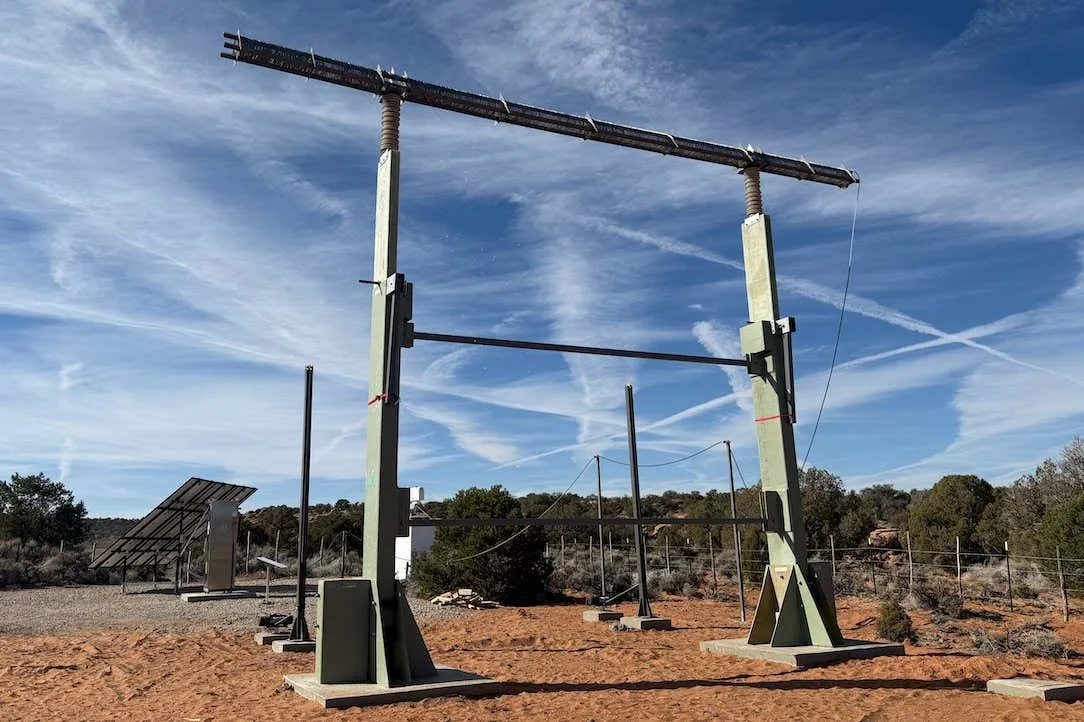
Rain Enhancement Technologies deployed its system upwind of the La Sal Mountains in January. The setup featured a coiled wire stretched between 8-meter pylons, energized with 10,000 volts to ionize passing aerosols like dust and salt particles.[1]
These negatively charged particles rode the wind into clouds, where they accelerated the collision and growth of water droplets through electrostatic attraction. Company meteorologist Jeff Chagnon described the approach: “Cloud-seeding operations have been active for quite some time and we are offering another means of enhancing precipitation… but one which doesn’t involve any chemicals. We also don’t have to fly into clouds… We can just flip a switch from anywhere in the world and operate for about 48 hours at a time.”[1]
The technology avoided traditional silver iodide chemicals and aircraft, positioning it as a remote, eco-friendlier alternative. Operators activated the array remotely, allowing continuous operation without on-site personnel.
Evidence from La Sal Peaks
The firm compared snow accumulation in the La Sal Mountains to the nearby Abajo Mountains, 70 kilometers south, across five dry winters. In the treated period, the La Sal range received 9 centimeters more snow than baseline expectations derived from Abajo data.[1]
This equated to a 20 percent uplift, according to the company’s analysis. Prior trials lent support: a five-year experiment in Oman yielded 10 to 14 percent more rain, while a Chinese study reported 20 percent precipitation gains. Historical data from Cold War-era nuclear tests even showed 24 percent extra rain over the UK’s Shetland Islands when air ionization peaked.[1]
- No chemicals required, reducing environmental concerns.
- Remote activation simplifies logistics.
- Targets existing clouds for efficiency.
- Operates up to 48 hours per cycle.
- Potentially scalable for drought-prone regions.
Scientific Community Calls for More Proof
Researchers expressed measured optimism tempered by caution. Edward Gryspeerdt at Imperial College London noted the intriguing consistency but highlighted precipitation’s natural variability: “There is always a significant chance that the effect they’ve seen has just happened by chance.”[1]
Jeff French at the University of Wyoming questioned the five-year baseline, suggesting seasonal snowpack shifts might skew results. He advocated for extended experiments. Ibrahim Oroud at Mutah University in Jordan echoed the need for additional validation, while the World Meteorological Organization stated that ionization methods lack proven efficacy compared to salt-based seeding.[1]
Traditional cloud seeding with silver iodide operates in nine US states, yet faces bans or restrictions in ten others due to health fears and chemtrail conspiracies.
Drought Drives Demand for Solutions
The western US endured a record snow drought this season, heightening wildfire risks and straining the Colorado River. Such shortages contributed to protests in water-stressed Iran and signal a global crisis, with the UN projecting three-quarters of humanity facing scarcity or contamination by mid-century.[1]
Utah’s program, among the largest, underscores the urgency. Rain Enhancement Technologies’ chemical-free pitch arrives as states seek reliable water augmentation without public backlash.
Key Takeaways
- Rain Enhancement Technologies claims 20% snowfall increase in Utah’s La Sal Mountains using ionized aerosols.[1]
- Experts demand longer trials to rule out natural variability.
- The method offers a chemical-free alternative amid rising drought pressures.
As water challenges intensify, innovations like charged aerosols could prove vital — if science confirms their impact. What do you think about this electric approach to weather enhancement? Tell us in the comments.