A Bold Challenge to Europe’s Leaders (Image Credits: Assets.realclear.com)
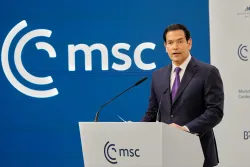
Munich – U.S. Secretary of State Marco Rubio urged European allies to reject managed decline and reform outdated institutions during the 2026 Munich Security Conference.[1]
A Bold Challenge to Europe’s Leaders
Rubio’s address followed Vice President JD Vance’s provocative remarks from the previous year and delivered an unmistakable ultimatum. He rejected the notion of America serving as a mere caretaker for the West’s weakening position.[1]
America possesses no interest in being polite and orderly caretakers of the West’s managed decline, Rubio stated. He called for a reinvigorated alliance focused on mutual interests and innovation to usher in a new Western century.[1]
The speech highlighted how post-World War II institutions, originally aimed at countering Soviet threats, had outlived their purpose. These bodies now prioritized supranational ties over national sovereignty, fostering policies that undermined Western vitality.[1]
Insights from the Budapest Global Dialogue
Earlier that week, the Budapest Global Dialogue echoed similar concerns about the decaying international framework. Hosted by the Hungarian Institute of International Affairs and the Observer Research Foundation, the event framed the choice between escalating conflict or building lasting security.[1]
HIIA President Gladden Pappin opened discussions by stressing the need to move beyond propping up obsolete systems. Panelists, including U.S. Under Secretary of State for Public Diplomacy Sarah B. Rogers and Balázs Orbán, political director to Hungarian Prime Minister Viktor Orbán, targeted the European Union’s Digital Services Act.
The law employs trusted flaggers to suppress online speech, even affecting Americans, Rogers noted. You do not have self-governance without freedom of speech, she asserted.[1]
Core Failures of the Fading System
Speakers identified multiple flaws in the old order that demand urgent correction. Unchecked globalization sacrificed sovereignty for short-term gains, leading to deindustrialization exposed during the COVID-19 crisis.
Western policies inadvertently bolstered China’s economic dominance by integrating it deeply into global trade. China now leads in key metrics and expands its energy capacity rapidly, while the U.S. grapples with grid vulnerabilities and stalled nuclear development.[1]
- Censorship regimes exported from the EU threaten free expression worldwide.
- Mass migration, particularly Islamic inflows to Europe, poses long-term risks, as noted by French professor Alexandre del Valle.
- Climate mandates and green energy pushes risk energy crises without viable alternatives.
- Supply chains shifted abroad weakened domestic manufacturing traditions dating to Alexander Hamilton.
- Institutions like the U.N. fail to address modern threats effectively.
Paths to Renewal and Selective Alliances
Rubio emphasized partnerships with nations sharing political goals, such as Hungary. During a visit to Budapest, he affirmed President Trump’s commitment to Prime Minister Orbán’s re-election amid upcoming parliamentary contests.[1]
Hungarian Foreign Minister Péter Szijjártó highlighted his country’s success in halting illegal migration. Orbán declared a new golden age in U.S.-Hungary ties during a joint appearance with Rubio.
Experts advocated adapting alliances, like evolving NATO into a version where partners shoulder more burdens. Historical precedents show international orders shift; five have passed since the Budapest conference venue’s construction in 1896.[1]
Key Takeaways
- The liberal order’s collapse requires bold reformation, not preservation.
- National interests must supersede supranational bureaucracies.
- America-first policies can lead a dynamic Western revival.
Leaders now prioritize actions matching rhetoric to secure peace and prosperity. Serious leaders marry their rhetoric to actions that will lead to peace, prosperity, and the good of the West – and America above all.[1] As nations confront this pivotal moment, the blueprint for renewal takes shape. What vision do you see for the West’s future? Share your thoughts in the comments.