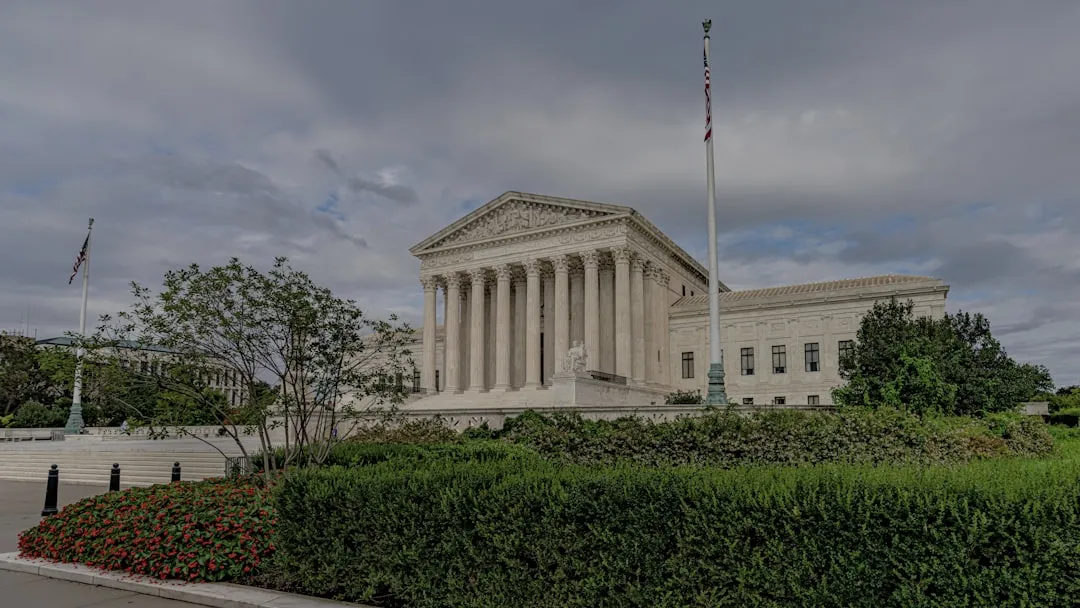
Court Delivers Major Check on Executive Trade Power (Image Credits: Unsplash)
Washington – The U.S. Supreme Court ruled Friday that President Donald Trump overstepped his authority by imposing broad tariffs under a decades-old emergency law, prompting a sharp rebuke from the White House.[1][2]
Court Delivers Major Check on Executive Trade Power
In a decision that reshaped presidential authority over imports, the justices declared the International Emergency Economic Powers Act of 1977 does not permit tariffs. Chief Justice John Roberts authored the majority opinion, emphasizing that the law’s text lacks any reference to duties or taxes. He wrote that the president could not claim unlimited power to levy tariffs “on imports from any country, of any product, at any rate, for any amount of time” based solely on vague language about regulating importation.[1]
The ruling targeted tariffs Trump enacted last year, including a 10% global levy on nearly all imports and steeper rates on goods from China, Canada, Mexico, the European Union, Japan, and South Korea. These measures addressed issues like fentanyl trafficking and trade imbalances, which the administration framed as national emergencies. Challengers, including small businesses and states, argued successfully that Congress reserved tariff powers for itself under the Constitution.[3]
Ideological Lines Blur in Splintered 6-3 Vote
The outcome hinged on a coalition that defied traditional divides, with three justices appointed by Republican presidents joining the three Democratic appointees in the majority. Roberts, Neil Gorsuch, and Amy Coney Barrett aligned with Sonia Sotomayor, Elena Kagan, and Ketanji Brown Jackson to invoke the major questions doctrine, requiring explicit congressional approval for vast economic actions. Gorsuch and Barrett offered separate concurrences reinforcing statutory limits, while Kagan focused on plain text interpretation.[4]
Justices Clarence Thomas, Samuel Alito, and Brett Kavanaugh dissented. Kavanaugh argued that “regulate importation” historically encompassed tariffs and warned of potential billions in refunds to importers. The splintered opinions highlighted tensions over emergency powers in foreign affairs, but the core holding stood firm: IEEPA targets sanctions, not revenue-raising duties.[2]
Trump Fires Back, Labels Ruling ‘Deeply Disappointing’
President Trump reacted swiftly during a White House press conference, calling the decision “deeply disappointing” and expressing “absolute shame” toward certain justices for lacking courage. He accused the majority of unpatriotic behavior influenced by foreign interests, claiming they acted out of partisanship despite the involvement of GOP appointees in the ruling against him. Trump interrupted a speech to governors upon receiving news of the outcome, terming it a “disgrace.”[3]
Still, he framed the loss as a potential advantage, insisting other legal avenues remained open. The president highlighted tariffs’ role in generating revenue and leverage, vowing they would continue to protect American interests.[2]
Administration Maps Alternatives to Keep Pressure On
White House officials outlined a path forward, pointing to statutes untouched by the ruling. U.S. Trade Representative Jamieson Greer noted preparations for reimposition using established trade laws. Potential tools include:
- Section 232 of the Trade Expansion Act of 1962, for national security threats.
- Section 301 of the Trade Act of 1974, targeting unfair practices.
- Section 201 for import injury relief and Section 122 for balance-of-payments issues.
- Section 338 of the Tariff Act of 1930 for discrimination.
Trump announced plans for a new 10% global tariff, though details on timing emerged unclear. Republicans like House Speaker Mike Johnson pledged quick action, while Democrats celebrated the check on executive overreach. Markets responded positively, with stocks rising and the dollar strengthening.[3]
The decision underscores Congress’s enduring grip on trade policy, forcing the administration to navigate procedural hurdles for future levies. Refunds for over $200 billion collected loom as a flashpoint, with businesses already filing claims. As Trump eyes his upcoming China trip, the ruling tests his trade agenda’s resilience.
Key Takeaways
- SCOTUS ruled 6-3 that IEEPA bars broad tariffs, crossing party lines with three GOP justices in the majority.
- Trump decried the “disappointing” outcome but promised new tariffs via alternative laws.
- Potential refunds and market gains signal wide economic ripples.
This pivotal clash between branches leaves trade policy in flux – what adjustments will shape America’s global stance? Share your thoughts in the comments.