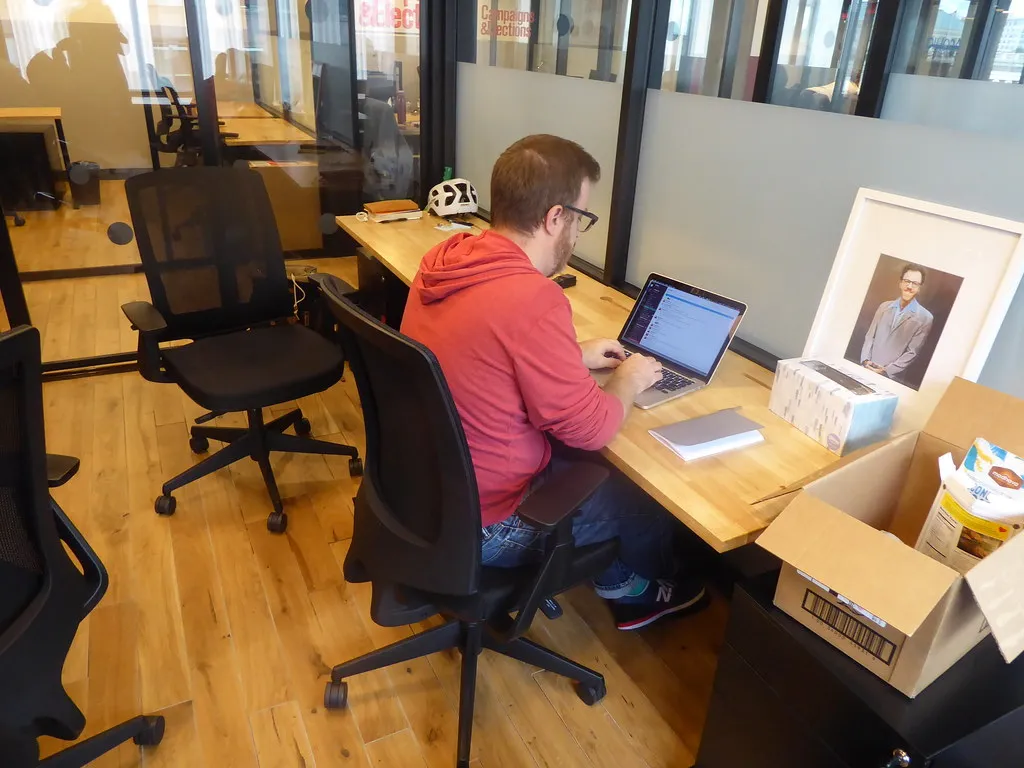
A Symbol of Maturity in Coworking (Image Credits: Flickr)
Downtown Manhattan – WeWork marked a clear departure from its past with the January opening of 250 Broadway, its first New York City location since 2019 and a showcase of refined workspaces over former party vibes.
A Symbol of Maturity in Coworking
Visitors once left WeWork meetings enticed by complimentary beer taps, but recent tours at 250 Broadway end with offers of kombucha instead. This simple change captured the company’s shift toward practicality. The 60,000-square-foot space spans five floors and achieved 94% occupancy, even before one floor fully opened in spring. Clear signage now guides users through straightforward corridors, replacing confusing layouts. Art from ArtLifting, featuring works by artists facing homelessness or disabilities, adorns the walls. Espresso machines stand ready at the bar, prioritizing focus over festivity.
No neon lights or ping-pong tables appear here. The design draws from Lower Manhattan’s heritage, including stone tile floors and art deco glass that nod to the nearby Woolworth Building. Local makers supplied sconces and furniture, blending authenticity with utility. Private offices received carpeted floors to dampen noise complaints. A mothers’ room gained a window overlooking the skyline, and phone booths clustered near lounges responded to member feedback for balanced quiet and collaboration.
From Excess to Emergence
WeWork launched in 2010 amid Silicon Valley hype, fueled by billions from SoftBank’s Vision Fund. Founders Adam Neumann and Miguel McKelvey built a community-driven model that expanded rapidly. A failed initial public offering in 2019 exposed risks, leading to Neumann’s exit. Bankruptcy followed in November 2023, prompting massive restructuring. The company emerged in June 2024, lighter by $4 billion in debt and hundreds of closed sites, under new CEO John Santora from Cushman & Wakefield.
Chief design officer Ebbie Wisecarver highlighted the evolution during a tour. “WeWork’s culture and what it stands for has evolved,” she said. “I don’t think it’s diminished this idea of community and connection, I just think we’ve adapted in a lot of ways to providing more spaces that are more suitable for what people are doing there.” Pre-2019 designs enforced a uniform trendy aesthetic, but flexibility now allows sites to match their buildings and neighborhoods.
Adapting to Hybrid Work Demands
The COVID-19 pandemic reshaped office needs, favoring hybrid models with on-demand quiet and social zones. WeWork’s updates addressed this directly at 250 Broadway, born partly from an expiring nearby lease. New York City’s portfolio exceeds 3 million square feet across a global network of 600 locations. Occupancy reached 82% citywide, with Midtown at 90%.
- Global average climbed from 70% to 77%, eyeing 80% this year.
- Dublin’s One Central Plaza hit 100%.
- Barcelona and Milan exceeded 90%.
- Toronto rose from 73% to 85%.
- San Francisco improved from 64% to 76%.
Facing Stiff Competition and Bold Investments
Rivals challenge WeWork’s recovery. Industrious, bought by CBRE for $400 million early in 2025, targets enterprise clients with premium offerings. IWG, behind Regus and Spaces, maintained profitability longer. In New York’s financial district, WSA mixes coworking with arts and events.
| Market | Occupancy Rate |
|---|---|
| New York City (overall) | 82% |
| Midtown | 90% |
| Global | 77% |
WeWork committed $80 million yearly to upgrades, matching 2025 spending into 2026. Upcoming projects include 245 Fifth Avenue in NoMad, an added floor at Toronto’s 1 University Avenue, and enhancements at Washington’s 1201 Wilson. These moves test whether functional timelessness sustains momentum.
Key Takeaways
- WeWork shed excess for practical, history-inspired designs boosting high occupancy.
- Post-bankruptcy focus on flexibility meets hybrid work realities.
- Annual $80 million investments signal confidence amid rising competition.
WeWork’s pivot at 250 Broadway proves coworking’s future lies in reliability over razzle-dazzle, potentially redefining flexible offices. What changes would you prioritize in a modern workspace? Share in the comments.