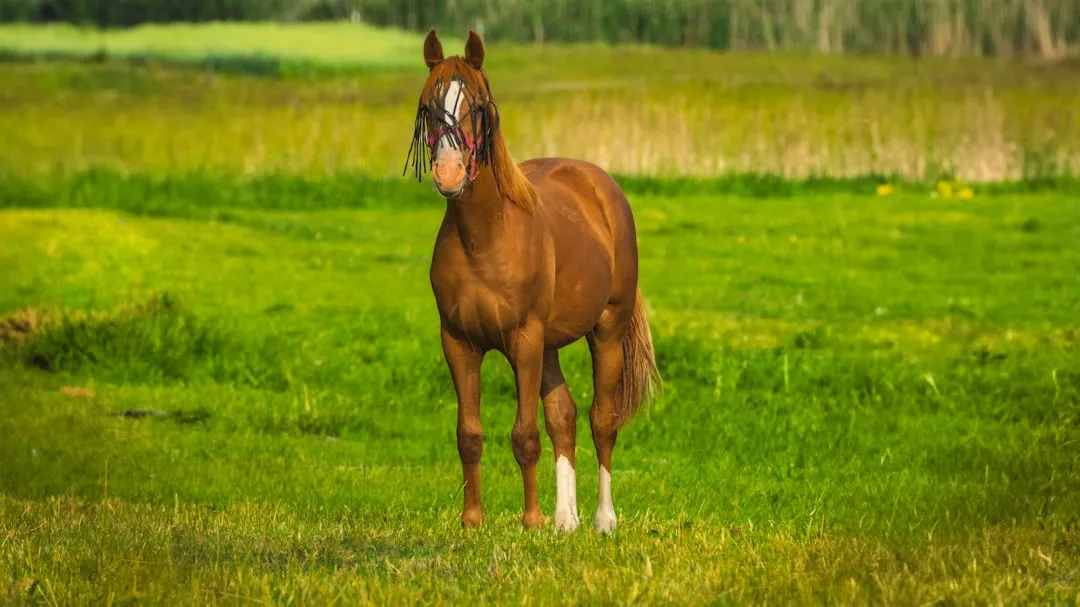
A Spectrogram Surprise Sparks New Research (Image Credits: Unsplash)
Scientists have decoded the intricate sound of a horse’s whinny, identifying it as a rare dual-frequency call produced by distinct mechanisms in the larynx.[1][2]00004-7)
A Spectrogram Surprise Sparks New Research
More than a decade ago, animal behavioral scientist Élodie Briefer analyzed recordings of horse whinnies and spotted something unexpected in the spectrogram: two distinct frequencies occurring simultaneously, one low and one strikingly high.[1] She initially thought two horses were vocalizing together. This observation, published in a recent Current Biology study, prompted a deep investigation into how such biphonation works in these large mammals.[2]00004-7)
The whinny stands out as the longest and most common horse call, often used for greetings over distances. Researchers confirmed the low frequency, around 200 to 400 hertz, arises from vibrations of the vocal folds, much like human speech. The high frequency, exceeding 1,000 hertz, originates elsewhere in the vocal tract.[3]
Unpacking the Laryngeal Mechanics
Horses generate the whinny’s high pitch through an aerodynamic whistle formed when air rushes through a narrowed glottis created by adducted arytenoid cartilages. A newly identified cavity above the vocal folds may create a vortex that sustains this whistle. The low pitch joins soon after as vocal folds vibrate.[2]00004-7)
This separation of sound sources marks a first for large mammals. Unlike birds, which routinely produce dual tones, mammals rarely achieve simultaneous low and high fundamentals. Domestic horses and Przewalski’s horses exhibit this trait consistently, but zebras and donkeys do not.[4]
Rigorous Experiments Confirm the Dual Production
The team employed multiple techniques to validate their findings. They inserted endoscopes through the noses of 10 healthy Franches-Montagnes stallions, capturing video of larynx movements during whinnies elicited by playback of female calls.[1] CT scans of larynges revealed anatomical features supporting the whistle, including asymmetrical ventricles.
Excised larynges from six horses underwent airflow tests with air and helium. The low frequencies remained stable in helium, while high ones shifted upward, proving their aerodynamic nature. In horses with recurrent laryngeal neuropathy, where vocal folds paralyze, the low tone often vanished, but the whistle persisted.[2]00004-7)
- Endoscopy: Observed cartilage adduction at whinny onset.
- Helium tests: Distinguished whistle from vibration.
- Neuropathy cases: Isolated high frequency intact.
- CT imaging: Mapped potential whistle chambers.
- Spectrographic analysis: Quantified frequencies and independence.
Enhancing Communication Through Complexity
This biphonation likely evolved to transmit layered information. Briefer’s earlier work indicated the high frequency signals emotional valence – pleasant or unpleasant – while the low conveys arousal intensity. Such duality expands the acoustic space for individual recognition and long-distance signaling.[1]
Understanding these mechanisms aids animal welfare assessments, as vocal changes can signal health issues. Conservation efforts may also benefit from decoding population-level communication patterns. The study underscores how anatomical tweaks drive vocal innovation across species.[3]
Key Takeaways
- Horse whinnies feature biphonation: low from vocal folds, high from laryngeal whistle.
- Rare in mammals; enables richer emotional expression.
- Validated by endoscopy, helium experiments, and clinical data.
Horse whinnies exemplify nature’s ingenuity in sound production, blending familiar vibrations with an unexpected whistle to enrich social bonds. As research illuminates these calls, it invites fresh perspectives on equine emotions and interactions. What do you think about this vocal discovery? Tell us in the comments.