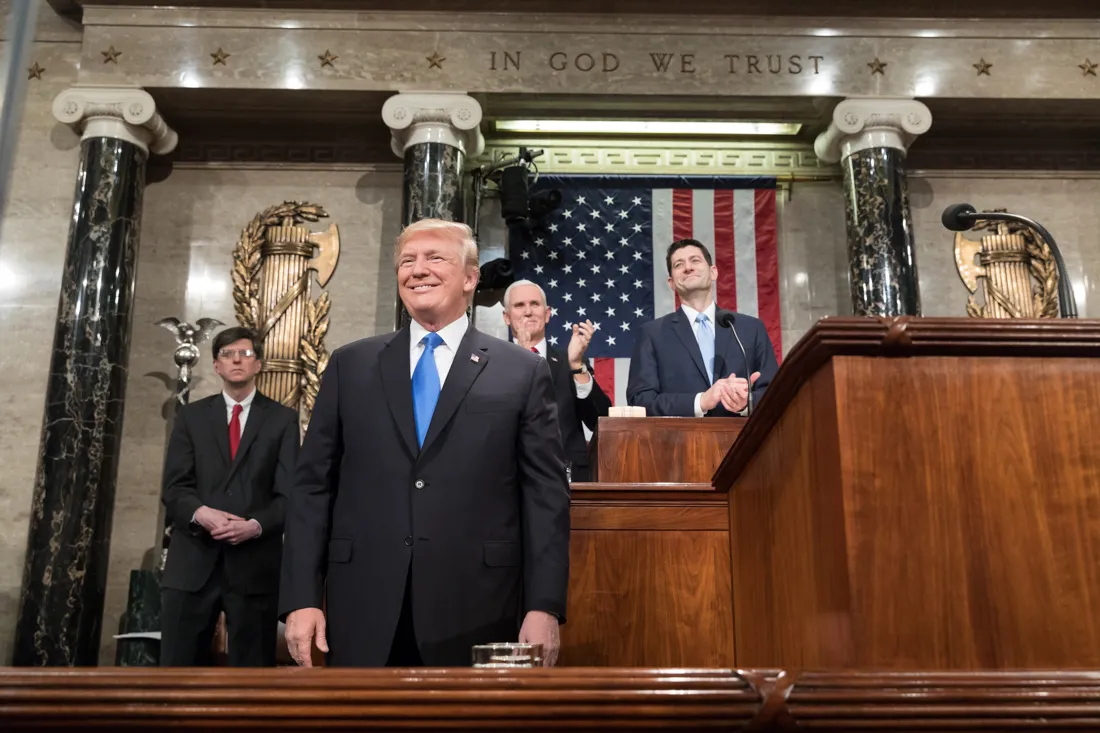
Marathon Speech Spotlights National Turnaround (Image Credits: Upload.wikimedia.org)
Washington – President Donald Trump delivered the longest State of the Union address in history on Tuesday, celebrating economic gains and border security while glossing over voter frustrations with rising costs, just as the House rejected a bipartisan aviation safety bill spurred by last year’s deadly Potomac River crash.[1][2]
Marathon Speech Spotlights National Turnaround
Standing before a joint session of Congress for 1 hour and 48 minutes, Trump proclaimed a “transformation like no one has ever seen.”[3] He hailed plummeting inflation to 1.7 percent in late 2025, gasoline prices dipping below $2.30 a gallon, and the Dow surpassing 50,000.[3]
The president credited tariffs for generating hundreds of billions in revenue and securing $18 trillion in investments. Achievements extended to military recruitment highs, record deportations, and crime reductions, including the lowest murder rate in 125 years. Trump awarded medals onstage, from Purple Hearts to the Presidential Medal of Freedom, and introduced American heroes like an Olympic hockey goalie.
New ideas emerged amid the pageantry. He proposed “Trump Accounts,” tax-free investment vehicles for newborns funded by the Treasury and private donors, potentially worth over $100,000 by age 18. Other pitches included ratepayer protections for AI data centers and a ban on Wall Street firms buying single-family homes.
Economic Boasts Mask Voter Anxieties
Despite the upbeat tone, Trump largely overlooked affordability struggles that polls identify as voters’ top worry. Approval ratings for his economic handling hovered around 36 to 39 percent, with midterms looming.[1] Critics noted the speech ignored high living costs blamed partly on tariffs, even as Trump doubled down on them.
“The Biden administration and its allies in Congress gave us the worst inflation in the history of our country. But in 12 months, my administration has driven core inflation down,” Trump stated.[3] Yet public sentiment remained sour, with many families still grappling with elevated prices for essentials. Immigration and culture wars dominated instead, from border triumphs to jabs at Democrats as “crazy” on transgender issues.
- Secure borders with zero illegal entries in nine months and fentanyl seizures down 56 percent.
- Drug price reforms tying U.S. costs to the lowest global rates.
- “Dalilah Law” to bar illegal immigrants from commercial driver’s licenses.
- “SAVE America Act” mandating voter ID and citizenship proof.
- End to sanctuary cities and restored DHS funding.
ROTOR Act Rejection Stuns After Pentagon Flip
The House voted 264-133 against the ROTOR Act, falling one vote short of the two-thirds majority needed under suspension rules.[4] The bill would have mandated ADS-B tracking technology on most aircraft to broadcast locations and avert midair collisions.
Senate authors Ted Cruz and Maria Cantwell secured unanimous passage there in December. The measure responded to the January 29, 2025, tragedy near Reagan National Airport, where an Army Black Hawk helicopter collided with an American Airlines regional jet over the Potomac, killing all 67 aboard – the deadliest U.S. crash in 25 years.[2] Families of victims watched from the gallery as the vote failed.
Pentagon spokesman Sean Parnell announced opposition on Monday, warning the bill created “significant unresolved budgetary burdens and operational security risks affecting national defense activities.”[4] House GOP leaders, including Speaker Mike Johnson, sided against it, favoring a rival ALERT Act from Transportation Chairman Sam Graves. Cruz called the defeat a “temporary delay,” vowing to push forward.
Rachel Feres, who lost four relatives, decried the outcome: “The U.S. government failed my family in 50 different ways.”
- Trump’s speech energized his base but missed a chance to address economic discontent ahead of midterms.[1]
- The ROTOR Act’s failure highlights tensions between aviation safety advocates and defense priorities.
- Alternative legislation like the ALERT Act may advance, but families demand swift action on NTSB recommendations.
These developments underscore divides in Washington: triumphant rhetoric versus legislative realities. Lawmakers now face pressure to reconcile safety reforms with security concerns before another tragedy strikes. What do you think about these pivotal moments? Tell us in the comments.