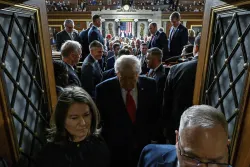
Panel Dissects the ‘Trap’ in Trump’s Speech (Image Credits: Assets.realclear.com)
President Trump’s recent State of the Union address highlighted divisive cultural battles, prompting analysts to question whether the approach positions Democrats uncomfortably ahead of the 2026 midterms.[1][2]
Panel Dissects the ‘Trap’ in Trump’s Speech
Experts on the RealClearPolitics podcast gathered to unpack Trump’s emphasis on issues like gender transitions for minors. They argued that the president deliberately chose topics that unify his party while exposing rifts among opponents. Presidential historian Tevi Troy pointed out the broad consensus within Republican ranks on these matters.[1]
Co-host Andrew Walworth described the cultural spotlight as a reminder of Democratic stances that many voters find extreme. “Everyone’s saying it’s the economy, economy, economy – but these are the cultural issues that resonate with people and remind people where the Democrats stand on some of this stuff,” Walworth said. The discussion referenced specific examples, such as schools withholding information from parents about a child’s transition, backed by judicial decisions favoring institutions over families. Disruptions from the Democratic side, including shouts from Rep. Ilhan Omar, only amplified the moments captured for future campaign ads.[2]
Cultural Issues as an ’80/20′ Advantage
Troy labeled transgender policies an “80/20 issue,” suggesting overwhelming public opposition that Republicans exploit effectively. Unlike economic debates, where GOP factions diverge, cultural fronts show rare party cohesion. Trump spotlighted cases where minors transitioned without parental knowledge, framing it as a conspiracy between schools and activist judges.[1]
Carl Cannon noted the challenge this poses for Democrats, who face internal pressures to defend such positions. A transgender member of Congress reportedly viewed Trump’s remarks as pandering bigotry, complicating unified responses. The panel agreed that these segments created “standing-and-sitting traps,” perfect for social media clips and ads that force opponents into revealing optics.[2]
Economic Populism Blends with Culture
Beyond culture, Trump outlined distrust of big insurance, banks, and corporations snapping up housing stock. Cannon likened this rhetoric to 1920s Democratic populism, a style long absent from modern politics. Congressional stock trading also drew fire, positioning the president as an outsider against elite interests.
- Attacks on insurance companies for high costs.
- Criticism of banks and corporate housing dominance.
- Calls to curb lawmakers’ insider trading.
- Overall theme of protecting working Americans.
The speech’s marathon length tested attention spans but delivered viral soundbites. Democratic rebuttals, led by Virginia Gov. Abigail Spanberger, landed flatly, lacking the punch of past iconic responses.[2]
Midterm Implications and Election Trends
RCP Senior Elections Analyst Sean Trende joined to assess broader patterns. Special elections in Pennsylvania showed Democrats holding seats comfortably, with Republicans trailing Trump’s 2024 margins by about 14 points on average. Trump’s approval hovered at 42%, a risky level for the incumbent party in midterms.[2]
Trende highlighted the GOP’s gains with working-class whites, Blacks, and Hispanics, offset by suburban losses. Immigration remains a flashpoint, with polls indicating unpopularity for Democratic proposals like abolishing ICE. He warned that midterm dynamics favor anti-incumbent sentiment, but presidential races could flip the script.
| Factor | GOP Strength | Dem Opportunity |
|---|---|---|
| Culture Wars | High Unity | Internal Divisions |
| Economy | Debated | Referendum Risk |
| Immigration | Polling Edge | Midterm Leverage |
Key Takeaways:
- Trump’s cultural emphasis unifies Republicans on hot-button issues.
- Democratic disruptions provided ad-ready footage.
- Midterms loom as a test of Trump’s coalition durability.
Trump’s address blended provocation with policy, leaving Democrats to navigate a minefield of responses. As midterms approach, these tactics could reshape the battlefield – or expose vulnerabilities. What do you think of this strategy? Share in the comments.