Something big is happening quietly across American offices, factories, hospitals, and courtrooms. It is not a policy shift or a recession. It is artificial intelligence, and it is moving faster than most workers ever expected. The headlines swing between two extremes: AI will create a golden age of productivity, or AI will leave millions jobless. Honestly, the truth is messier and more fascinating than either story.
What we know for certain in 2026 is that the transformation is already underway. The numbers are real, the case studies are multiplying, and the debate is heating up. So let’s get into the data and find out exactly what is happening.
The Scale of Exposure: More Jobs Than You Think

The numbers from the International Monetary Fund’s landmark 2024 analysis are nothing short of staggering. In advanced economies like the United States, roughly six in ten jobs may be impacted by AI, and while about half of those exposed jobs could benefit from AI integration by enhancing productivity, the other half face the real risk of AI executing tasks currently performed by humans. That is not a fringe scenario. That is the median forecast from one of the world’s most respected financial institutions.
The IMF’s findings are striking in another key way: almost forty percent of global employment is exposed to AI, and unlike previous waves of automation that tended to affect mostly routine tasks, one of the things that sets AI apart is its ability to impact high-skilled jobs. Think lawyers, analysts, engineers, and accountants. This is not your grandfather’s factory automation story.
The Productivity Windfall That Could Change Everything
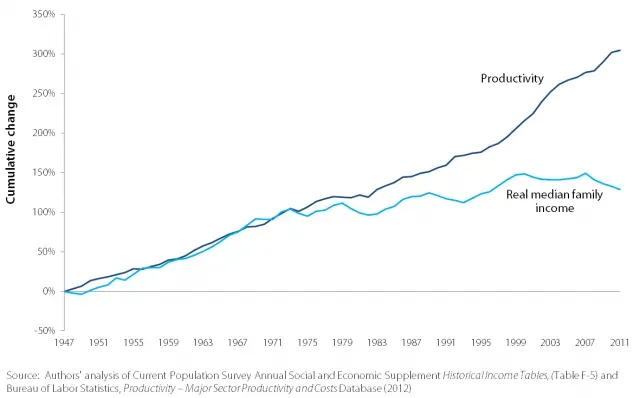
McKinsey’s research estimates that generative AI could add the equivalent of $2.6 trillion to $4.4 trillion annually across 63 identified use cases – a figure that, for comparison, is close to the United Kingdom’s entire GDP in 2021. Think about that for a second. We are talking about adding the economic output of an entire major nation, every single year, simply through productivity gains. That is breathtaking.
Together with other technologies, the current capabilities of generative AI have the potential to automate work activities that currently occupy between sixty and seventy percent of the time employees spend working. The implications for how the American workday is structured could be enormous. Shorter task completion times, fewer bottlenecks, faster decisions. Employees will need support in learning new skills that help them work together with generative AI, and in some cases, in changing roles altogether.
The Job Creation Side That Gets Ignored

Here is the thing: most coverage of AI and work focuses almost entirely on what gets lost. The creation story barely makes the front page. In 2024 alone, AI growth generated more than 8,900 employees added to the U.S. economy specifically to develop, train, and operate AI models, including machine learning engineers and data scientists, on top of a massive surge in data center construction activity.
Each large-scale data center requires roughly 1,500 on-site workers and can take up to three years to complete, and given the record volume of data centers being built, this translated into over 110,000 construction jobs in 2024 alone. Taken together, the evidence tells a clear story: the employment gains from AI and the data center buildout significantly outpace the displacement effects from automation, and instead of hollowing out the workforce, AI is reshaping it and creating new job opportunities across the economy.
The Surge in AI-Specific Job Demand

Want a number that tells you where the American labor market is actually heading? In just the first quarter of 2025, there were over 35,000 AI-related positions open across the U.S., representing a jump of more than twenty-five percent compared to the same period in 2024. That is explosive, sustained growth – not a one-year blip.
AI jobs are not just growing in number; they are becoming increasingly strategic and well-compensated, with the median annual salary for AI roles in early 2025 rising to nearly $157,000. The three AI job titles currently seeing the most openings are Data Scientist, AI and Machine Learning Engineer, and Big Data Engineer. If you are a young person trying to figure out where to plant your career flag, these fields are worth a very serious look.
Computer and IT Occupations Are Growing Fast

Bureau of Labor Statistics projections show that computer occupations are on track to grow nearly three times faster than the overall labor market, with 11.7 percent growth compared to 4.0 percent across all jobs, with software developers and other computer-related roles expected to add almost 600,000 positions by 2033. That is a striking divergence from the broader economy.
Even in areas heavily exposed to automation, such as programming or financial analysis, most jobs are forecasted to expand as AI integration creates new functions rather than eliminating them outright. While AI tools can already perform many database administration tasks, the employment effects of productivity improvements are projected to be outweighed by strong business demand for data infrastructure solutions, and integration of AI into business operations is likely to spur even more demand for these workers. In other words, the pie is getting bigger, not just being sliced differently.
The Global Jobs Forecast: A Net Positive
The World Economic Forum’s Future of Jobs Report 2025 offers perhaps the most comprehensive look at what lies ahead. The report reveals that job disruption will equate to roughly twenty-two percent of jobs by 2030, with 170 million new roles set to be created and 92 million displaced, resulting in a net increase of 78 million jobs. That net gain matters enormously – it suggests the global economy, including the U.S., will ultimately be a bigger employer after this transition, not a smaller one.
According to surveyed executives, the three fastest-growing jobs in percentage terms are big data specialists, fintech engineers, and AI and machine learning specialists, and a remarkable eighty-six percent of respondents expected AI and information processing technologies to transform their business by 2030. The same report notes that roughly thirty-nine percent of workers’ key skills are expected to change by 2030, and technological skills are projected to grow in importance more rapidly than any others in the coming years.
Office and Administrative Workers: The Exposed Middle

I think this is where the story gets most uncomfortable for everyday American workers. Surveys from the Pew Research Center in 2023 showed that about one in five U.S. workers are in jobs highly exposed to AI, with office and administrative support roles being among the most affected categories. These are not edge-case occupations. These are some of the most common jobs in the country.
According to the World Economic Forum, businesses expect AI trends to cause a sharp fall in clerical roles, including cashiers, ticket clerks, administrative assistants, printing workers, and accountants and auditors. Around sixty percent of these roles will see significant task-level changes due to AI integration, and this shift highlights the urgent need for workers to adapt through upskilling and technological proficiency. That is not a small update. That is a fundamental rethinking of what these jobs look like day-to-day.
Entry-Level Workers Are Feeling It First

If there is one group feeling the sharpest edge of AI’s arrival in the workforce, it is younger and early-career workers. Research has found substantial employment declines for early-career workers in occupations most exposed to AI, such as software development and customer support, while economy-wide employment continues to grow overall.
In 2025, the labor market faced growing concerns at the entry level, with opportunities shrinking just as workforce participation from younger generations peaked, and since January 2024, entry-level job postings had already fallen by twenty-nine percent. Workers aged 18 to 24 are significantly more likely than older workers to worry that AI will make their job obsolete, and nearly half of Gen Z job seekers believe AI has reduced the value of their college education. That is a profound shift in how an entire generation is thinking about the future.
Augmentation Over Replacement: What U.S. Companies Are Actually Doing

Let’s be real about one thing: the doomsday scenario of mass firings has not arrived. What is actually happening in most American companies looks more like a gradual reallocation of tasks. The Federal Reserve Bank of Dallas reinforces this outlook, noting that research shows little evidence of widespread job loss from AI so far, and that instead task allocation is shifting, with high-skill roles seeing stronger demand while low-skill roles face moderate pressure.
Lifelong learning and upskilling are now a top priority for three out of four U.S. employers. Many enterprise deployments in 2023 and 2024 reported productivity gains of anywhere from ten to thirty percent in early use cases, according to a range of corporate surveys. Even as twenty-two percent of current jobs are projected to undergo structural change, most employers are responding by offering upskilling, with eighty-five percent providing upskilling programs and seventy-seven percent offering AI training.
The Inequality Question Nobody Wants to Answer

Here is the uncomfortable undercurrent running through all these optimistic projections. Labor income inequality may increase if the complementarity between AI and high-income workers is strong, while capital returns will also increase wealth inequality, though if productivity gains are sufficiently large, income levels could surge for most workers. That is a very large “if.”
Contrary to popular thinking, which may tend to see AI as replacing only low-level and repetitive work, research found that AI would have a larger effect on higher-wage and highly educated knowledge workers – and the higher the level of education, the greater the impact of AI technology. AI will impact income and wealth inequality in a new way, targeting high-wage jobs unlike past automation, and high complementarity between AI and high-income roles could lead to disproportionate income gains for wealthier workers, exacerbating income and wealth disparities. This is the part of the conversation that most productivity forecasts tend to quietly minimize.
Conclusion: A Workforce at a Crossroads

The American workforce is not being destroyed by AI. It is being fundamentally reorganized. The evidence from the IMF, McKinsey, the Bureau of Labor Statistics, the World Economic Forum, and a growing body of real-world research all point to the same basic conclusion: this technology creates as much as it disrupts, but the disruption and the creation do not fall on the same people equally.
The workers who will come out ahead are those who treat learning as a permanent habit, not a one-time credential. Technological skills are projected to grow in importance more rapidly than any others in the next five years, with AI and big data at the top of the list, followed by networks and cybersecurity, while human traits like creative thinking, resilience, flexibility, and agility are also rising sharply in importance.
The real question is not whether AI will change your job. It almost certainly will. The real question is whether American workers, companies, and policymakers move fast enough to make sure the benefits land broadly and not just at the top. What do you think – is your workplace already feeling the shift?