Tracing Back to a Historic Guest Star (Image Credits: Unsplash)
Astronomers have obtained a striking new view of RCW 86, the expansive remnant of a supernova that blazed across ancient skies around 185 A.D. This celestial relic, located roughly 8,000 light-years away in the constellation Circinus, spans about 101 light-years and continues to offer clues about stellar cataclysms. NASA’s Imaging X-ray Polarimetry Explorer, or IXPE, recently targeted its outer rim, blending fresh data with longstanding observations to illuminate the explosive aftermath.[1][2]
Chinese astronomers documented the original event as a “guest star” that shone for eight months, marking it as the earliest recorded supernova visible to the naked eye. Modern telescopes now probe its glowing debris, heated to millions of degrees by the shock wave from the long-extinct star. This latest portrait merges X-ray insights with optical starfields, revealing intricate structures shaped by the blast’s immense forces.
Tracing Back to a Historic Guest Star
Records from 185 A.D. described a brilliant newcomer in the night sky, visible even during daylight at times. That apparition, now tied to RCW 86, captivated ancient observers in China. The remnant’s irregular form – resembling two mismatched halves of a circle – sets it apart from more symmetric supernova shells.[2]
Over centuries, the debris field expanded into interstellar space, interacting with surrounding gas clouds. NASA’s Chandra X-ray Observatory first uncovered a vast low-density cavity encircling the system during observations spanning 2001 to 2021. This 16-point dataset, totaling more than 164 hours, highlighted how the cavity accelerated the remnant’s growth beyond typical rates.[2]
Multi-Telescope Collaboration Lights the Way
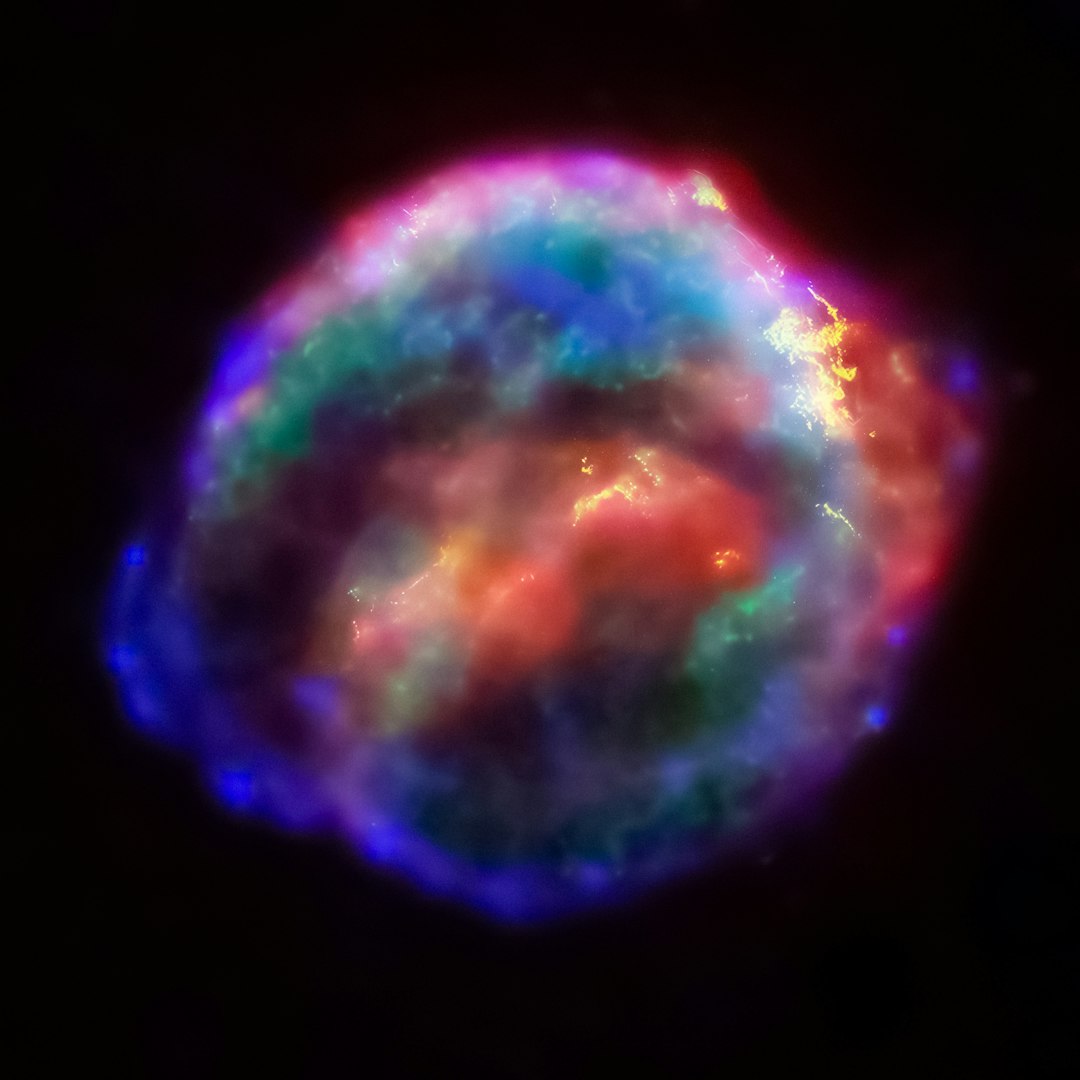
The new composite image draws from multiple observatories to paint a vivid picture. Yellow hues represent low-energy X-rays from Chandra and ESA’s XMM-Newton, while blue shades capture higher-energy emissions. A purple inset spotlights IXPE’s focus on the outer rim, overlaid against a backdrop of faint stars from NSF’s NOIRLab.[1]
IXPE, a NASA-Italian Space Agency partnership launched in 2021, specializes in measuring X-ray polarization. Its gaze on RCW 86’s edge provides context for where the blast’s momentum stalled. This integration reveals swirls and fingers of superheated gas, sculpted by the supernova’s shock front.[2]
- Chandra: Discovered the low-density cavity and mapped energy distributions over two decades.
- XMM-Newton: Supplied complementary high-energy X-ray data.
- IXPE: Targeted the outer rim for polarization insights, highlighting reflected shocks.
- NOIRLab: Added optical starfield for spatial reference.
The Role of the Mysterious Cavity
A key puzzle in RCW 86’s evolution emerged from Chandra’s long-term monitoring. The remnant grew unusually large in a short cosmic timeframe, prompting questions about its progenitor star. Scientists determined that a pre-explosion cavity of rarified gas allowed the debris to surge outward rapidly, forging the observed asymmetry.[1]
At the cavity’s boundary, expansion hit denser material, generating a reflected shock. IXPE’s data from this zone, marked in purple, underscores these dynamics. The interaction continues to heat gas to extreme temperatures, emitting X-rays that telescopes like Chandra detect across vast distances.
Previous studies, including those from 2006 onward, refined the age estimate to match the 185 A.D. record. This alignment strengthens the link between the ancient sighting and today’s glowing shell.
Insights into Supernova Physics
RCW 86 serves as a natural laboratory for supernova mechanics. The shock wave’s passage through varied densities produces distinct X-ray signatures, from soft yellow glows to intense blue flares. IXPE’s polarimetry adds a layer, probing magnetic fields tangled in the turbulence.[2]
Researchers note the remnant’s scale – 43.5 arcminutes across – reflects not just power but environmental influences. The cavity’s presence suggests the star carved out space via stellar winds before detonating. Such findings inform models of Type Ia explosions, common progenitors of these events.
Key Takeaways:
- RCW 86 links directly to the 185 A.D. guest star, the oldest recorded supernova.
- A low-density cavity drove unusually fast expansion and irregular shape.
- IXPE’s outer rim data reveals reflected shocks at the cavity edge.
Two millennia after its flash, RCW 86 endures as a testament to stellar violence and cosmic recycling. Ongoing observations promise deeper revelations about how supernovae forge elements and shape galaxies. What secrets might future missions uncover in this ancient blast? Share your thoughts in the comments.