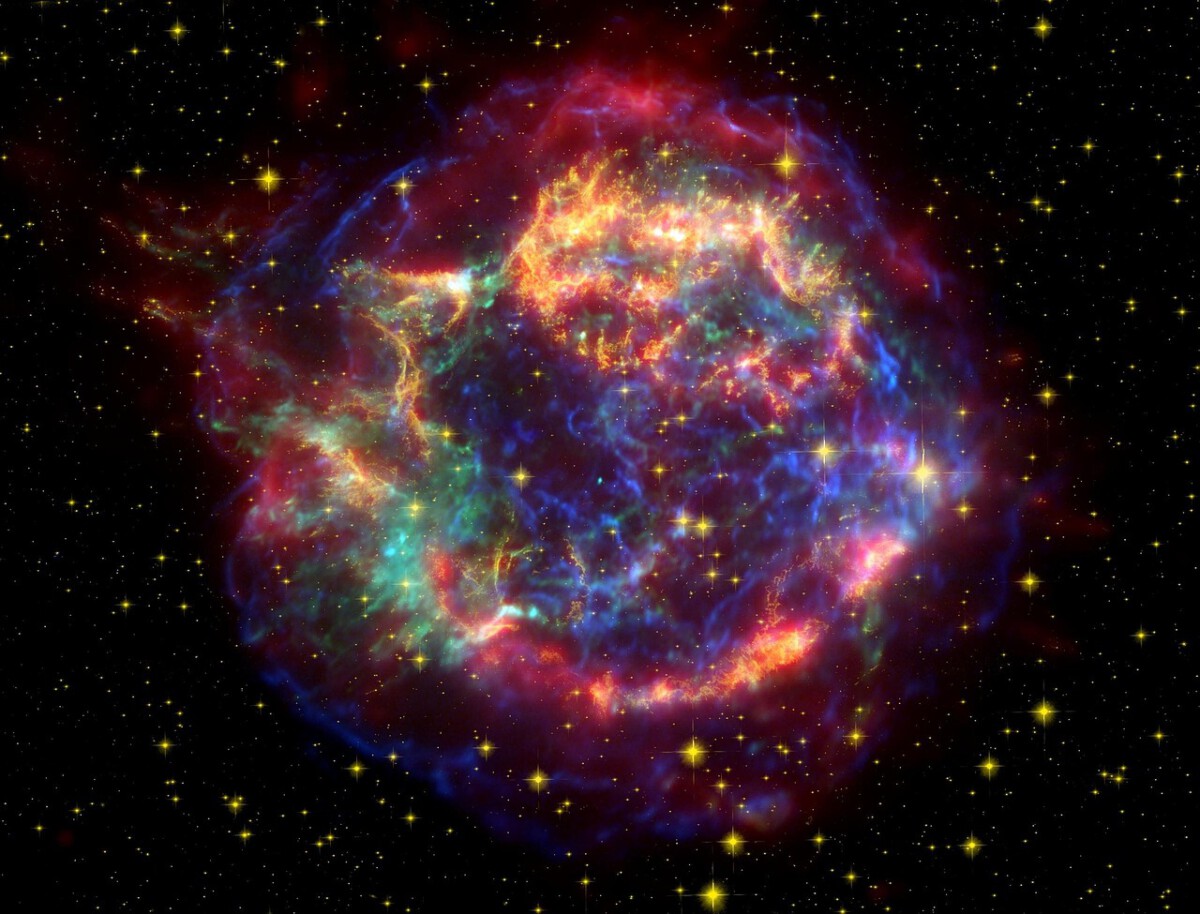
A Persistent Cosmic Riddle Emerges (Image Credits: Pixabay)
Visible to the naked eye in the W-shaped constellation Cassiopeia, Gamma Cassiopeiae has long captivated astronomers with its unusual behavior. For over half a century, scientists grappled with the source of its intense X-ray emissions, far brighter than those from similar massive stars. Recent observations from the XRISM space telescope have now pinpointed the cause: a concealed white dwarf companion siphoning material from the star’s expansive disk.
A Persistent Cosmic Riddle Emerges
Astronomers first detected Gamma Cassiopeiae’s high-energy X-rays in the mid-1970s, revealing plasma heated to an astonishing 150 million degrees. This emission proved 40 times stronger than expected for a star of its class, defying standard models of stellar activity.[1][2]
Classified as a Be star since 1866 by Angelo Secchi, who noted its distinctive hydrogen emission lines, Gamma Cassiopeiae ejects material into a rotating disk. This disk causes brightness variations visible even without a telescope. Yet the X-rays remained elusive, spawning debates that persisted for decades.
Prior missions like XMM-Newton ruled out many hypotheses, narrowing the field to two main ideas. One suggested magnetic fields in the star interacting with its disk. The other proposed disk material accreting onto a companion star.
XRISM Delivers the Decisive Evidence
The X-ray Imaging and Spectroscopy Mission, or XRISM, launched by an international collaboration of Japanese, European, and American teams, provided the breakthrough. Its Resolve spectrometer captured high-resolution data during a targeted campaign. The observations showed X-ray signatures tracking the orbital motion of an unseen companion, not the primary star itself.[1]
This motion confirmed the companion as a white dwarf: a compact object with the Sun’s mass but Earth’s size. As it orbits, the white dwarf pulls gas from Gamma Cassiopeiae’s disk, heating it through accretion and generating the variable X-rays. The plasma’s Doppler shifts aligned precisely with this binary dance.
Unpacking the Gamma Cas System
Gamma Cassiopeiae anchors a rare group of about two dozen similar Be stars exhibiting strong X-rays. These “gamma Cas analogs” challenge theories of isolated massive star evolution. The discovery reveals such systems often involve high-mass Be stars paired with accreting white dwarfs, rarer than models predicted.[1]
Key features of the system include:
- A massive Be star with a decretion disk of ejected gas.
- A low-mass white dwarf companion in close orbit.
- X-ray variability tied to accretion episodes.
- Orbital period detectable through spectral line shifts.
- Overall brightness making it a naked-eye target.
Refined monitoring had hinted at the companion’s presence, but XRISM supplied direct proof.
Insights from the Research Team
Yaël Nazé of the University of Liège in Belgium led the study, published March 24, 2026, in Astronomy and Astrophysics. “There has been an intense effort to solve the mystery of gamma-Cas across many research groups for many decades,” Nazé stated. “And now, thanks to the high-precision observations of XRISM, we have finally done it.”[1]
Alice Borghese, an ESA Research Fellow, highlighted prior work: “XMM-Newton did so much of the groundwork in ruling out various theories about gamma-Cas. And now with the next generation of advanced instrumentation, XRISM has brought us over the finish line.” Matteo Guainazzi, XRISM Project Scientist, praised the teamwork: “This wonderful result underlines the strong collaboration between XRISM’s Japanese, European and American teams.”
Nazé added future directions: “We think the key is in understanding how exactly the interactions take place between the two stars. Now that we know the true nature of gamma-Cas, we can create models specifically for this class of stellar systems, and update our understanding of binary evolution accordingly.”
Broader Implications for Stellar Science
This resolution extends beyond one star. It refines models of binary star evolution, particularly for massive systems. Such pairs illuminate how Be stars shed mass and interact with compact companions.
| Theory | Description | Status |
|---|---|---|
| Magnetic Disk Interaction | Star’s fields heat local plasma | Ruled Out |
| Accretion onto Companion | White dwarf feeds from disk | Confirmed |
The findings, detailed in EarthSky and ESA reports, open doors to studying similar systems.[1]
Key Takeaways:
- XRISM confirmed a white dwarf companion as the X-ray source.
- The mystery spanned 50 years from mid-1970s discovery.
- Advances binary evolution models for Be stars.
Gamma Cassiopeiae’s unveiling underscores the power of next-generation observatories in decoding the universe’s oldest puzzles. As researchers build targeted simulations, more secrets of these dynamic binaries may soon emerge. What do you think this means for our view of stellar life cycles? Tell us in the comments.