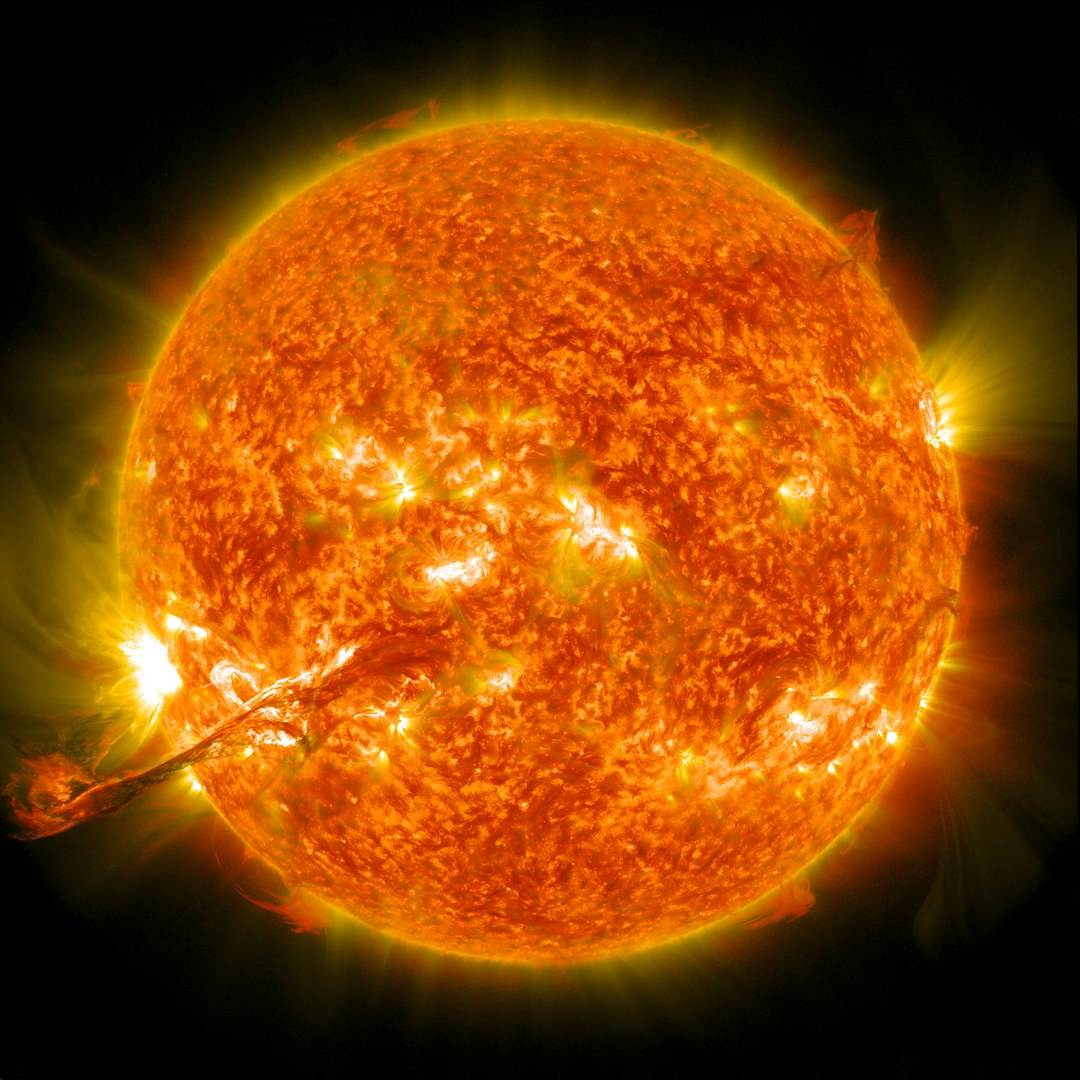
Sunspot 4405 Unleashes Fierce Eruption (Image Credits: Unsplash)
A potent X1.4-class solar flare erupted from the sun early on March 30, 2026, casting a shadow over NASA’s final preparations for the Artemis 2 mission. The event disrupted high-frequency radio communications across multiple regions and hurled a fast coronal mass ejection into space. With the crewed lunar flyby launch targeted for no earlier than April 1, space weather experts heightened their scrutiny of the sun’s volatile behavior.[1][2]
Sunspot 4405 Unleashes Fierce Eruption
Active region 4405, a magnetically complex sunspot group rotating into Earth’s view, produced the X1.4 flare that peaked at 11:19 p.m. EDT on March 29, or 0319 GMT on March 30. NASA’s Solar Dynamics Observatory recorded the outburst in exquisite detail across various wavelengths. This marked a strong R3-level event on the radio blackout scale, one of several powerful flares amid the ongoing solar maximum.[1]
Solar flares of this magnitude release immense energy, equivalent to millions of hydrogen bombs detonating simultaneously. The sun’s surface twisted and contorted as plasma heated to tens of millions of degrees surged outward. Region 4405 demonstrated its potential for further activity as it faces Earth more directly in coming days.[3]
Radio Signals Fade Across Pacific Regions
The flare immediately triggered widespread degradation of high-frequency radio signals on Earth’s sunlit side. Communications blackouts struck hardest in southeast Asia and Australia, hampering aviation, maritime operations, and amateur radio enthusiasts. NOAA’s Space Weather Prediction Center classified the disturbance as strong, with signals fading for up to an hour in affected zones.[1]
Operators reported intermittent outages as ionized particles from the flare bombarded the ionosphere, temporarily absorbing radio waves. Such disruptions, though brief, underscore the sun’s influence on modern technology reliant on HF and VHF bands. Satellite operators also noted minor glitches in their systems during the peak.[2]
Coronal Mass Ejection Heads Toward Earth
Accompanying the flare, a swift coronal mass ejection launched billions of tons of solar plasma into space. Early analysis suggested a partial Earth-directed component, prompting NOAA to issue a moderate G2 geomagnetic storm watch for March 31. Minor G1 conditions remained possible through March 30 and into April 1.[1]
If the CME glances Earth, it could spark vibrant auroras visible at mid-latitudes. Power grids, GPS accuracy, and satellite drag might experience subtle effects. Forecasters tracked the ejection’s speed and trajectory using coronagraph imagery from solar observatories.[1]
Artemis 2 Faces Heightened Space Weather Risks
NASA’s Artemis 2 mission, slated for a two-hour window opening at 6:24 p.m. EDT on April 1 from Kennedy Space Center, will send four astronauts – Reid Wiseman, Victor Glover, Christina Koch, and Jeremy Hansen – on a 10-day lunar flyby. The crew will test the Orion spacecraft beyond low-Earth orbit for the first time since Apollo. Timing coincides with peak solar activity, amplifying radiation concerns.[1]
Solar events like this flare can seed solar energetic particle events, flooding space with high-speed protons. Astronauts outside Earth’s magnetosphere face elevated cancer risks and acute radiation sickness if exposed. The recent outburst replenished radiation in the Van Allen belts, a key transit zone for Orion.[2]
- Radio bursts threaten launch communications and early orbit maneuvers.
- SPEs could spike doses inside Orion, prompting shelter protocols.
- CMEs might disrupt tracking networks and onboard systems.
- Galactic cosmic rays add baseline exposure during the lunar loop.
NASA’s Robust Defenses Against Solar Threats
Teams from NASA’s Moon to Mars Space Weather Analysis Office and Space Radiation Analysis Group maintain 24/7 vigilance. Spacecraft like Solar Dynamics Observatory, SOHO, and GOES satellites feed real-time data into forecasting models. Even the Perseverance rover on Mars peers at the sun’s far side via its cameras, spotting trouble spots weeks early.[4]
Orion carries six radiation sensors and crew dosimeters that trigger alarms if thresholds rise. Flight controllers receive NOAA alerts for go/no-go decisions. Solar physicist Tamitha Skov emphasized the stakes: “NASA is paying attention regarding the upcoming Artemis 2 launch. We need to pay attention to radio bursts now. Those can really impact HF/VHF as well as satellite radio communications during critical launch operations and early orbit maneuvers!”[1]
Recent testbeds simulated storms, honing response protocols. Experts like Shawn Dahl from NOAA’s SWPC affirmed readiness despite solar maximum’s unpredictability.
| Solar Flare Class | Strength | Typical Impacts |
|---|---|---|
| C | Minor | Weak radio fades |
| M | Moderate | Regional blackouts |
| X | Major | Global disruptions, radiation storms |
As the sun quiets post-maximum, Artemis 2 pioneers safer deep-space travel amid cosmic unpredictability. Vigilance ensures crews return unscathed, paving the way for lunar landings.
- X1.4 flare from sunspot 4405 caused strong radio blackouts in Asia-Pacific.
- Fast CME may trigger geomagnetic storms and auroras through April 1.
- Artemis 2 launch on April 1 demands precise space weather monitoring to shield astronauts from radiation.
Will space weather delay the moon’s next visitors? Share your thoughts in the comments.