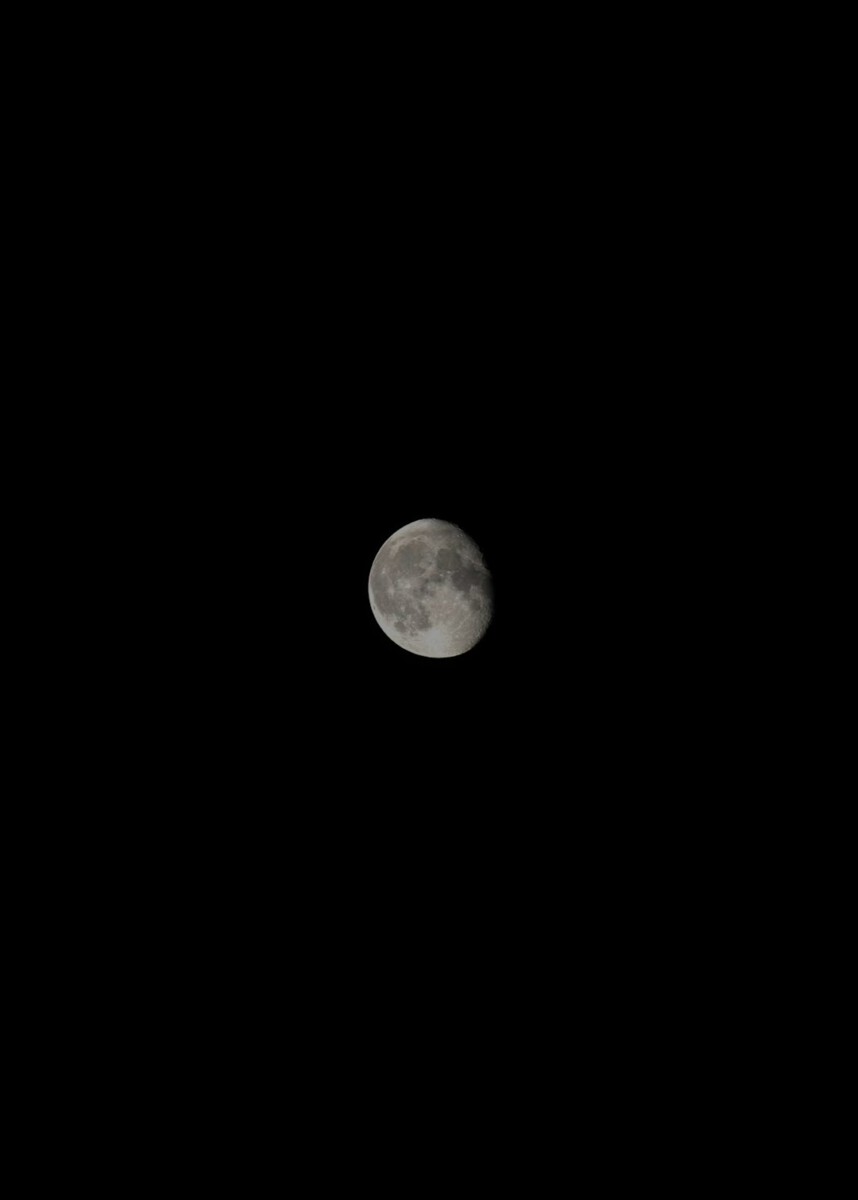
The Sun Always Lights Half the Moon (Image Credits: Unsplash)
Each lunar cycle brings a moment when the Moon seems to vanish from the night sky. This occurs during the New Moon phase, when the Moon aligns precisely between Earth and the Sun. Observers on Earth see only the Moon’s dark, unilluminated hemisphere, while its far side receives full sunlight.[1][2]
The Sun Always Lights Half the Moon
Half of the Moon remains bathed in sunlight at every instant, regardless of its phase. The Sun’s rays strike one hemisphere consistently, much like they illuminate Earth’s dayside. Visibility from our planet depends on the overlap between this lit portion and the hemisphere facing Earth.
During most phases, some illuminated area reflects light toward us, creating the familiar crescent, quarter, or full Moon. New Moon disrupts this pattern entirely. The alignment ensures no sunlight reaches the Earth-facing side, plunging it into shadow.[1]
Tidal Locking Keeps One Face Toward Earth
Earthbound viewers never glimpse more than one side of the Moon. This stems from tidal locking, where the Moon’s rotation period matches its orbital period around Earth – both approximately 27.3 days for a sidereal month. The Moon spins once on its axis for each lap around our planet.
This synchronization arose over billions of years through gravitational interactions. Earth’s tides gradually slowed the Moon’s spin until equilibrium set in. As a result, the same lunar landscape confronts us eternally, while the opposite side stays hidden.[1][3]
New Moon Alignment in Detail
The New Moon marks the start of the lunar cycle, with the Moon’s position directly in line with the Sun as seen from Earth. Sunlight floods the hemisphere averted from us, making the far side resemble a full Moon to any hypothetical observer there. No light scatters back to illuminate our view.
| Lunar Phase | Earth-Sun-Moon Position | Visibility from Earth |
|---|---|---|
| New Moon | Moon between Earth and Sun | None (dark side faces Earth) |
| Waxing Crescent | Moon follows Sun eastward | Thin lit edge visible |
| Full Moon | Earth between Moon and Sun | Entire facing side lit |
This table simplifies the cycle. Phases shift gradually over the synodic month of about 29.5 days, as the Moon laps the Sun in our sky.[4]
Recreate Lunar Phases at Home
A simple experiment demonstrates these dynamics. Position a lamp – representing the Sun – at one end of a dark room. Stand at the opposite end as Earth, holding a baseball or styrofoam ball as the Moon at arm’s length.
- Face the lamp directly: observe the New Moon, with the ball’s lit side turned away.
- Rotate slowly counterclockwise: watch waxing phases emerge as more of the lit half swings into view.
- Reach the opposite side: the full phase appears, fully illuminated toward you.
- Continue circling: waning phases follow until darkness returns.
This hands-on model reveals how orbital motion and fixed rotation produce the cycle. It matches diagrams showing the Moon’s path from above, with constant half-illumination.[1]
The Moon’s phases offer a window into celestial mechanics. Tidal locking and solar geometry ensure predictable rhythms observable worldwide. Next New Moon, consider the vibrant daylight on the far side – out of sight but fully aglow.
Key Takeaways
- The Sun illuminates exactly half the Moon at all times.
- Tidal locking means Earth always sees the same lunar face.
- During New Moon, that face remains unlit, hiding the glow on the opposite side.
What fascinates you most about the Moon’s phases? Share your thoughts or experiment results in the comments.