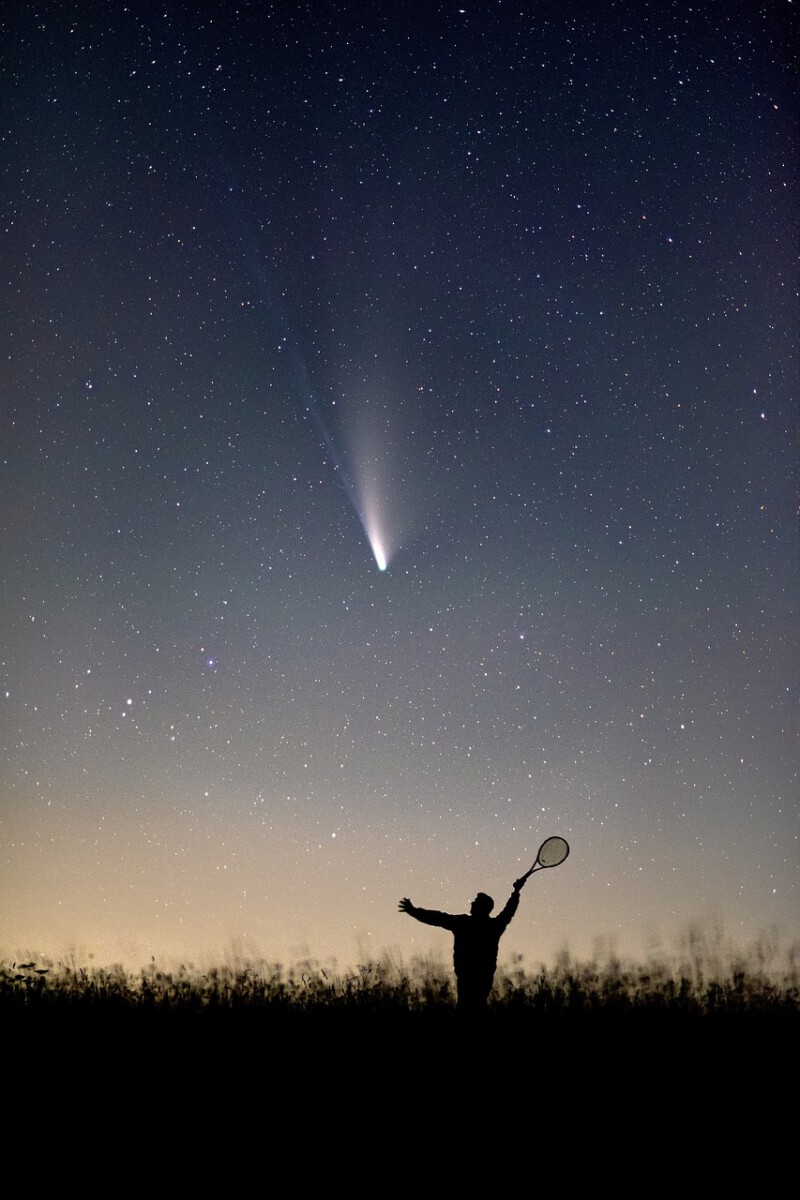
A Celestial Omen Amid Warring States Chaos (Image Credits: Pixabay)
China – In the spring of 240 B.C.E., keen-eyed astronomers in ancient China detected a distinctive “broom star” streaking across the heavens, marking the first verified written account of what we now know as Halley’s Comet.[1][2] This observation occurred during a period of intense rivalry among feudal states, yet it demonstrated remarkable attention to the skies. Preserved for posterity, the record highlights how early sky-watchers laid the groundwork for modern orbital predictions.
A Celestial Omen Amid Warring States Chaos
The sighting took place in the seventh year of Qin Shi Huang’s reign, a time when the Warring States period gripped China in near-constant conflict. Qin Shi Huang, who later unified the nation as its first emperor, ruled the state of Qin from 246 B.C.E. onward. Astronomers noted the comet’s arrival as kingdoms vied for dominance, often interpreting such events as portents of change or divine warning.
Chinese chroniclers captured the moment with precision unusual for the era. The comet, dubbed a “broom star” for its sweeping tail, first emerged in the east before shifting northward. Modern calculations align this path with Halley’s 76-year orbit, confirming the event’s authenticity.[3]
Sima Qian’s Shiji: The Timeless Witness
Over a century later, historian Sima Qian immortalized the observation in his monumental Shiji, or Records of the Grand Historian, compiled between 109 and 91 B.C.E. He wrote: “In the seventh year of Emperor Qin Shihuang of the Warring States, a broom star first appeared in the east, then it appeared in the north.”[1] This brief entry, drawn from earlier court records, endured as the comet’s inaugural documented passage.
Additional notes in the Shiji described the object reappearing in the west during the fifth lunar month, roughly late May to early June in the modern calendar. Such details allowed 20th-century astronomers to reconstruct the comet’s trajectory with striking accuracy.[2]
Tracing the Comet’s Path Through History
Halley’s Comet approached its perihelion – closest point to the Sun – sometime between late March and late May 240 B.C.E., making this the first recorded instance of such a passage. Observers tracked it from predawn eastern skies, through northern positions, and into evening western views post-perihelion. The retrograde orbit, inclined at 162 degrees to the ecliptic, explained its dramatic motion.
This event stood out because Chinese records spanned the comet’s full visibility cycle, unlike briefer accounts elsewhere. Babylonian tablets mention a 164 B.C.E. appearance, but nothing predates China’s 240 B.C.E. entry with certainty.[4]
- First sighting: Eastern sky, around March 30, 240 B.C.E.
- Mid-path: Northern position, increasing brightness toward perihelion.
- Post-perihelion: Western sky, fifth lunar month (May-June).
- Terminology: “Broom star,” evoking the tail’s whisk-like form.
- Historical value: Enabled precise orbital modeling centuries later.
Chinese Records Fuel Modern Comet Science
Ancient Chinese astronomers maintained meticulous logs of celestial events, including over 500 comet sightings by 1910. For Halley’s Comet alone, they documented around 30 returns, from 240 B.C.E. onward.[5] These archives proved invaluable when Edmond Halley predicted the comet’s periodicity in 1705, using data that included Eastern observations.
Cross-referencing with Babylonian, Korean, and European texts refined the 75.3-year cycle. Today, missions like Europe’s Giotto probe in 1986 and Japan’s Sakigake drew on this heritage to study the comet up close. The 240 B.C.E. record remains a cornerstone, bridging antiquity and space age exploration.
Key Takeaways
- China’s 240 B.C.E. observation is the earliest confirmed Halley’s Comet record, predating others by centuries.
- Sima Qian’s Shiji preserved path details matching modern orbits.
- These logs helped unlock the comet’s predictable return every 76 years.
The faint glow of that broom star over ancient China not only foretold imperial shifts but also ignited a legacy of cosmic curiosity that endures. As Halley’s next visit approaches in 2061, this pioneering record reminds us how vigilant eyes from the past illuminate our understanding of the universe. What celestial events from history fascinate you most? Share in the comments.