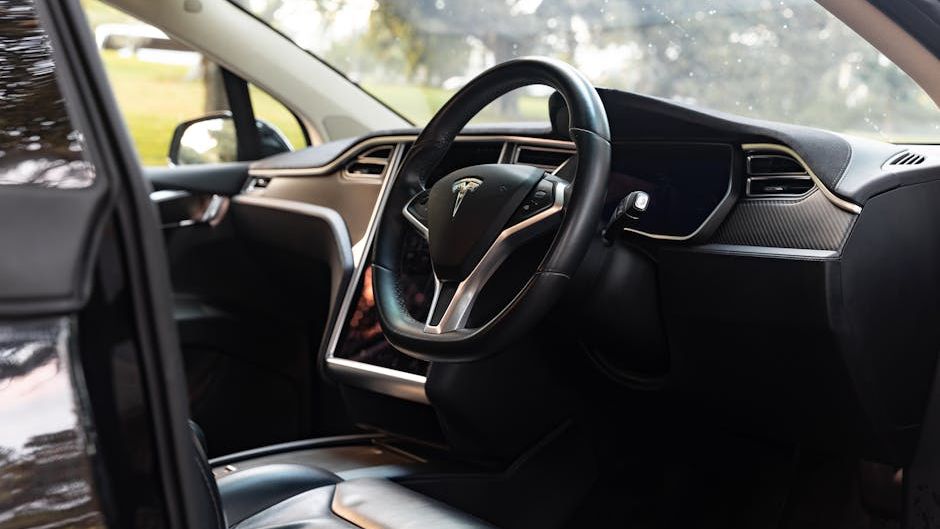
Cybercab Production Signals Autonomy Era (Image Credits: Pexels)
Tesla’s trailing price-to-earnings ratio exceeded 340 in late April 2026, dwarfing traditional automakers and signaling investor bets on transformative growth.[1][2] The electric vehicle leader confirmed production of its Cybercab robotaxi had begun at Giga Texas during the first-quarter earnings call, marking a pivotal step toward autonomy.[3] This development arrived as shares hovered around $376, supporting a market capitalization near $1.4 trillion.[4]
Cybercab Production Signals Autonomy Era
Tesla initiated volume manufacturing of the Cybercab in early 2026, with dozens of units already observed leaving production lots.[5] CEO Elon Musk highlighted this milestone on the Q1 earnings call, noting the vehicle’s fully autonomous design without steering wheel or pedals.[6] Production ramped up despite ongoing regulatory scrutiny, positioning Tesla to challenge rivals like Waymo.
Full Self-Driving software progressed with updates like version 14.3.2, incorporating driver-requested features.[7] Paid robotaxi miles nearly doubled sequentially in the first quarter, underscoring real-world deployment gains.[8] These advances reinforced Tesla’s pivot from pure EV sales toward AI-driven services.
2026 Financial Outlook Offers Growth Potential
Analysts projected Tesla’s revenue to reach $108.9 billion in 2026, reflecting 15% growth from prior estimates.[9] Earnings per share stood at a forecasted $2.25, with vehicle deliveries anticipated to climb nearly 12% to 1.83 million units.[10] Optimus humanoid robots and energy storage added diversification layers.
First-quarter results showed revenue of $22.39 billion, missing expectations slightly, though profits beat forecasts at $477 million, up 17% year-over-year.[11][12] Capital expenditures rose to over $25 billion for the year, targeting AI infrastructure and factory expansions.[13]
Valuation Premium Raises Eyebrows
Tesla’s forward P/E ratio lingered around 178 to 181, well above automotive peers like General Motors at 25.9.[14][15] This multiple implied flawless execution on ambitious goals, leaving scant margin for delays.
| Company | Trailing P/E (April 2026) |
|---|---|
| Tesla (TSLA) | ~340[2] |
| General Motors (GM) | 25.9[15] |
Consensus price targets averaged $383 to $406, suggesting modest upside from current levels, while bulls like Wedbush’s Dan Ives eyed $600 or a $2 trillion market cap by year-end.[16][17] Bears cautioned free cash flow could swing negative amid heavy spending.[18]
Challenges Temper the Enthusiasm
Tesla faced delivery declines in 2025, marking the second straight year of contraction before a projected rebound.[19] Intensifying competition from Chinese EV makers and trade pressures added headwinds.
- Regulatory hurdles for unsupervised FSD deployment persisted.
- High capex strained balance sheet, with 2026 free cash flow estimates varying wildly from positive billions to deficits.[18]
- EV market saturation slowed adoption curves globally.
Analysts rated the stock a consensus hold, balancing innovation allure against execution risks.[20]
Tesla’s trajectory hinges on delivering robotaxi fleets at scale and monetizing AI capabilities. Success could validate the premium pricing; setbacks might trigger sharp corrections. Investors weighed these dynamics as 2026 unfolded, with autonomy milestones poised to shape the narrative.