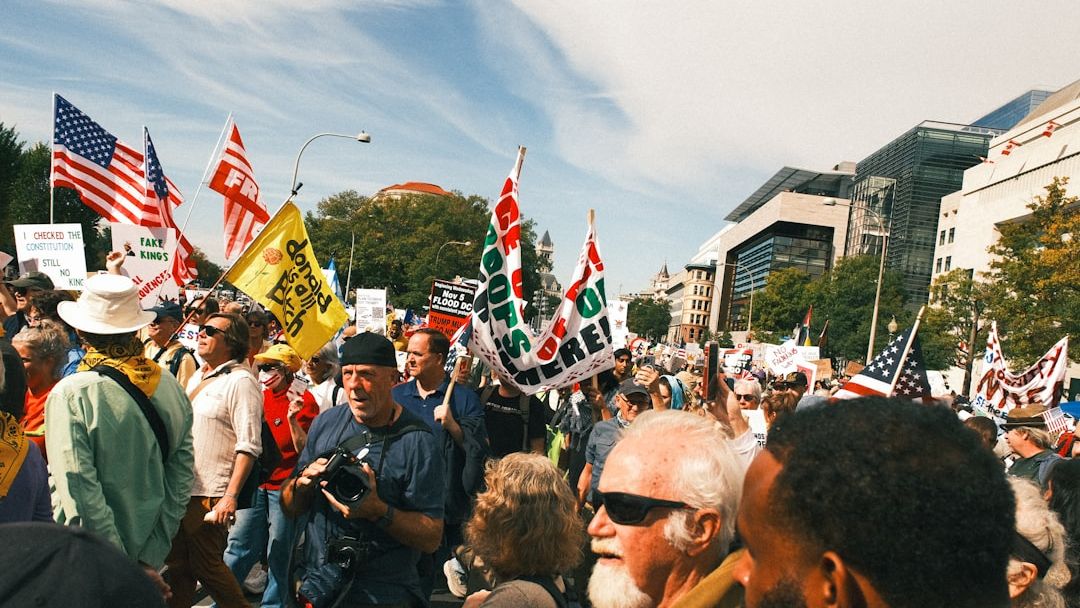
People Are Debating Adam Scott’s Claim That America “Lost What Was Left Of Its Innocence” When Trump Entered Politics, And The Discourse Is Fascinating – Image for illustrative purposes only (Image credits: Unsplash)
Actor Adam Scott recently reflected on the cultural shift in American entertainment during a Variety interview promoting his new horror film. He suggested that the country lost its remaining innocence in 2015 when Donald Trump entered politics, a comment that has prompted widespread discussion online.[1][2] The observation connects the optimistic tone of his former sitcom Parks and Recreation to broader changes in national mood over the past decade.
Reflecting on Parks and Recreation's Wholesome Era
Scott portrayed Ben Wyatt on the NBC series, which aired from 2009 to 2015 and captured a sense of hope and community in the fictional town of Pawnee, Indiana. The show concluded just as Trump announced his presidential candidacy in June of that year. Scott noted in the interview that the program still offers comfort to viewers facing difficult periods, including the pandemic.[1]
He contrasted this with the present landscape. "It is a dark time right now," Scott stated, adding that a modern version of the series would feel "slightly different."[1] The conversation arose amid discussions of how feel-good comedies endure amid shifting societal pressures.
Scott's Specific Claim About 2015
The actor pinpointed Trump's political debut as a turning point. "I do feel like our country may have lost what was left of its innocence in 2015, when Donald Trump stepped up and stepped into politics," he said. "And it’s easy to forget just how much our country has changed in the last 10 or 11 years."[1]
Scott elaborated on a prevailing sense of naivety at the time. "There was so much naivety about what this country was capable of and how much worse things could possibly get," he remarked. This perspective frames the Trump era as a revelation of deeper national capacities for division and challenge.
The interview, published on April 30, 2026, highlighted parallels with shows like Abbott Elementary, which Scott praised for preserving heartfelt humor despite contemporary headwinds.[1]
Online Discourse Highlights Divisions
Scott's words quickly drew reactions across platforms like Reddit, where interpretations varied sharply. Some users questioned the notion of American innocence altogether, asking "What innocence, man?" and linking it to Obama-era assumptions that racism had faded.[2]
Others defended the idea as referring to widespread optimism among certain groups. One commenter described it as "blissful ignorance" or "obnoxiously saccharine, politically moderate millennial optimism circa 2014." Critics argued that such positivity mainly benefited white, middle-class perspectives, while progressives saw Trump's 2016 victory as shattering expectations of inevitable improvement.[2]
- Pre-Trump era viewed as naively hopeful by some, especially in progressive circles.
- Skeptics pointed to longstanding inequalities, questioning applicability beyond privileged experiences.
- Agreement that 2015 marked a shift in political realism and lowered expectations.
Implications for Comedy in Polarized Times
Scott's remarks underscore challenges for optimistic storytelling post-2015. Parks and Recreation thrived on earnest characters and small-town problem-solving, elements that might clash with heightened cynicism today. He suggested creators could still produce such work, citing Abbott Elementary as evidence of an enduring audience for joy amid darkness.[1]
The timeline from the show's end to now reveals evolving viewer needs. Fans continue to draw solace from its reruns, even as real-world events test ideals of government competence and unity depicted on screen.
What Matters Now
- Scott's comments revive nostalgia for pre-2016 cultural optimism.
- Debate reveals ongoing divides in how Americans recall the Obama-to-Trump transition.
- Entertainment remains a refuge, with demand for hopeful narratives persisting.
As discussions continue, Scott's observation serves as a reminder of how political milestones reshape not just policy, but the collective imagination that fuels art and comedy. The enduring appeal of Parks and Recreation suggests that traces of that earlier hope linger, even in tougher times.