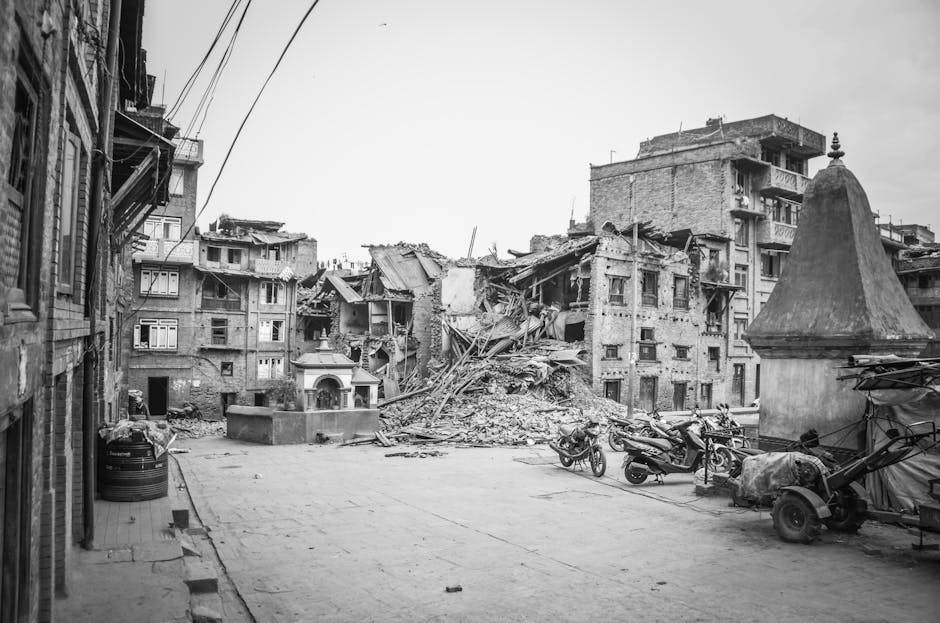
The Violent Awakening (Image Credits: Pexels)
South-central Alaska – Sixty-two years ago today, the region endured its most devastating seismic event when a magnitude 9.2 earthquake struck Prince William Sound on Good Friday, March 27, 1964.[1][2] The tremor, which lasted about four and a half minutes, ranks as the second-largest ever instrumentally recorded worldwide and the strongest in North American history.[3] This cataclysm not only reshaped the landscape but also advanced global understanding of subduction zone hazards.
The Violent Awakening
At 5:36 p.m. local time, the earth unleashed its fury along the Aleutian Trench, where the Pacific Plate subducts beneath the North American Plate. The rupture spanned over 500 miles, releasing energy equivalent to thousands of atomic bombs. Residents from Anchorage to remote coastal villages felt the intense shaking, which toppled buildings and triggered massive landslides.[1]
In Anchorage, 75 miles from the epicenter, the Turnagain Heights neighborhood suffered catastrophic failure as 130 acres of land slid seaward by up to 2,000 feet, destroying 75 homes. Wooden structures fared better than concrete ones, absorbing some of the violent motion. The holiday timing kept many schools and offices empty, sparing lives amid the chaos.[4]
Waves of Destruction
Tsunamis amplified the earthquake’s toll, generating waves from both tectonic uplift and submarine landslides. In Valdez, a massive underwater slide obliterated the harbor moments after the shaking, wiping out the town closest to the epicenter. Waves surged up to 220 feet in some areas, inundating ports like Seward and Kodiak.[1][5]
The tsunamis traveled across the Pacific, striking Oregon and California with deadly force and even reaching Hawaii. Crescent City, California, saw waves up to 21 feet high, claiming 11 lives there. Overall, these surges accounted for about 90 percent of the fatalities linked to the event.[6]
- Valdez: Complete harbor destruction from landslide-generated wave.
- Chenega: 27-foot tsunami killed 23 of 68 villagers.
- Whittier: Inundated by local waves shortly after shaking.
- Chenega: Survivors fled to higher ground just in time.
- Crescent City: Distant waves caused fires and further structural collapses.
A Region Transformed
Geological upheaval marked the landscape profoundly. Vast areas subsided by several feet, while others uplifted by up to 38 feet, altering coastlines permanently. Rivers shifted courses, and new bays formed where land sank. The U.S. Geological Survey documented these changes, which affected over 520,000 square kilometers.[7]
Property damage exceeded $300 million at the time, equivalent to billions today, with Anchorage’s downtown skyline forever altered. The Four Seasons apartment building pancaked, and highways buckled like accordions. Military and federal aid poured in swiftly, rebuilding infrastructure over years.[8]
Human Cost and Resilience
Officials recorded 131 deaths, with 115 in Alaska and the rest from distant tsunamis. Sparse population density and the afternoon holiday on Good Friday mitigated worse outcomes. Eyewitnesses recalled the surreal duration of the shaking, which allowed some to seek safety outdoors.[6]
Communities like Chenega lost nearly a third of their people, yet survivors rebuilt with determination. The event spurred advancements in seismology, including better tsunami warning systems and building codes. Alaska’s preparedness today owes much to those hard lessons.[9]
| Key Impacts | Details |
|---|---|
| Casualties | 131 total, mostly tsunamis |
| Damage Cost | $311 million (1964 dollars) |
| Land Affected | Over 500,000 sq km displaced |
| Aftershocks | Thousands, including 11 >6.0 |
- The 9.2 magnitude made it North America’s strongest quake, felt across the U.S.
- Tsunamis caused 90% of deaths, highlighting distant hazards.
- Event drove seismic research and modern warning networks.
Sixty-two years later, the Great Alaska Earthquake stands as a stark reminder of nature’s power and humanity’s capacity to adapt. Enhanced monitoring and resilient designs now guard against repeats. What lessons from 1964 resonate most with you today? Share in the comments.