

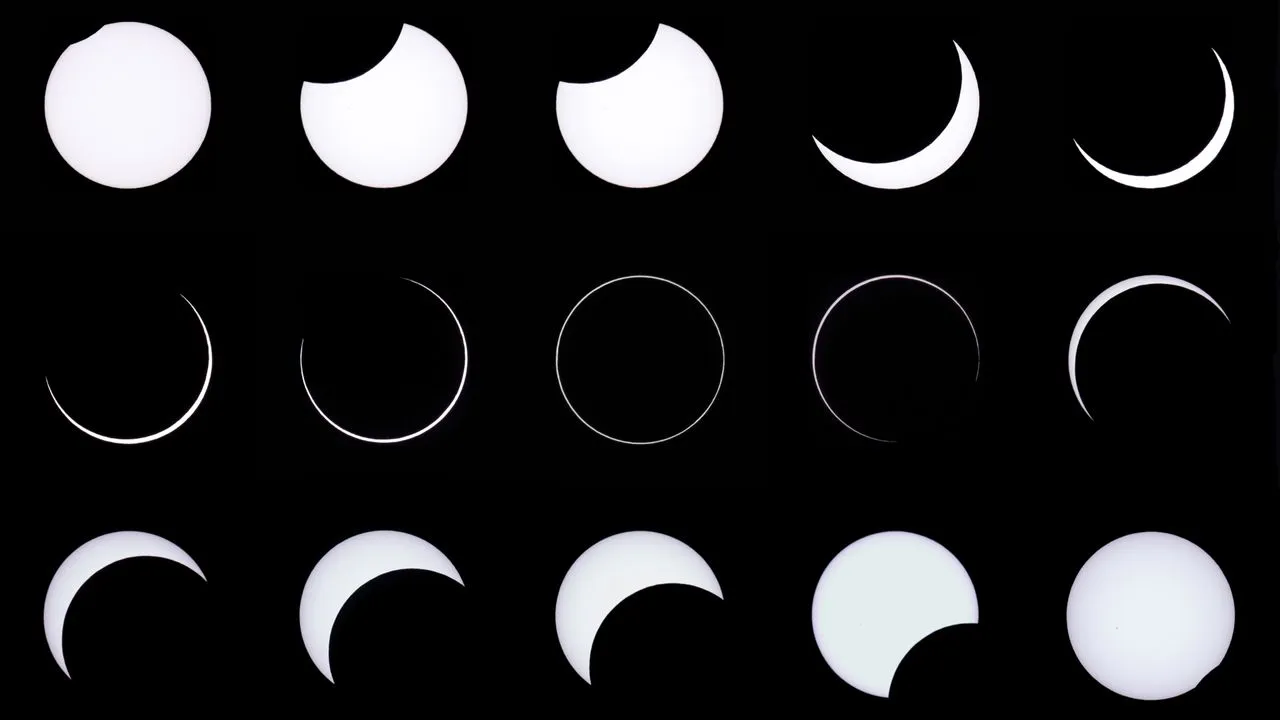
Celestial Mechanics at Play in the Frozen South (Image Credits: Cdn.mos.cms.futurecdn.net)
Antarctica – Remote research stations across the icy continent hosted a fleeting celestial spectacle on February 17, 2026, when an annular solar eclipse produced a vivid ring of sunlight around the moon’s silhouette.[1]
Celestial Mechanics at Play in the Frozen South
A glowing halo encircled the darkened moon for up to two minutes and 20 seconds, captivating the handful of observers in Antarctica’s interior. The event marked the first solar eclipse of 2026 and unfolded as the moon reached its farthest point from Earth in its elliptical orbit. This positioning made the lunar disk appear smaller than the sun, preventing a total blackout and instead forming the signature “ring of fire.”[2][3]
The eclipse began at 4:56 a.m. EST, with the moon gradually encroaching on the sun’s edge. Maximum annularity peaked around 7:12 a.m. EST over a narrow 383-mile-wide path. Partial phases extended the show for about two hours at key sites, though harsh weather challenged visibility in some areas.[1]
Precision Path Cuts Through Remote Terrain
The annularity corridor sliced across Antarctica’s eastern and interior regions, sparing most populated areas worldwide. Only specialized outposts fell squarely within the zone of perfect alignment. This exclusivity turned the eclipse into an event for scientists rather than crowds.
Researchers at these bases prepared meticulously, deploying telescopes and cameras despite subzero conditions. The path avoided major hubs like McMurdo Station, which experienced a deep partial eclipse covering 86% of the sun. Still, the phenomenon drew global attention through live streams and shared imagery.[4]
Observations from Frontier Stations
At Concordia Research Station, a French-Italian facility in the Antarctic plateau, the ring blazed for two minutes and one second. Russian teams at Mirny Station on the coast recorded one minute and 52 seconds of annularity. These durations highlighted the eclipse’s brevity and the precision required for optimal viewing.[5]
Cloud cover marred some efforts, yet clear moments yielded striking photos and videos. McMurdo observers noted a dramatic crescent sun amid twilight-like gloom. The stations’ logs captured not just visuals but also atmospheric data during the unusual midday dimming.
| Station | Location | Annularity Duration |
|---|---|---|
| Concordia | Interior Plateau | 2 min 1 sec |
| Mirny | Queen Mary Land Coast | 1 min 52 sec |
| McMurdo | Ross Island | Partial (86% coverage) |
Partial Views Reach Beyond the Ice
While full annularity stayed confined to Antarctica, partial phases graced southern Africa, the tip of South America, and surrounding oceans. Viewers in these areas saw the moon nibble at the sun’s edge, creating crescents up to 96% obscured in prime spots.[4]
Such wide partial visibility amplified scientific interest, with data collection spanning hemispheres. Amateur astronomers shared sequences online, extending the event’s reach.
- Southern Africa: Up to 70% solar coverage in optimal zones.
- Southern Ocean: Ship-based sightings amid waves.
- South America: Brief partials near Tierra del Fuego.
- Most of Antarctica: Varied partials outside annularity path.
- The eclipse lasted up to 2 minutes 20 seconds at maximum, visible only in a 383-mile path.[3]
- Research stations like Concordia provided prime views for under 100 people.
- Partial phases engaged millions indirectly through media.
This annular eclipse underscored the planet’s dynamic orbital dance, offering a rare glimpse into cosmic scale from Earth’s edge. As images circulate, they inspire awe at nature’s precision. What are your thoughts on this icy spectacle? Share in the comments below.