Crew Gears Up for Deep Space Challenge (Image Credits: Cdn.mos.cms.futurecdn.net)
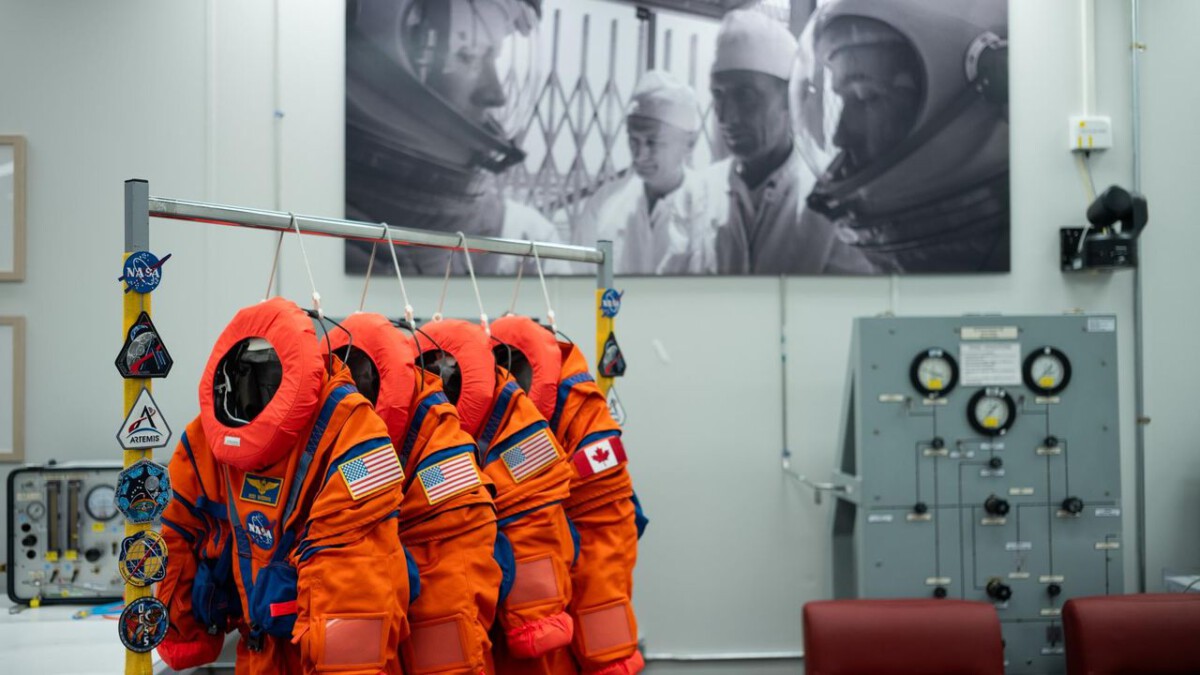
Kennedy Space Center, Florida – Four high-visibility orange spacesuits hang in preparation for the Artemis 2 crew’s upcoming journey around the moon.[1]
Crew Gears Up for Deep Space Challenge
The Artemis 2 mission marks NASA’s first crewed flight beyond low Earth orbit since Apollo 17 more than 50 years ago. Commander Reid Wiseman, Pilot Victor Glover, and Mission Specialists Christina Koch of NASA and Jeremy Hansen of the Canadian Space Agency will pilot the Orion spacecraft on a 10-day voyage.[2][1]
Launch preparations target no earlier than February 8, 2026, following recent weather-related delays in ground tests. The crew completed extensive training, including suited rehearsals and simulations, to handle operations far from Earth.[3]
Artemis II Chief Training Officer Jacki Mahaffey emphasized the focus on risk mitigation. “Artemis II training is all risk mitigation,” she stated. “By preparing the astronauts and flight controllers for what they might encounter, we enable mission success.”[3]
Engineering Behind the Orion Crew Survival System
These spacesuits form the Orion Crew Survival System, tailored for critical phases of the mission. They deliver pressure, oxygen, and thermal protection during launch, ascent, in-space contingencies, and reentry through Earth’s atmosphere.[3][1]
Engineers designed the suits to safeguard astronauts against cabin pressure loss or life-support failures inside Orion. Unlike extravehicular suits for moonwalks, these remain internal to the capsule, as Artemis 2 involves no surface landing.[1]
- High-visibility orange coloring for quick identification.
- Integration with Orion for oxygen supply, cooling, and safety monitoring.
- Leak-tight seals and mobility checks to ensure functionality.
- Support for communications between crew members and mission control.
- Protection during high-speed reentry and splashdown recovery.
The Meticulous Suiting Procedure
Technicians guide astronauts through a precise donning process in the Neil A. Armstrong Operations and Checkout Building. Crew members step into the suits, followed by adjustments for optimal fit and range of motion.[1]
Teams secure gloves, helmets, and seals, then test interfaces with the spacecraft. Verification steps confirm oxygen flow, cooling systems, and communication links operate seamlessly. This ritual uncovers any issues before flight, bolstering overall mission reliability.
Paving the Way for Future Lunar Exploration
Artemis 2 tests the Space Launch System rocket and Orion spacecraft in deep space conditions. Astronauts will observe the moon’s far side, capturing data on craters, regolith, and surface features to inform later landings.[3]
The mission builds toward Artemis 3, which plans the first woman and person of color on the lunar surface. Training in analogs like Iceland honed geology skills, even without a landing this time.
| Mission Phase | Suit Role |
|---|---|
| Launch/Ascent | Pressure and thermal protection |
| Contingencies | Life support in cabin failure |
| Reentry | Shielding during atmospheric friction |
Key Takeaways
- Artemis 2 launches four astronauts on a 10-day lunar flyby, validating systems for sustained moon presence.
- Orange suits prioritize crew safety inside Orion, distinct from future moonwalking gear.
- Recent rehearsals confirm readiness amid minor delays.
These suits symbolize a pivotal step in humanity’s return to the moon. As launch nears, they embody decades of innovation poised to unlock new frontiers. What aspect of Artemis 2 excites you most? Share in the comments.