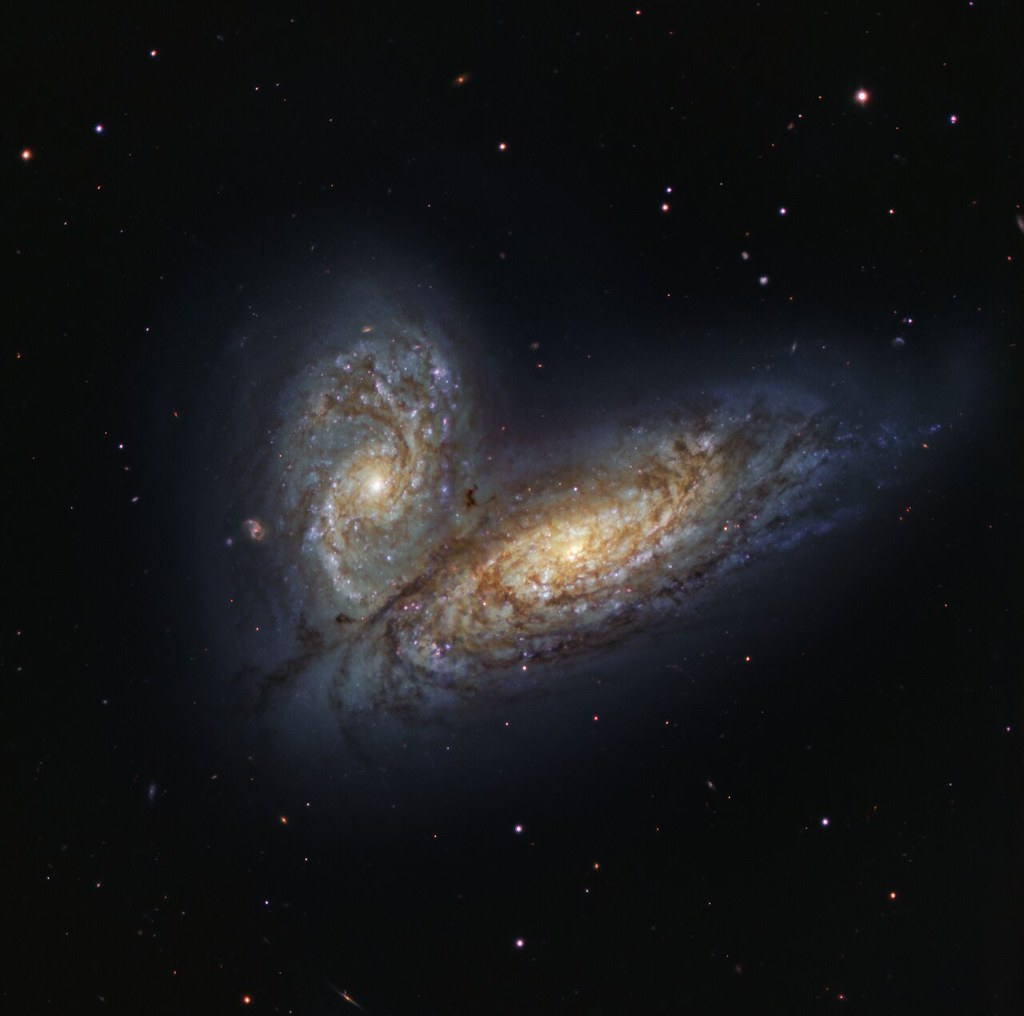
A Starburst Powerhouse in Collision (Image Credits: Flickr)
Deep within the colliding galaxies of Arp 220, powerful magnetic fields have been found directing high-velocity outflows that reshape the cosmic landscape.[1][2]
A Starburst Powerhouse in Collision
Arp 220 stands out as the nearest ultraluminous infrared galaxy, located roughly 250 million light-years away in the constellation Serpens. This system formed from the merger of two spiral galaxies, a process that ignited an intense burst of star formation.[3] The collision, which began hundreds of millions of years ago, compressed gas and dust into dense regions where stars blaze to life at an extraordinary rate.
Astronomers observed two distinct nuclei within Arp 220, remnants of the original galaxies now shrouded in thick dust. These cores fuel the galaxy’s luminosity, which rivals trillions of suns combined. Such mergers often trigger violent feedback mechanisms that influence the galaxy’s future evolution.[2]
Unveiling Hidden Magnetic Structures
Researchers turned to the Atacama Large Millimeter/submillimeter Array (ALMA) to probe Arp 220’s interior. The telescope detected polarized light from aligned dust grains, revealing the orientation and strength of magnetic fields for the first time in the galaxy’s fast-moving winds.[1] Focus fell on the western nucleus, where observations uncovered nearly vertical magnetic fields perpendicular to the galactic disk.
These fields proved remarkably ordered, spanning scales that thread through molecular outflows. The polarization data indicated field strengths reaching several milligauss, far stronger than typical interstellar values. This configuration suggested a coherent structure capable of influencing large-scale gas motions.[1]
Winds Racing at Incredible Speeds
Cosmic winds in Arp 220 barrel outward at 500 kilometers per second, equivalent to 1.1 million miles per hour. These outflows carry away metals, dust, and cosmic rays from the star-forming regions.[4] The magnetic fields align with the wind direction, forming what scientists described as a “magnetic superhighway” that channels this material efficiently.
Unlike turbulent, disordered flows, the structured fields act as invisible guide rails. This organization enhances the winds’ ability to escape the galaxy’s gravitational pull. Such dynamics highlight how magnetism amplifies the impact of stellar feedback during mergers.
- Wind velocity: 500 km/s (1.1 million mph)
- Magnetic field alignment: Nearly vertical in western nucleus
- Field strength: Several milligauss
- Outflow components: Metals, dust, cosmic rays
- Observation tool: ALMA polarized light
Shaping Galaxy Evolution
Galactic winds play a crucial role in regulating star formation by expelling gas that might otherwise form new stars. In Arp 220, the magnetized outflows help quench the starburst over time, preventing runaway growth.[2] The ejected material enriches the surrounding intergalactic medium, seeding future star formation elsewhere.
Findings from Arp 220 offer a template for similar processes in distant, early universe galaxies. Strong magnetic fields emerge as key players alongside gravity and radiation pressure. Future observations with advanced telescopes will likely reveal these superhighways across cosmic history.[1]
Key Takeaways
- ALMA first mapped magnetic fields in high-speed galactic winds using polarized dust emission.
- Ordered fields in Arp 220 drive efficient material ejection, regulating starbursts.
- This discovery illuminates feedback mechanisms in merging galaxies.
Arp 220 demonstrates how magnetic forces collaborate with violent mergers to sculpt galaxies, ensuring a balanced cosmic recycling process. What role do you think magnetic fields play in your favorite cosmic phenomenon? Share your thoughts in the comments.