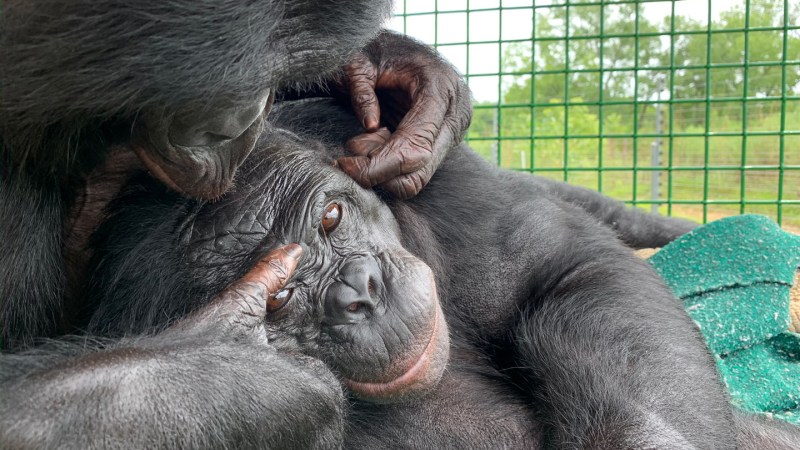
Kanzi Captivates Researchers with Playful Insight (Image Credits: Sciencenews.org)
A bonobo named Kanzi demonstrated an ability to follow imaginary objects during a simulated tea party, offering fresh insights into primate mental capabilities.
Kanzi Captivates Researchers with Playful Insight
Amalia Bastos, a comparative psychologist at the University of St Andrews in Scotland, first encountered Kanzi in 2023. The bonobo, renowned for communicating through lexigrams, quickly drew her attention during casual interactions. Researchers noted his enthusiasm for a pretend chase game, where humans feigned pursuit. This sparked the idea to test more structured make-believe scenarios. Kanzi, raised in a human environment from birth, stood out as one of the last of his kind. He passed away in March 2025, just months after participating in the experiments.
Bastos collaborated with Christopher Krupenye, a psychologist at Johns Hopkins University, to design the tests. They aimed to determine if Kanzi could track objects that existed only in pretense. The setup mimicked everyday social play humans share with children. Such observations challenged assumptions about animal minds.
Tracking Invisible Juice in a Pretend Pour
Experimenters placed two glasses before Kanzi and pretended to pour his favorite juice from an empty, transparent jug into each. They then mimicked pouring the contents of one glass back into the jug. Kanzi received a lexigram prompt to select the glass that still held the “juice.” A control tested his preference between real orange juice and a pretend-filled glass.
Researchers extended the trial to imaginary grapes, repeating the pour-and-return sequence. Kanzi pointed consistently to the correct locations. These tasks required distinguishing pretense from absence. The methods echoed games parents play with toddlers.
- Initial juice test: Pretend pour into two cups, return one.
- Real versus fake: Choose between actual juice and imaginary.
- Grapes variation: Track pretend fruit in cups.
Results Point to Genuine Pretend Understanding
Kanzi selected the correct cup with imaginary juice 68 percent of the time, far exceeding random chance. He chose real juice over pretend nearly 80 percent of the time, confirming he differentiated the two. Performance held steady in the grapes test, where he located the unseen treats reliably. These outcomes addressed concerns about his age-related vision or confusion with real liquid.
Bastos acknowledged potential limitations. She noted Kanzi’s advanced years might impair sight, yet the controls validated his grasp of pretense. The bonobo’s choices aligned with deliberate reasoning rather than guesswork.
Reshaping Views on Primate Imagination
The study, published February 5 in Science, aligns with human developmental milestones. Children begin pretend play around 12 months and construct elaborate fantasies by age 3. Kanzi’s feats suggest apes share this capacity to envision beyond the immediate. Cognitive scientist Cathal O’Madagain, unaffiliated with the research, linked it to tool innovation. He remarked, “You can’t invent a bicycle if you can’t imagine one first.”
Previously, inventive behaviors in apes drew skepticism as mere accidents. These findings invite reevaluation. Bastos plans to replicate the tests with apes lacking Kanzi’s enriched upbringing. Such work could broaden understanding of mental flexibility across species.
Key Takeaways
- Kanzi tracked pretend juice and grapes above chance levels.
- Apes may imagine scenarios outside the present moment.
- Future tests will probe untrained primates.
This bonobo’s playful experiments underscore how thin the line may be between human and ape minds. What do you think about Kanzi’s legacy in animal cognition? Share in the comments.