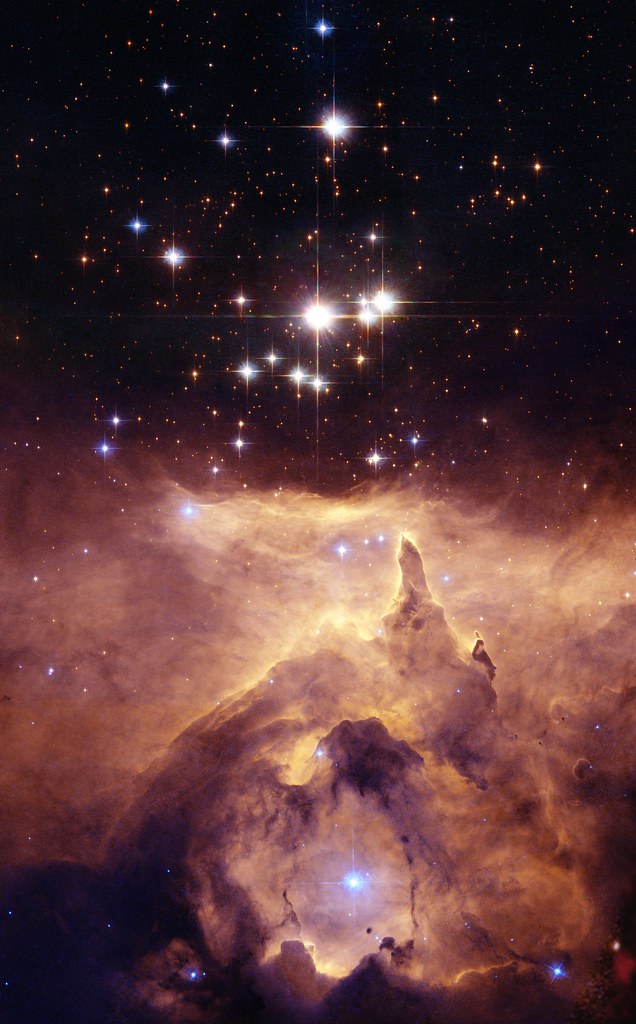
High-Energy Bursts Reveal Hidden Stellar Activity (Image Credits: Flickr)
NASA released a striking composite view on December 22, 2025, that merged X-ray observations from the Chandra X-ray Observatory with infrared data from the James Webb Space Telescope, bringing to life the dynamic heart of the Pismis 24 star cluster.
High-Energy Bursts Reveal Hidden Stellar Activity
Chandra’s observations captured bursts of red, green, and blue lights punctuating the scene, marking high-energy emissions from active young stars.[1]
These twinkling points highlighted processes invisible in infrared alone, showcasing the vigorous radiation and winds sculpting the surrounding environment. Astronomers gained a clearer picture of how massive stars influence their stellar neighborhood. The overlay transformed a serene infrared landscape into a vibrant display of cosmic energy.[2]
Such combinations proved essential for unraveling the life cycles of hot, young stars. Pismis 24 emerged as a prime laboratory for these studies.
Pismis 24: Gateway to Massive Star Formation
Nestled in the core of the Lobster Nebula, also known as NGC 6357, Pismis 24 hosted a thriving stellar nursery just 5,500 light-years from Earth in the constellation Scorpius.[1][3]
This proximity offered one of the closest vantage points on massive star birth. The cluster spanned roughly 9 light-years tall and 6.5 light-years across, filled with infant stars eroding nearby dust and gas through intense outflows.
James Webb’s NIRCam instrument previously unveiled intricate details of this process in September 2025, revealing how radiation carved spire-like structures from cosmic dust.[2]
- Young stars dominate the cluster’s population.
- Massive protostars drive environmental sculpting.
- Dense gas clouds fuel ongoing formation.
- High-energy X-rays trace the hottest objects.
- Infrared penetrates obscuring dust layers.
The Lobster Nebula’s Fiery Core
The Lobster Nebula earned its name from its claw-like appearance in visible light, but infrared and X-ray views exposed its energetic interior. Pismis 24 sat at this center, where conditions favored the birth of heavyweight stars.
Chandra’s data pinpointed sources of X-ray emissions tied to these powerhouses. Such stars evolved rapidly, shedding light on galaxy-wide processes. Researchers valued the region for its clarity in studying stellar properties.
Observations drew from multiple wavelengths, with Webb using filters spanning near-infrared to capture molecular hydrogen and polycyclic aromatic hydrocarbons.
Scientific Synergy Drives New Discoveries
The December 2025 composite built on Webb’s earlier release, processed by experts at NASA’s Chandra X-ray Center and the Space Telescope Science Institute. Credits included contributions from Penn State, SAO, ESA, and CSA.[1]
This teamwork extended astronomers’ reach across the electromagnetic spectrum. X-rays from Chandra complemented Webb’s infrared prowess, revealing complementary layers of activity.
| Wavelength | Telescope | Reveals |
|---|---|---|
| X-ray | Chandra | High-energy star emissions |
| Infrared | Webb NIRCam | Dust structures, protostars |
Future observations promised deeper insights into star evolution.
Key Takeaways
- Pismis 24 offers a nearby window into massive star birth 5,500 light-years away.
- Chandra’s X-rays spotlight active young stars amid Webb’s star-forming vista.
- Combined data enhances understanding of hot star properties and evolution.
As telescopes like Chandra and Webb continue to peer into stellar nurseries, discoveries like Pismis 24 remind us of the universe’s ongoing creativity. The blend of high-energy sparks and sculpted dust underscores the raw power shaping our galaxy. What aspects of this cosmic scene intrigue you most? Share your thoughts in the comments.