Astonishing JWST Revelation Challenges Expectations (Image Credits: Unsplash)
Deep in the early universe, astronomers peered through the James Webb Space Telescope and uncovered an unexpected puzzle: regions around some of the brightest quasars seemed emptier of galaxies than models predicted. Researchers at the University of Arizona traced the phenomenon to powerful radiation from supermassive black holes, which suppressed star formation not only in their host galaxies but also in neighbors millions of light-years distant.[1][2] This revelation reshapes understanding of how galaxies developed together in the cosmos’s infancy.
Astonishing JWST Revelation Challenges Expectations
Early data from the James Webb Space Telescope revealed fewer galaxies clustered around luminous quasars than anticipated. Yongda Zhu, a postdoctoral researcher at the University of Arizona, recalled the team’s initial confusion. “We were puzzled,” Zhu said. “Was the expensive JWST broken?”[2]
Further analysis clarified the mystery. Galaxies within a million light-years of quasar J0100+2802 displayed weaker emissions of doubly ionized oxygen, or O III, compared to their ultraviolet light output. This tracer indicated recent star formation had been curtailed. The effect extended across intergalactic distances, marking the first direct evidence of such widespread influence.[1]
The Mechanism: Radiation’s Distant Reach
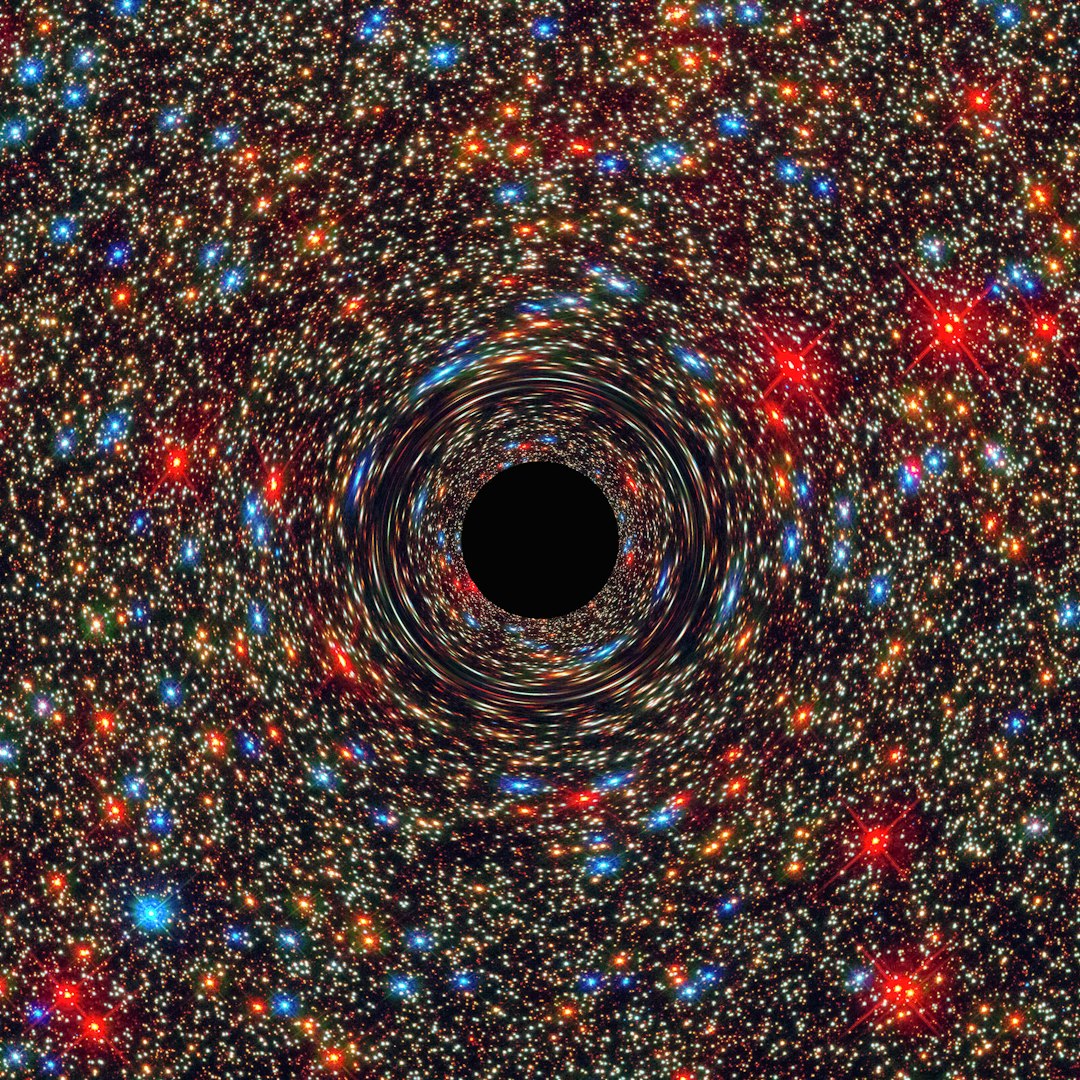
Quasars power up when supermassive black holes gorge on surrounding matter. J0100+2802, observed at redshift z=6.3, draws from a black hole roughly 12 billion times the sun’s mass. Light from this quasar traveled more than 13 billion years, capturing the universe when it was under one billion years old.
The black hole’s feast unleashes intense radiation and heat. This energy splits molecular hydrogen in interstellar gas clouds across nearby galaxies. Without intact hydrogen to coalesce into stars, formation halts. Zhu explained, “Quasars don’t just suppress stars in their host galaxies, but also in nearby galaxies within a radius of at least a million light-years.”[2]
- Radiation ionizes and photodissociates hydrogen gas.
- O III emissions drop while UV continuum persists.
- Effect spans at least one million light-years.
- Suppresses very recent star birth specifically.
- Resolves “missing galaxies” around early quasars.
Interconnected Galaxy Ecosystems Emerge
Astronomers long viewed galaxies as largely independent actors, separated by vast voids. This study upends that notion. Zhu described a “galaxy ecosystem” where active black holes act as dominant predators. “An active supermassive black hole is like a hungry predator dominating the ecosystem,” he noted. “It swallows up matter and influences how stars in nearby galaxies grow.”[1]
The findings appeared in The Astrophysical Journal Letters. Researchers analyzed JWST observations of faint infrared signals, stretched by cosmic expansion. Prior telescopes lacked the sensitivity. This interconnected evolution likely shaped structures like the Milky Way, which may have hosted its own quasar phase.[3]
Broader Ramifications for Cosmic History
Supermassive black holes now emerge as key architects of the universe. Their radiation tempers star growth on scales once deemed improbable. This process explains faint or absent galaxies near early quasars. Galaxy clusters thus co-evolve, bound by these cosmic forces.
Future observations could confirm if the pattern holds across more quasars. Teams plan wider surveys to quantify the phenomenon’s prevalence. Such insights illuminate the Milky Way’s origins and the black holes’ outsized role in the early cosmos.
Key Takeaways
Supermassive black holes wield influence far beyond their gravitational grasp, dictating the pace of stellar nurseries across the void. As cosmic predators, they remind us that the universe thrives on delicate balances. What do you think about these galaxy-shaping forces? Tell us in the comments.