

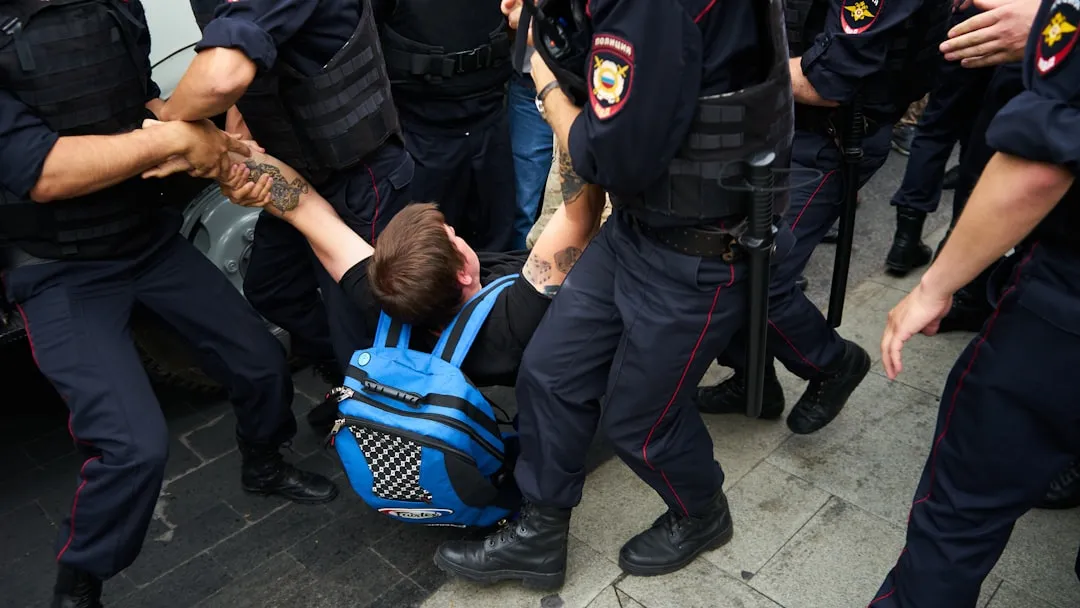
Tens of Thousands Face Immediate Risk (Image Credits: Unsplash)
Washington – The Department of Homeland Security issued a memo on February 18, 2026, empowering immigration agents to arrest and detain refugees legally present in the United States if they fail to adjust their status to permanent residents after one year.[1][2]
Tens of Thousands Face Immediate Risk
Immigration officials now possess authority to pursue refugees nationwide who have resided in the country for more than a year without obtaining green cards. The directive, signed by U.S. Citizenship and Immigration Services Director Joseph Edlow and acting ICE Director Todd Lyons, rescinds previous policies that shielded such individuals from detention.[1][2]
This shift treats refugee admissions as conditional, mandating a one-year review to identify potential security threats, fraud, or criminal issues. Agents must “locate, arrest, and take the alien into custody,” according to the document, with detention lasting through the full inspection process.[1] Officials argue the measure aligns refugee vetting with standards for other immigrants and addresses gaps in prior screening.[2]
Refugees detained under this policy either advance to permanent residency or enter removal proceedings. The change reverses a 2010 guidance that deemed failure to apply for adjustment insufficient grounds for arrest.[3]
The Refugee Green Card Pathway Explained
Refugees arriving in the United States undergo rigorous pre-admission vetting before resettlement. Once here, they gain work authorization and must apply for lawful permanent resident status after at least one year.[1]
Many encounter obstacles, including USCIS backlogs and complex paperwork requirements. Resettlement agencies previously assisted with these transitions, but recent funding cuts have strained support systems.[1] The new memo views non-compliance as a trigger for enforcement rather than an administrative hurdle.
- Pre-arrival: Multi-agency security checks spanning years.
- Post-arrival Year 1: Eligibility for green card application.
- After Year 1: Risk of detention without adjustment under the memo.
- Detention outcome: Re-vetting, residency approval, or deportation proceedings.
Minnesota Emerges as Flashpoint
Federal scrutiny intensified in Minnesota, where authorities targeted about 5,600 refugees without permanent status. ICE arrests there prompted a class-action lawsuit from groups including the International Refugee Assistance Project.[2][3]
U.S. District Judge John Tunheim criticized the actions, stating refugees hold “a legal right to be in the United States, a right to work, a right to live peacefully.” He ordered the release of detained individuals and halted further arrests without warrants pending a hearing.[3] The case highlights tensions in communities like Minneapolis’s Somali neighborhoods.
Outrage from Advocacy Organizations
HIAS CEO Beth Oppenheim condemned the memo as “a transparent effort to detain and potentially deport thousands of people who are legally present in this country.” She noted, “They were promised safety and the chance to rebuild their lives. Instead, DHS is now threatening them with arrest and indefinite detention.”[4][1]
Shawn VanDiver of AfghanEvac called it a “reckless reversal of long-standing policy” that undermines trust in U.S. commitments. Resettlement groups warned of widespread fear, disrupted lives, and shocks to support networks already burdened by delays.[1]
Context Within Trump-Era Reforms
The memo fits a pattern of tightened controls. The administration set fiscal year 2026 refugee admissions at 7,500, the lowest on record, prioritizing certain groups while reviewing cases from the prior administration’s higher intakes of 38,000 in fiscal 2025.[1]
| Policy Aspect | Prior Approach | New Directive |
|---|---|---|
| Status Adjustment Failure | No detention basis | Mandatory arrest and vetting |
| Admission Review | Unconditional post-vetting | Conditional with one-year check |
| Annual Cap (FY2026) | Higher under Biden | 7,500 |
This enforcement push extends to broader initiatives like Operation Parris for case re-examinations.[3]
Key Takeaways:
- The memo affects primarily Biden-era refugees facing backlog delays.
- Courts have intervened in Minnesota, signaling potential nationwide blocks.
- Advocates urge reversal to honor U.S. resettlement pledges.
The directive underscores a rigorous stance on immigration enforcement, balancing security claims against humanitarian protections long afforded to refugees. Communities await further court rulings that could reshape its reach. What do you think about this policy shift? Tell us in the comments.