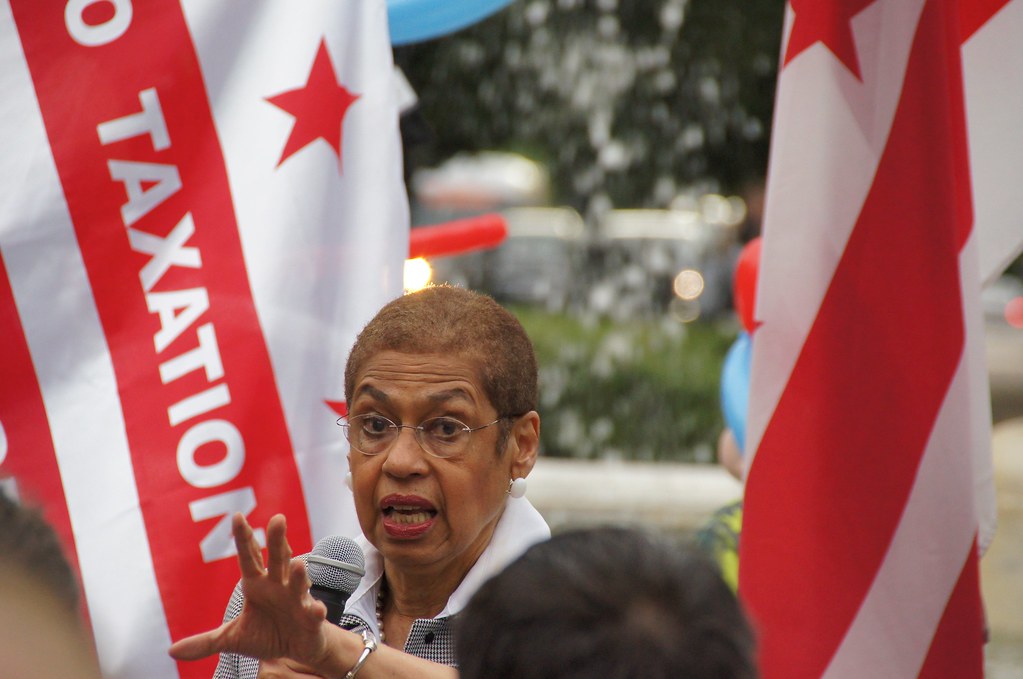


Civil Rights Pioneer Closes a Historic Chapter (Image Credits: Flickr)
Washington, D.C. – Veteran nonvoting delegate Eleanor Holmes Norton filed paperwork Sunday to terminate her reelection campaign, signaling the conclusion of a storied career representing the nation’s capital in Congress.[1][2]
Civil Rights Pioneer Closes a Historic Chapter
The 88-year-old Norton, an 18-term delegate since 1991, embodied Washington’s fight for self-determination. She emerged from the Civil Rights Movement as a key figure, organizing during Mississippi’s Freedom Summer in 1963 and attending the March on Washington that same year. Medgar Evers once picked her up at the airport; tragedy struck hours later with his assassination.
Born and raised in the District, Norton attended its last segregated high school class at Dunbar. She later became the first woman to chair the Equal Employment Opportunity Commission. Her entry into Congress followed her predecessor’s retirement to pursue the D.C. mayoralty. Contemporaries included Rep. Jim Clyburn and the late Reps. John Lewis and John Conyers.[1]
Scrutiny Grows Over Effectiveness in Turbulent Times
Recent months brought mounting pressure for Norton to step aside. Residents and local leaders questioned her capacity amid the Trump administration’s interventions in the city. Federal officials federalized the police force, deployed National Guard troops from six states and D.C., and sent Department of Homeland Security agents into neighborhoods. These actions sparked protests and a lawsuit from the District’s attorney general.[1]
Signs of frailty appeared, with Norton retreating from public events and halting speeches. Reports noted her absence during key announcements and even referenced early-stage dementia concerns after a scam incident. Though she insisted on running again, her campaign raised little funds, and her office issued no statement on the Federal Election Commission filing.[2]
A Legacy of Bold Wins for the District
Norton earned the nickname “Warrior on the Hill” for relentless advocacy. Without a vote on the House floor, she secured bipartisan victories. She drove legislation granting D.C. residents in-state tuition at public colleges nationwide or up to $2,500 grants for private schools.
In the 1990s, she brokered a pivotal deal shifting billions in unfunded pension liabilities to the federal government, resolving the city’s financial crisis. Norton led House passage of D.C. statehood bills twice and championed federal workers’ labor rights. Mayor Muriel Bowser praised her upon the news: “For 35 years, Congresswoman Norton has been our Warrior on the Hill. Her work embodies the unwavering resolve of a city that refuses to yield in its fight for equal representation.”[1]
- Pushed D.C. statehood through the House on two occasions.
- Engineered financial rescue amid 1990s crisis.
- Expanded educational access for residents.
- Defended autonomy against federal overreach.
- Advanced civil rights from EEOC chair to Congress.
Competitive Primary Awaits Her Successor
Norton’s exit clears the path in a heavily Democratic district. Several candidates already declared for the primary, including D.C. Council members Brooke Pinto and Robert White, strategist Kinney Zalesne, and former aide Trent Holbrook. The race promises intensity in a city unaccustomed to Republican wins.
This move aligns with a surge in congressional retirements. More than one in 10 House members opted out of reelection this cycle.[1]
Key Takeaways
- Norton’s 35-year tenure defined D.C.’s congressional voice amid civil rights and home-rule struggles.
- Federal interventions and health concerns fueled calls for her retirement.
- A crowded Democratic primary now shapes the District’s future representation.
Eleanor Holmes Norton’s departure leaves an indelible mark on Washington politics, from Freedom Summer to statehood fights. As the primary unfolds, her legacy prompts reflection on leadership in challenging eras. What do you think her successor must prioritize? Tell us in the comments.