

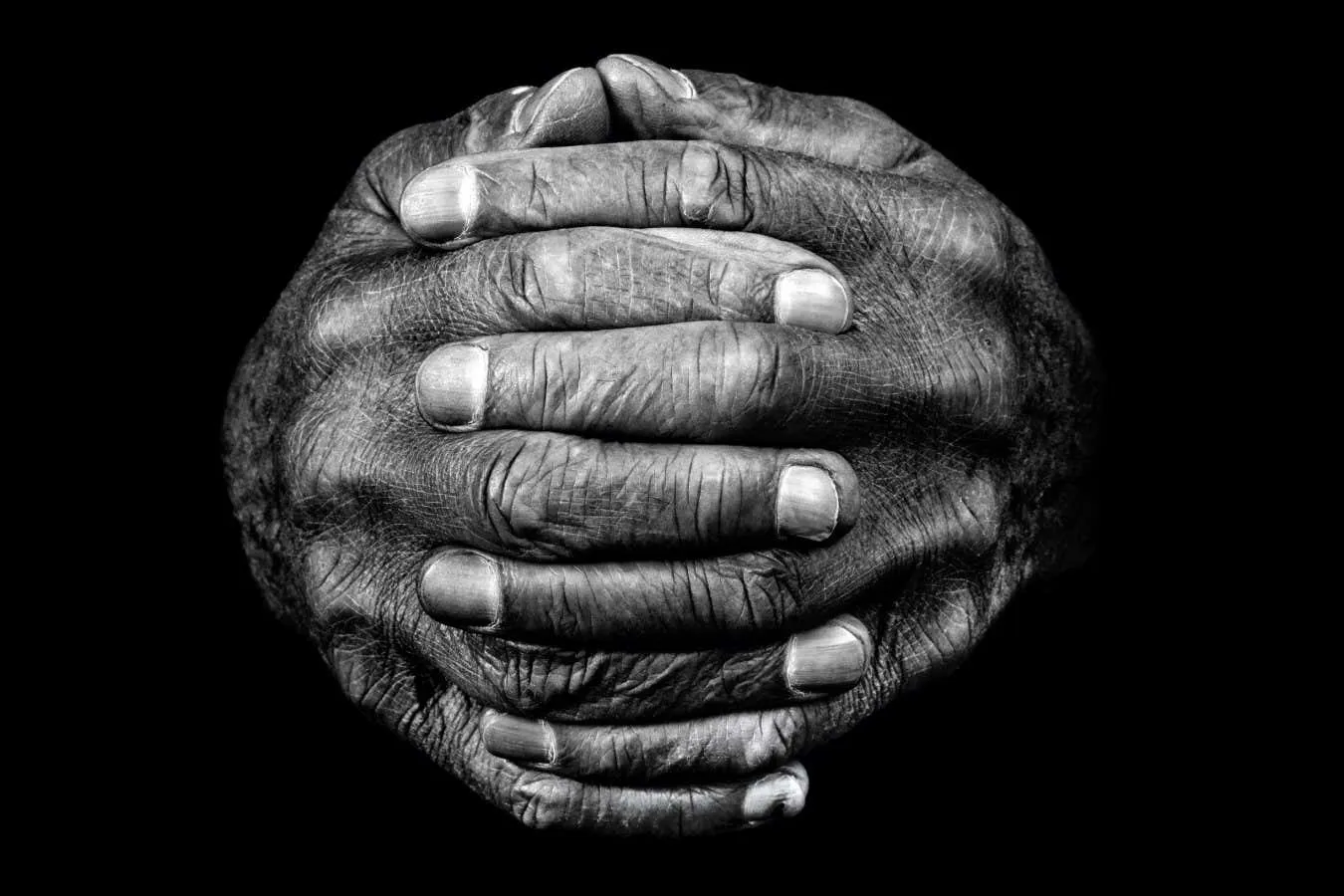
Distinct Traits Set Human Hands Apart (Image Credits: Images.newscientist.com)
Recent fossil discoveries have illuminated the critical role human hands played in our evolutionary ascent, transforming from climbing aids into instruments of innovation.[1][2]
Distinct Traits Set Human Hands Apart
Human hands feature a long, robust thumb relative to shorter, straighter fingers, enabling a precision grip essential for tool manipulation. Chimpanzees and bonobos, by contrast, possess elongated, curved fingers and shorter thumbs optimized for arboreal suspension.[1] This skeletal configuration, combined with powerful muscles like the flexor pollicis longus, allowed independent thumb flexion absent in apes.
“The human hand proportions are really different,” noted Carrie Mongle of Stony Brook University. “We have a really long and a really robust thumb, compared to our fingers.”[2] Such adaptations supported both forceful precision grips and versatile thumb mobility, distinguishing our lineage early on.
Bipedalism Frees the Hands
Charles Darwin anticipated in 1871 that upright walking liberated hands from locomotor duties, paving the way for dexterity. Early 20th-century finds in Tanzania’s Oldupai Gorge yielded Oldowan stone tools from around 2.6 million years ago, prompting Louis and Mary Leakey’s 1964 description of Homo habilis with associated hand bones.[1]
These bones appeared robust and curved, more ape-like than modern human equivalents. Tracy Kivell of the Max Planck Institute observed, “The hand bones actually are really quite robust and the finger bones are still curved… It looks a lot more ape-like.”[2] Despite ambiguities, the discovery highlighted hands’ emerging significance in human origins.
Mosaic Fossils Chart Gradual Change
Australopithecus afarensis, exemplified by the 3.2-million-year-old Lucy skeleton, preserved limited hand elements suggesting intermediate forms. A 2003 composite from Ethiopia’s Hadar site indicated longer thumbs and shorter fingers, though debates persisted over grip efficiency. Later species like Australopithecus sediba (2 million years ago) and Homo naledi (300,000 years ago) displayed hybrid traits: human-like thumbs and wrists alongside curved fingers for climbing.[1]
Ardipithecus ramidus, or “Ardi” from 4.4 million years ago, initially seemed non-ape-like but a 2021 reanalysis aligned it closely with chimpanzee morphology for branch-swinging. These mosaics reflected dual demands of terrestrial bipedalism and arboreal life, evolving stepwise from around 7 million years ago with Sahelanthropus tchadensis.[2]
- Longer, robust thumbs emerged in Australopithecus for basic manipulation.
- Curved phalanges persisted for climbing security.
- Wrist mobility increased, balancing locomotion and dexterity.
- Muscle attachment scars indicated growing grip strength.
Stone Tools Mark a Turning Point
The 2015 discovery of 3.3-million-year-old Lomekwian tools at Kenya’s Lomekwi site predated Homo, implicating Australopithecus makers. These crude implements required minimal precision, aligning with internal bone analyses revealing palm structures for thumb-finger opposition. Oldowan tools followed soon after, associated with both Homo and the flat-faced Paranthropus.[1]
October 2025 brought pivotal Paranthropus boisei hand fossils from Lake Turkana, 2.8 to 1.4 million years old, boasting human-like proportions but enlarged bones for power. This find, detailed by Mongle and colleagues, anchored reconstructions of hand evolution, confirming reduced finger curvature and enhanced thumbs by 3.5 million years ago in the Homo-Paranthropus ancestor.[2]
Broader Impacts on Brain and Culture
Hand evolution intertwined with neural expansion; studies linked thumb length to neocortex growth and refined motor control. Complex tool instruction around 600,000 years ago likely spurred gestural communication precursors to language.
Key Takeaways
- Fossils depict a 7-million-year progression from ape-like climbers to dexterous tool users.
- New Paranthropus hands clarify the Homo lineage’s pivotal adaptations.
- Bipedalism and tools drove feedback loops with brain development.
These revelations affirm Darwin’s foresight while underscoring hands as architects of humanity’s dominance. What aspect of this evolutionary tale intrigues you most? Share in the comments.