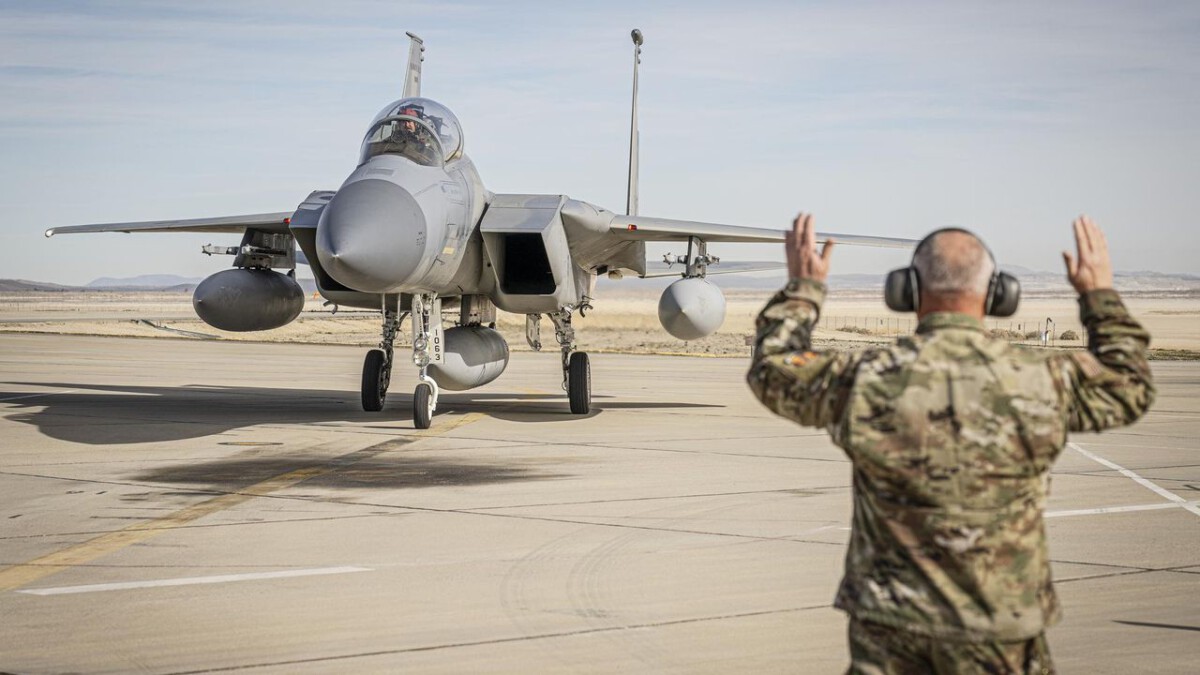
Military Icons Transition to Cutting-Edge Research (Image Credits: Cdn.mos.cms.futurecdn.net)
Edwards, California – NASA recently added two retired F-15 fighter jets to its research arsenal, positioning them as key supporters for the X-59 quiet supersonic aircraft’s ongoing test campaign.[1][2]
Military Icons Transition to Cutting-Edge Research
The U.S. Air Force transferred the F-15s from the Oregon Air National Guard’s 173rd Fighter Wing at Kingsley Field. Pilots delivered the aircraft to NASA’s Armstrong Flight Research Center on December 22, 2025, marking the end of their military service.[1]
One jet will return to active flight status after modifications, while the second provides spare parts for sustained operations. NASA plans to equip the flying F-15 with specialized software, flight controls, and high-altitude life support systems. These upgrades enable safe missions up to 60,000 feet, surpassing typical commercial altitudes.
“These two aircraft will enable successful data collection and chase plane capabilities for the X-59 through the life of the Low Boom Flight Demonstrator project,” stated Troy Asher, director for flight operations at NASA Armstrong.[2]
Chase Planes: Eyes in the Sky for Supersonic Tests
F-15s excel as chase aircraft due to their speed, altitude ceiling, and payload capacity. They carry sensors under wings or fuselage to measure shock wave pressures from the X-59. Specialized Schlieren cameras on board visualize airflow disruptions during supersonic passes.[2]
Operators previously deployed F-15s alongside the X-59 for electromagnetic interference checks and early validation flights. The platform’s versatility supports envelope expansion and acoustic testing phases. NASA has relied on F-15s for research since the early 1970s, hosting dozens of experiments that advanced high-speed aeronautics.
- High-altitude pursuit up to 60,000 feet
- External instrumentation for pressure data
- Schlieren imaging for shockwave visualization
- Software tweaks for mission-specific profiles
- Fleet sustainment through parts sharing
X-59 Takes Aim at Sonic Boom Barriers
Lockheed Martin built the X-59 for NASA’s Quesst mission, which targets quieter supersonic flight over land. The aircraft completed its maiden voyage in October 2025 from Palmdale, California, landing flawlessly at Armstrong after an hour aloft.[2]
Engineers shaped the X-59’s long fuselage and canards to disperse shock waves into a soft “thump” rather than a disruptive boom. It cruises at Mach 1.4 around 55,000 feet, gathering data for regulators on community noise tolerance. Successful validation could lift bans on overland supersonic commercial travel.
A Legacy of Innovation Fuels Future Flights
The F-15 additions extend NASA’s Flight Demonstrations and Capabilities project beyond X-59 tests. They facilitate partnerships with defense entities and aviation firms for broader high-speed research. Modifications mirror those on NASA’s existing F-15 pair, ensuring seamless integration.
Asher emphasized the historical impact: “Dozens of scientific experiments have been flown over the decades on NASA’s F-15s and have made a significant contribution to aeronautics and high-speed flight research.”[1]
Key Takeaways
- F-15s provide essential chase and data roles for X-59’s quiet boom demonstrations.
- One jet flies actively; the other sustains the fleet long-term.
- High-altitude capabilities match X-59’s 55,000-foot envelope.
These repurposed fighters bridge military prowess with civilian innovation, potentially halving transcontinental flight times. What do you think about the prospects for quiet supersonic passenger jets? Tell us in the comments.