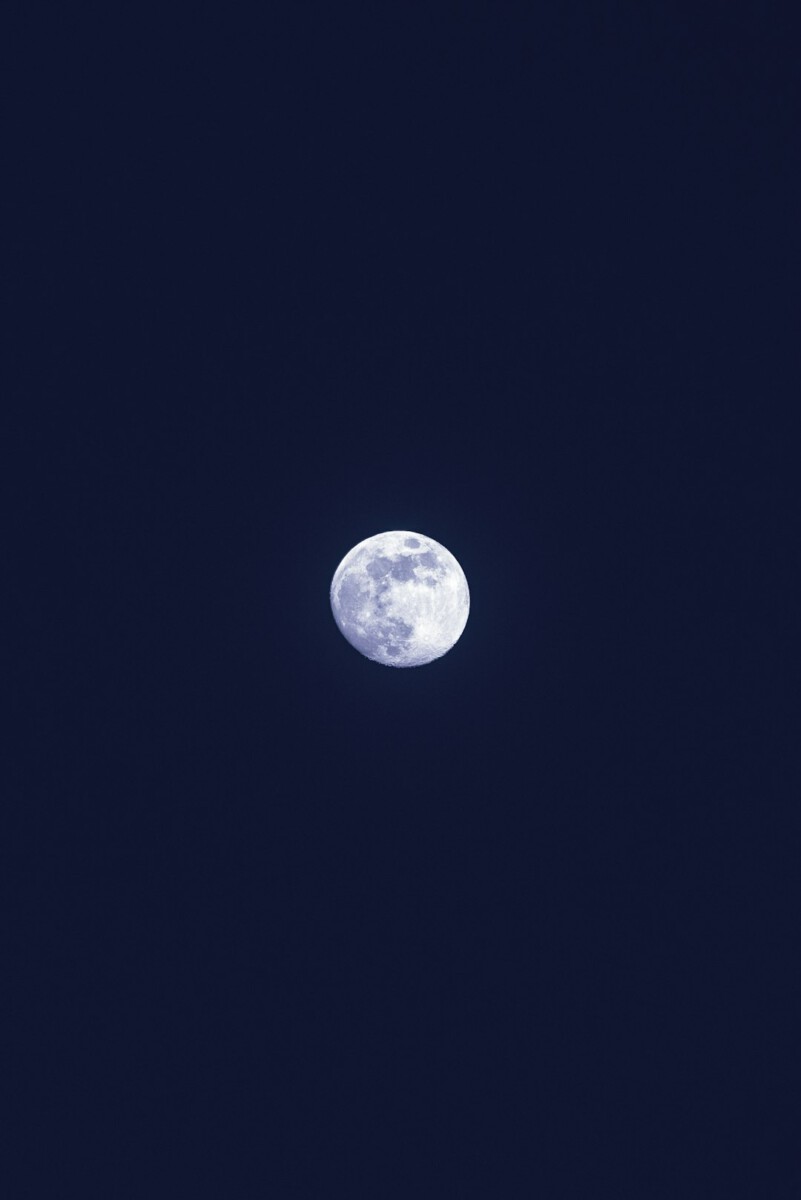
Nearly Full Moon Dances Near Jupiter (Image Credits: Unsplash)
Stargazers across North America can look forward to a vibrant week capped by the Full Snow Moon, featuring close celestial encounters and rewarding targets for binoculars and telescopes.[1]
Nearly Full Moon Dances Near Jupiter
The week begins Friday evening with a striking conjunction as the Moon passes 4° north of Jupiter at 9 P.M. EST. This pair gleams in the heart of Gemini, where the gas giant’s brilliance eclipses even Castor and Pollux.
Early observers will spot the waxing gibbous Moon positioned upper left of Jupiter, visible through much of the night. Meanwhile, northern skies reveal Camelopardalis arching over Polaris. Binoculars uncover Collinder 464, a magnitude 4 open cluster 7° northeast of Alpha Camelopardalis, spanning 2° with brighter stars in its west side.[1]
Saturn and Neptune Draw Exceptionally Close
Saturday highlights a tight planetary duo: Saturn and Neptune separate by just 1.7° in southwestern Pisces, near the Circlet asterism. Around 90 minutes after sunset, they hover 20° above the western horizon before midnight.
Saturn shines at 1st magnitude, easy to find, while magnitude 7.8 Neptune demands a telescope. Center on Saturn’s 16″-wide disk and thin rings tilted 2.2°, with Titan nearby. Slide northeast to Neptune’s 2″ bluish-gray form. Their proximity peaks below 1° by mid-February.[1]
Full Snow Moon Bathes the Skies in Light
Sunday brings the Full Snow Moon at 5:09 P.M. EST, a name rooted in Native American traditions for winter’s snowy cloak. Alternative titles include Storm Moon or Hunger Moon.
Rising at dusk opposite the setting Sun, it floods the night with –12.7 magnitude light – over 250,000 times brighter than Sirius. Binoculars or telescopes reveal details, though sunglasses may help against the glare. Fewer stars pierce the glow, emphasizing the Moon’s dominance.[1]
Monday’s waning gibbous Moon brushes 0.4° north of Regulus in Leo at 10 P.M. EST, rising around 6:45 P.M. local time. Parts of western Africa, the U.S., and Canada witness an occultation from 8:40 P.M. to 10:05 P.M. EST. Check visibility at In-The-Sky.org.[1]
Uranus Halts, Jupiter Hosts a Transit
Tuesday marks Uranus stationary at midnight EST in Taurus, magnitude 5.7 below the Pleiades. Locate it 0.8° southwest of 13 Tauri; its 4″ gray disk distinguishes it in scopes as retrograde motion reverses.[1]
Wednesday evening features Io and its shadow transiting Jupiter after 10 P.M. EST, visible nationwide. The magnitude –2.6 giant sits low right of Gemini’s twins. Io crosses from 10:20 P.M., shadow follows; both exit by 1:15 A.M. Ganymede, Europa, and Callisto frame the scene.
Deep-Sky Targets Shine in Moonless Windows
Thursday offers darker skies before late moonrise for M106, a magnitude 8.4 spiral galaxy in Canes Venatici. From Chi Ursae Majoris, shift 5.5° east; its bright core and uneven arms reward larger scopes.
Friday spotlights M67 in Cancer, 8.3° south-southeast of the Beehive Cluster. This ancient 6th-magnitude group, 3.2 billion years old, spans Full Moon size with dozens of stars and 200 white dwarfs visible in modest instruments.
- Best gear: Binoculars for clusters, telescopes for planets and galaxies.
- Prime times: Evenings post-sunset; check local rise/set for your latitude.
- Locations: Dark sites away from city lights enhance faint objects.
- Weather tip: Clear western horizons for early planetary views.
- Apps: Use sky charts for precise positioning.
Key Takeaways
- Full Snow Moon on Feb. 1 dominates but yields to deep-sky pursuits midweek.
- Planetary highlights include Saturn-Neptune (1.7°), Moon-Jupiter, and Uranus stationary.
- Bonus: Lunar occultation of Regulus and Jupiter’s Io transit add drama.
This week’s sky blends easy naked-eye wonders with telescopic thrills, reminding us of the universe’s constant motion. Grab your optics and step outside – what’s your top event this week? Share in the comments.