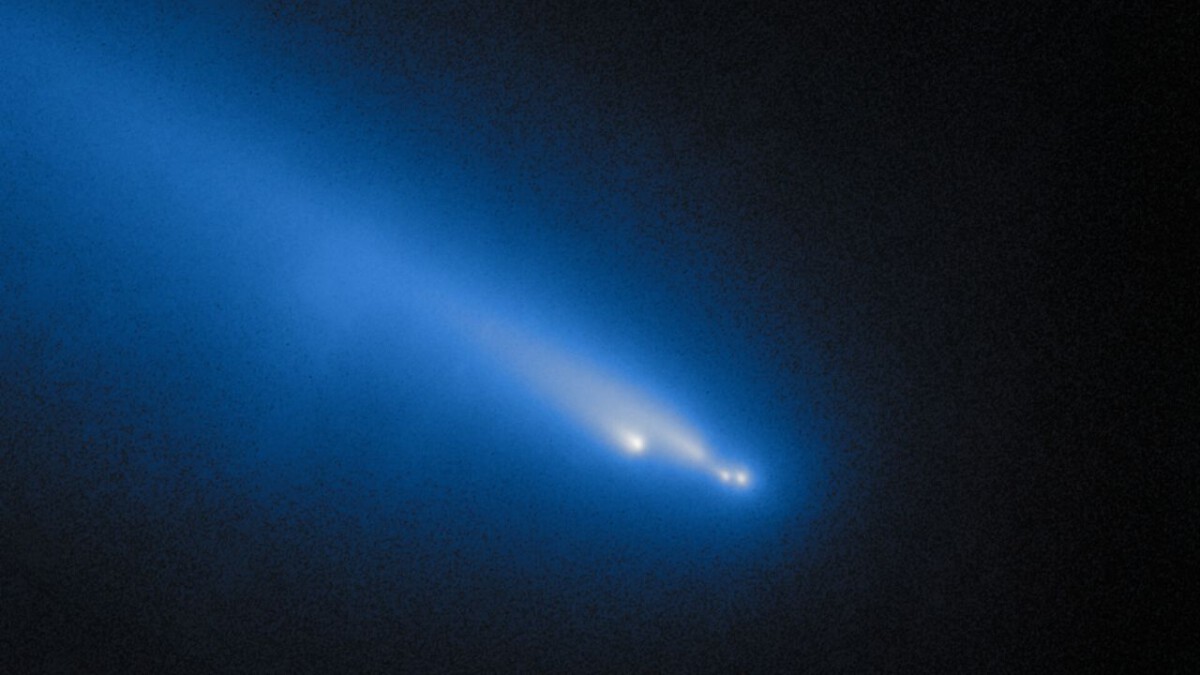
Unexpected Survivor Turns Fragile (Image Credits: Cdn.mos.cms.futurecdn.net)
Astronomers documented the structural failure of Comet C/2025 K1 (ATLAS) as it splintered into visible fragments following its intense brush with the sun.[1][2])
Unexpected Survivor Turns Fragile
Experts had doubted the comet’s endurance after its discovery in May 2025 by the ATLAS survey in Chile. The icy visitor from the Oort Cloud reached perihelion on October 8, 2025, at just 0.334 AU from the sun – closer than Mercury’s average orbit.[2]) Initial recovery on October 18 confirmed survival, but stresses from solar heat and gravity soon took their toll.
Fragmentation signs emerged as early as October 10, reported by observers at Dauban Observatory. An outburst on November 4 propelled material outward, setting the stage for multiple splits. By mid-November, telescopes resolved distinct pieces within the coma.[3]
Clear Evidence from Hawaii’s Skies
Gemini North atop Mauna Kea in Hawaii provided pivotal views on November 11 and December 6, 2025. The images displayed three suspected nuclear fragments, each shifting in brightness, density, and position night to night.[1] This real-time capture highlighted the comet’s instability post-perihelion.
Fragment B appeared first, followed by C, which briefly shone brightest. Amateur and professional scopes worldwide corroborated the scene, with a V-shaped coma replacing the usual round form. Observations from Italy’s Asiago Observatory and others tracked the evolving debris field.[3]
A Rare Golden Hue Signals Unique Makeup
The comet stood out with its golden glow, stemming from a scarcity of carbon-chain molecules like diatomic carbon in the coma. Spectra from Asiago in August 2025 and Lowell Observatory confirmed low levels of CN, CO, and cyanide – rarer than in most comets.[2]) Only two other comets showed similarly depleted compositions.
This chemistry likely influenced its fragility. As ices sublimated rapidly near the sun, internal pressures cracked the nucleus, estimated at 1-2 km across. The result offered scientists a window into Oort Cloud relics rarely seen so intimately.
Further Splits and Ejection Trajectory
James Webb Space Telescope observations in January 2026 detected a secondary breakup on fragment C, advancing understanding of sequential failures.[2]) A fourth piece, D, joined by late November, with all passing Earth around 0.4 AU on November 24.
Fragments A, B, and D maintain hyperbolic paths, destined to exit the solar system. Meanwhile, C nears parabolic. Austrian astrophotographer Michael Jäger captured the progression: “Following brightness surges in early November, we have been able to observe this comet splitting into three brighter fragments for the past two weeks.”[4]
- May 24, 2025: Discovery as faint, diffuse object.
- October 8: Perihelion at 0.334 AU.
- October 10: First fragmentation report.
- November 4: Major outburst.
- November 11-13: Three fragments confirmed.
- January 2026: JWST views secondary split.
Key Takeaways
- Gemini North images pinpoint three fluctuating fragments from November-December 2025.
- Golden appearance ties to carbon-poor ices, accelerating breakup.
- Most pieces will escape solar system on hyperbolic orbits.
Comet C/2025 K1 (ATLAS) reminds us of celestial fragility, where solar proximity turns ancient wanderers to dust. Its observed demise enriches comet science for years. What fragments intrigue you most? Share in the comments.