

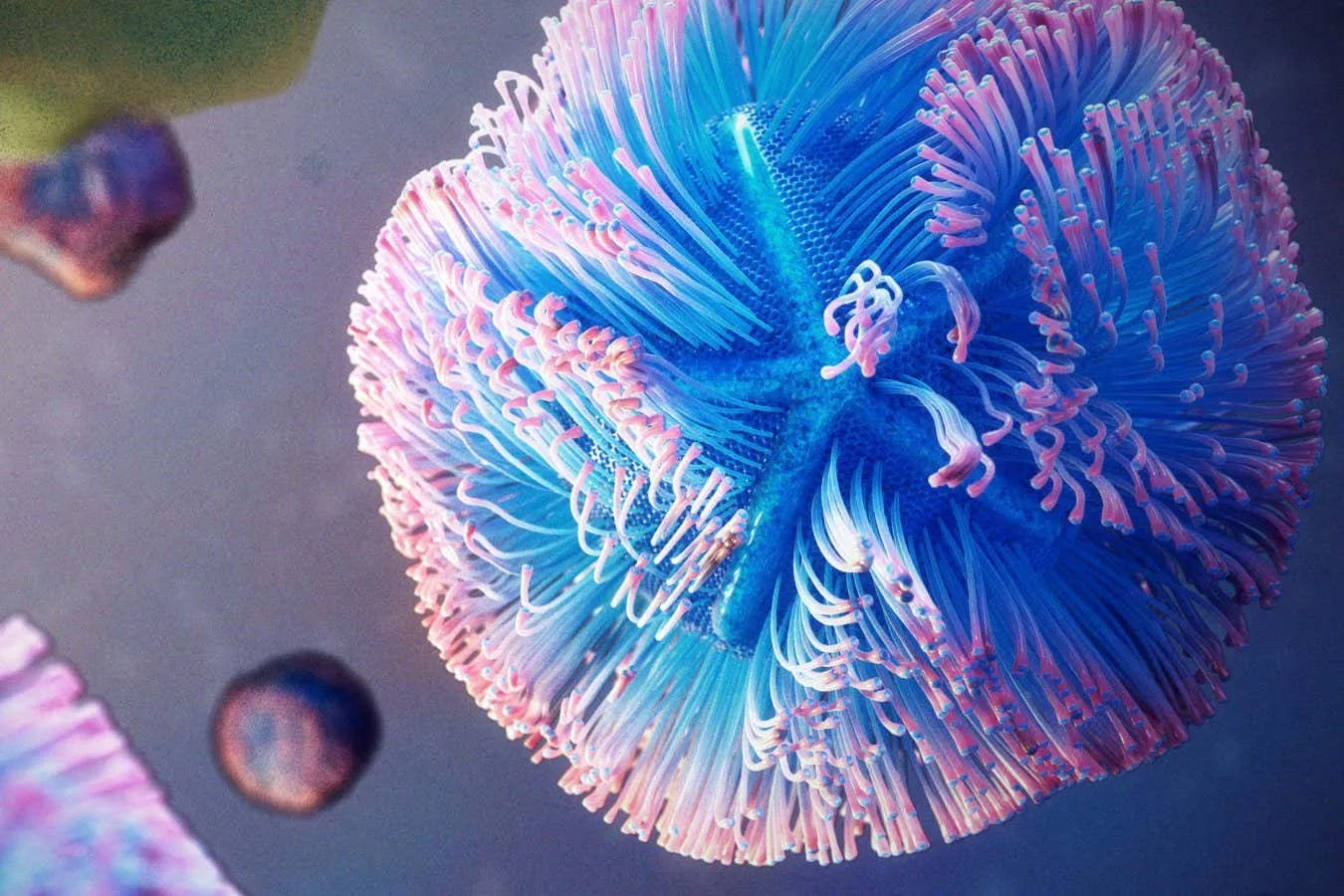
Viral Machinery Rivals Cellular Life (Image Credits: Images.newscientist.com)
Researchers revealed that mimivirus, a massive virus infecting amoebae, carries genes for a key part of the cell’s protein production system, allowing it to dominate its host’s machinery.[1][2]00055-3)
Viral Machinery Rivals Cellular Life
Max Fels at Harvard Medical School led the team that identified viral proteins clinging to host ribosomes in infected amoebae. These proteins formed a complex mimicking the cell’s own translation initiation setup. Knocking out just one gene slashed viral production by up to 100,000 times and crippled new particle formation.[1][2]00055-3)
The discovery stunned virologists. Mimivirus, first spotted in 2003 from a UK cooling tower sample, packs a genome rivaling small bacteria with around 1,000 genes. Many functions puzzled scientists until now. This viral toolkit redirected the amoeba’s ribosomes to churn out viral proteins relentlessly.[1]
Experiments isolated ribosomes from Acanthamoeba castellanii cells eight hours post-infection. Mass spectrometry pinpointed the culprits: viral versions of initiation factors.[2]00055-3)
Breaking Down the vIF4F Complex
Mimivirus encodes three proteins forming the vIF4F complex: vIF4E grabs the mRNA cap, vIF4A unwinds RNA structures, and vIF4G scaffolds the assembly. Crystal structures confirmed their eukaryotic-like folds with viral twists, like specialized cap recognition.[2]00055-3)[3]
This setup launches translation of late-stage viral mRNAs for structural components. Host factors alone failed to compensate in knockouts. The virus even tags its mRNAs with a 2′-O-methyl group at the first adenosine for selective binding.[2]00055-3)
- vIF4E: Binds m7G cap and methylated adenosine specifically.
- vIF4A: Helicase with unique extensions for viral RNAs.
- vIF4G: HEAT-repeat scaffold linking the others.
Such precision ensured efficient protein output despite short, AU-rich viral mRNA leaders.[3]
Dominating the Host Under Stress
Acanthamoeba polyphaga mimivirus targets free-living amoebae in variable environments. The vIF4F complex shone during nutrient shortages, oxidative bursts, or ER stress. Wild-type virus replicated robustly; mutants faltered by one to two logs.[2]00055-3)
Ribosome profiling showed no drop in viral mRNA levels from knockouts. Translation of structural genes like capsid protein L425 plunged instead. Electron microscopy revealed malformed particles in mutants, confirming assembly failures.[3]
Frank Aylward of Virginia Tech noted giant viruses snag host genes via exchange during infection. Natural selection then hones them for unstable protist habitats.[1]
Origins and the Life Debate
How did mimivirus snag this toolkit? Theories split: some see giant viruses as relics of ancient cells; others as gene-raiding escapees. Hiroyuki Ogata of Kyoto University stated, “Viruses have long been considered rather passive entities in the evolution of living systems. This study shows that giant viruses can reshape molecular systems that are otherwise stably conserved across the domains of life.”[1]
The work, detailed in Cell on February 17, 2026, fuels debate on life’s edge. Viruses lack independent metabolism or replication but now command a core life process: translation.[2]00055-3)
| Feature | Host eIF4F | Viral vIF4F |
|---|---|---|
| Cap Binding | Standard m7G | m7G + 2’OMeA |
| Stress Tolerance | Shuts down | Maintains polysomes |
| Essential for Late Genes | No | Yes |
This adaptation hints at viruses shaping eukaryotic translation evolution.[2]00055-3)
Key Takeaways:
- Mimivirus vIF4F replaces host complex for viral dominance.
- Enables replication in harsh amoeba environments.
- Challenges passive virus role in life’s story.
These findings redefine viral prowess and invite scrutiny of life’s fuzzy borders. What boundaries will future discoveries erase? Share your thoughts in the comments.