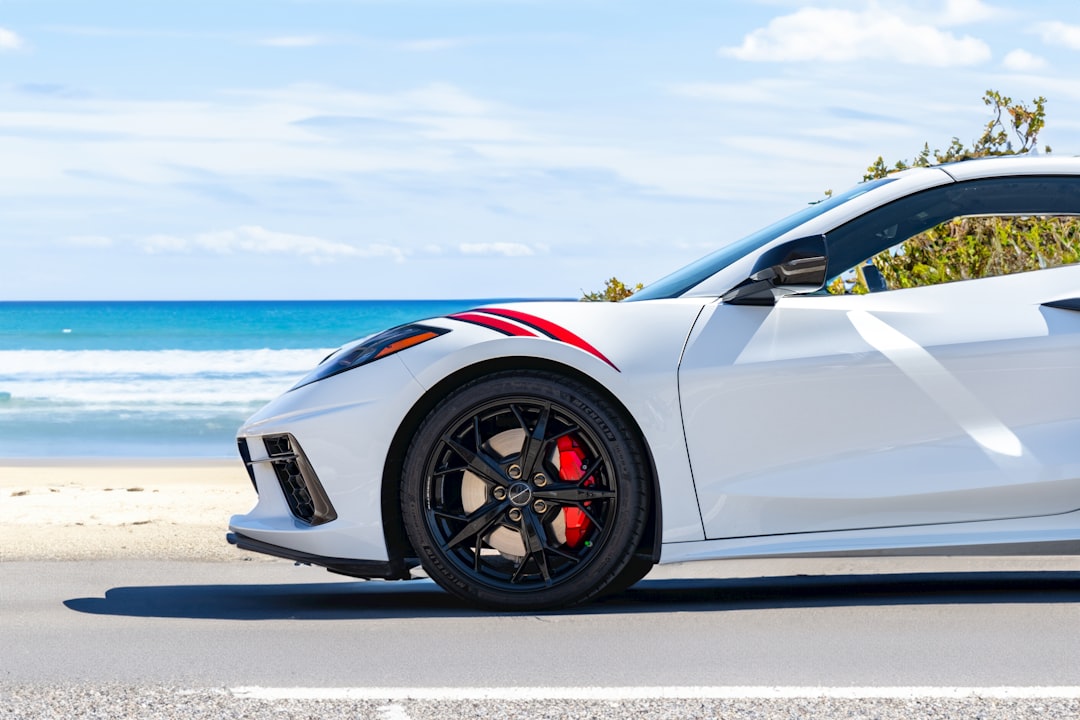
Unleashing the Corvette CX’s Raw Power (Image Credits: Unsplash)
Outside Detroit — General Motors pushed the boundaries of automotive innovation in 2025 with four distinct Corvette concept vehicles. These prototypes emerged from global design studios amid rising electric vehicle adoption and intensifying global competition. Designers crafted them to explore electrification, aerodynamics, and driver experiences for the iconic sports car brand, first introduced in 1953.
Unleashing the Corvette CX’s Raw Power
The Corvette CX stands as a pinnacle of engineering ambition, boasting 2,000 horsepower from four individual electric motors. Its ultralight carbon fiber chassis supports both street and track performance, while wind-tunnel-inspired fans channel air through open bodywork. An adjustable rear spoiler adapts in real time to maintain stability during high-speed maneuvers. The roof mechanism lifts with robotic precision, evoking a fighter jet cockpit.
Teams of hundreds invested three years in this all-electric hypercar, drawing from GM’s substantial resources. Phil Zak, executive design director for Chevrolet, described it as a conceptual project rather than a direct preview of production models. Still, its influence extends to the anticipated ninth-generation Corvette, or C9, expected around 2029. Zak called the CX a “spiritual guide” for future interior and exterior development.
Global Studios Reshape an American Icon
GM enlisted studios in England, California, and Michigan to reimagine the Corvette for an electrified, autonomous era. The UK team produced a Batmobile-esque electric version with sharp lines and bulbous fenders. Pasadena designers crafted a sleek, snake-like racer with street vibes. Alongside the CX, a hybrid V8 twin-turbo variant emerged, co-branded with the Gran Turismo video game and featuring a vivid yellow racing livery.
These concepts diverged subtly in contours, materials, and even simulated engine sounds, testing diverse paths forward. Past Corvette prototypes from 1992, 2002, and 2009 similarly shaped production generations, introducing features like rearview cameras and carbon fiber components. The 2009 Stingray even starred in a Transformers film, amplifying brand appeal. Each remains a drivable, one-off testament to costly research and development.
- UK studio: Electric muscle car with aggressive nose and smooth canopy.
- Pasadena: Snakelike profile for urban racing aesthetics.
- Detroit CX: Jet-like hypercar with active aerodynamics.
- CX-R: Hybrid racer for virtual and real-world tracks.
From Historic Roots to Modern Workshops
Concept cars trace back to the 1938 Buick Y-Job, GM’s first, crafted by design pioneer Harley Earl on a modified Buick chassis. It featured hidden headlights, electric windows, and flush handles, setting aerodynamic standards by the 1940s. Earl drove it daily, logging over 25,000 miles to gauge public reactions organically. Unlike today’s isolated prototypes, it served as both testbed and company vehicle.
GM’s expansive Design West facility, opened in 2024, now centralizes creation under one roof. Mechanics hand-build vehicles like the Cadillac Elevated Velocity concept, complete with deployable steering wheels for autonomous modes. Bryan Nesbitt, GM’s senior vice president of global design, emphasized in-house fabrication’s efficiency and secrecy benefits. “The flexibility of having this all in one place gives us operational efficiency,” he stated. Suppliers gain early insights into future needs, from carbon fiber suspensions to innovative doors.
Physical Prototypes in a Digital Age
Auto shows once spotlighted concepts, but rising costs and digital media have shifted focus to production vehicles. Raphael Zammit, an automotive design professor, noted their declining return on investment. GM adapts by blending physical builds with digital tests, like Buick’s virtual Electra Orbit for China. Michael Simcoe, former design chief, highlighted the irreplaceable “visceral reaction” of tangible prototypes before his 2025 retirement.
Chinese rivals like BYD and Geely challenge incumbents with EV advances and state backing. GM counters by leveraging heritage brands amid U.S. policy uncertainties. Nesbitt warned, “If you don’t create the beacon, you just spin and spin and spin.” Physical models refine ideas beyond screens, as seen when designers roof-chopped a Cadillac concept for better executive views, sparking further evolution.
Key Takeaways
- 2025 Corvette concepts test electrification for the muscle car legacy.
- In-house facilities accelerate from sketch to drivable prototype.
- Physical builds provide essential feedback in an AI-driven design world.
GM’s Corvette concepts illuminate paths through industry turbulence, blending tradition with bold experimentation. They promise not just faster cars, but smarter manufacturing and engaging experiences. What role will these visions play in your next drive? Share your thoughts in the comments.