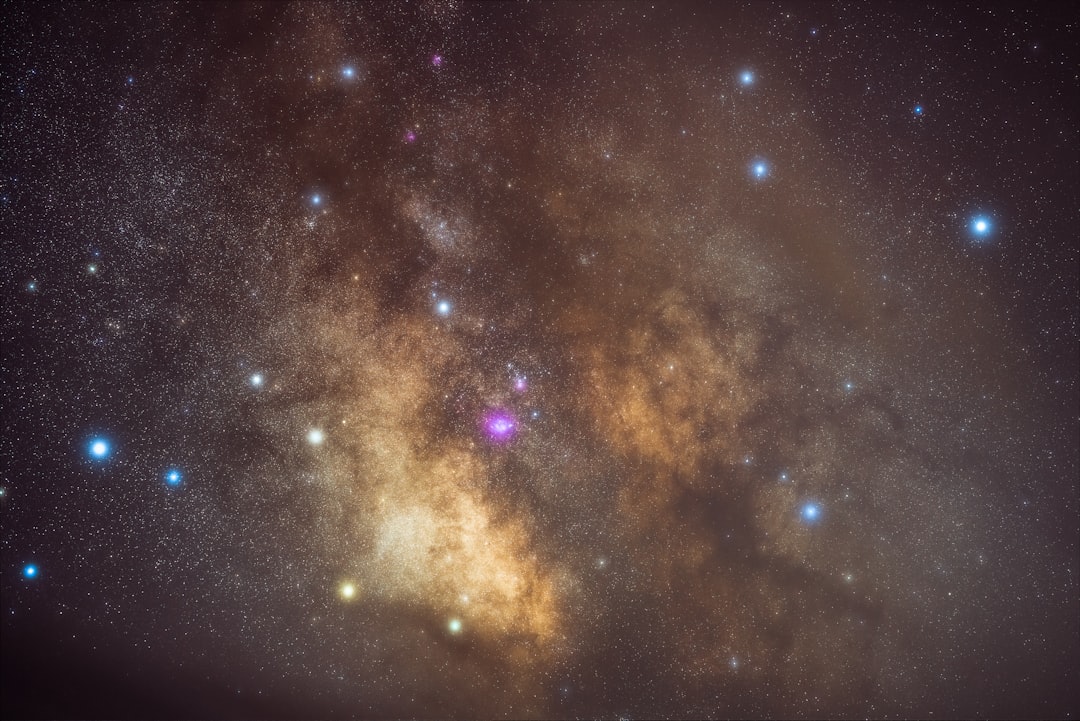
A Hidden Realm Exposed (Image Credits: Unsplash)
NASA’s James Webb Space Telescope recently delivered breathtaking near-infrared views of Sagittarius B2, the Milky Way’s most prolific molecular cloud and star nursery.[1][2]
A Hidden Realm Exposed
Located roughly 27,000 light-years from Earth, Sagittarius B2 sits a few hundred light-years from the supermassive black hole Sagittarius A* at our galaxy’s heart. Dust and gas long blocked optical telescopes from probing this dense region, but JWST’s infrared capabilities cut through the veil.[1]
These observations unveiled massive young stars enveloped in warm dust, along with over a dozen previously undetected pockets of ionized hydrogen. The images highlight how infrared wavelengths reveal structures invisible to earlier instruments. Researchers now see dense clouds birthing successive generations of stars. Such clarity marks a leap in exploring the galactic center’s dynamics.
The Might of Massive Stars
Massive stars dominate their surroundings with extreme surface temperatures that unleash intense ultraviolet radiation. This radiation strips electrons from nearby hydrogen atoms, creating glowing ionized zones. Their powerful stellar winds carve and sculpt the interstellar medium.[1]
Yet these giants consume nuclear fuel at a furious rate, enduring brief lifetimes before exploding as supernovae. Their rarity underscores their pivotal role in galactic evolution. In Sagittarius B2, JWST captured these behemoths in action, surrounded by the chaos they foster.
Sagittarius B2 Versus the Central Molecular Zone
The Central Molecular Zone spans 1,500 light-years and harbors 80 percent of the Milky Way’s dense gas. Despite this abundance, it generates only 10 percent of the galaxy’s stars. Sagittarius B2, by contrast, measures just 150 light-years across but drives nearly half the zone’s star production.[1]
| Region | Size (light-years) | Dense Gas Share | Star Production Role |
|---|---|---|---|
| Central Molecular Zone | 1,500 | 80% | 10% of galaxy stars |
| Sagittarius B2 | 150 | N/A | ~50% of CMZ stars |
Sgr B2 churns out stars at a rate equivalent to 4 solar masses per century, roughly 8 to 10 new stars. Its dense clouds resist disruption, fostering efficient formation. A sharp eastern boundary hints at a supernova shockwave that recently ignited this frenzy.
Fresh Insights and Lingering Questions
Principal investigator Adam Ginsburg of the University of Florida noted, “Webb’s powerful infrared instruments provide detail we’ve never been able to see before. It will help us unravel mysteries of massive star formation and why Sagittarius B2 is so active.”[1]
Lead author Nazar Budaiev added, “For everything new Webb shows us, there are new mysteries to explore.” The data suggest Sgr B2 might only now be ramping up its star-making phase. These findings illuminate processes in extreme environments akin to those in early universe galaxies.[3]
- Over a dozen new ionized hydrogen regions spotted.
- Warm dust cocoons around young massive stars.
- Dense, resilient clouds enabling multi-generational star birth.
- Potential supernova trigger at the cloud’s edge.
- Implications for star formation 3.5 billion years after the Big Bang.
Key Takeaways:
- JWST’s infrared eyes pierce dust to expose hidden stellar activity in Sgr B2.
- Massive stars’ UV and winds shape the galactic core’s future.
- This region punches above its weight, fueling half the CMZ’s stars.
These JWST revelations reshape views of our galaxy’s core, bridging local phenomena to cosmic history. As astronomers decode Sgr B2’s secrets, they gain tools to probe distant star factories. What surprises might the next images bring? Share your thoughts in the comments.