

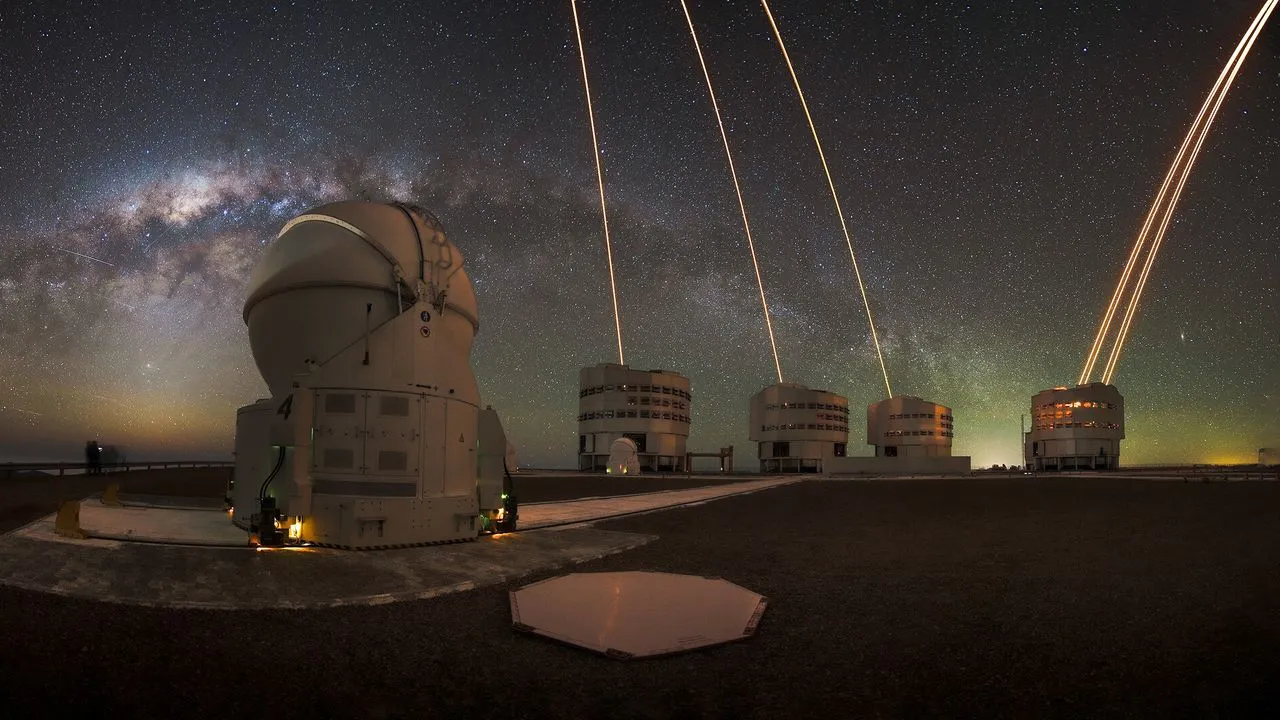
Transforming Turbulent Skies into Crystal-Clear Windows (Image Credits: Cdn.mos.cms.futurecdn.net)
Chile’s Atacama Desert – Vibrant laser beams streaked across the night sky above Paranal Observatory, summoning artificial stars to aid astronomers in their quest for clearer cosmic visions.[1]
Transforming Turbulent Skies into Crystal-Clear Windows
Astronomers at the European Southern Observatory’s (ESO) Very Large Telescope (VLT) fired powerful lasers skyward, creating pinpoint artificial stars that rival natural ones in brightness. These beams pierced the darkness, arcing gracefully against the backdrop of the Milky Way. The display not only captivated observers but also served a critical purpose in overcoming Earth’s atmospheric distortions.[2]
The technology sharpened telescope views dramatically. Without it, air turbulence blurred distant starlight much like heat haze warps road views on hot days. Operators activated the system during observations, ensuring precise data collection from faint celestial objects.
The Ingenious Science of Laser Guide Stars
Each laser, a 22-watt sodium beam, targeted a thin layer of sodium atoms about 90 kilometers above the surface. Excited by the light, these atoms fluoresced, forming bright guide stars visible to the telescope’s adaptive optics systems.[3][4]
The VLT deployed four such lasers simultaneously through its Four Laser Guide Star Facility (4LGSF). This setup allowed coverage of a wide sky area, essential for studying diverse targets. Deformable mirrors then adjusted in real-time, compensating for atmospheric ripples thousands of times per second.
- Excites sodium in mesosphere to mimic natural guide stars.
- Enables high-resolution imaging over larger fields.
- Boosts VLT’s ability to resolve exoplanets, galaxies, and nebulae.
- Reduces reliance on rare bright natural stars near observation targets.
- Operates nightly under Paranal’s exceptionally dry, dark conditions.
Paranal Observatory: Ground Zero for Groundbreaking Astronomy
Nestled in Chile’s arid Atacama Desert, Paranal hosted the VLT’s four 8.2-meter Unit Telescopes since their debut in the early 2000s. The site’s altitude of over 2,600 meters and minimal light pollution provided ideal viewing.[2]
ESO staff captured the laser spectacle recently, highlighting ongoing operations. The beams converged dramatically, drawing eyes upward in a symphony of science and beauty. Such images underscored the observatory’s role in discoveries from black holes to distant supernovae.
Why This Tech Revolutionizes Stargazing
Laser guide stars extended the VLT’s reach to nearly any sky position, unlike traditional methods limited by natural stars. This innovation multiplied effective observation time and precision. Recent upgrades further enhanced beam power and stability.[5]
Astronomers worldwide relied on these tools for breakthroughs. The system proved indispensable for instruments like NACO and MUSE, delivering data that reshaped our cosmic understanding.
Key Takeaways
- Laser guide stars correct atmospheric distortion for razor-sharp images.
- Four 22-watt beams create stars at 90 km altitude from Paranal, Chile.
- Boosts VLT’s discoveries in exoplanets, galaxies, and more.
These artificial stars bridged human ingenuity and the universe’s vastness, proving technology’s power to unveil hidden wonders. What strikes you most about this cosmic light show? Share your thoughts in the comments.