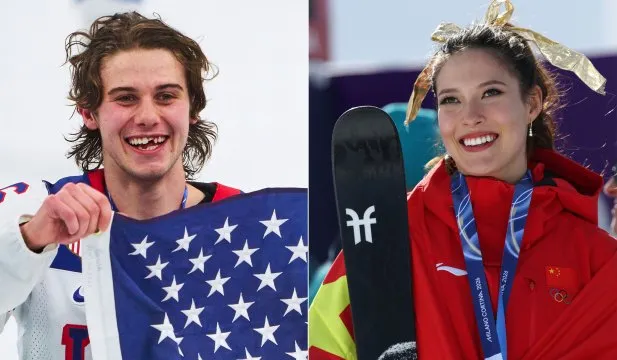
Jack Hughes Seals USA’s Hockey Triumph (Image Credits: I0.wp.com)
The closing days of the 2026 Milan-Cortina Winter Olympics showcased extraordinary athletic feats that extended beyond the slopes and ice, igniting conversations about allegiance and identity.
Jack Hughes Seals USA’s Hockey Triumph
Team USA captured its first men’s ice hockey gold medal since 1980 when Jack Hughes scored just 1:41 into overtime against Canada, securing a 2-1 victory in a tense final.
Hughes endured a high-stick incident that cost him two front teeth earlier in the game, yet he returned to deliver the decisive goal.
Bloody-mouthed and triumphant, he draped himself in the American flag during celebrations, dedicating the win to fallen teammate Johnny Gaudreau.
“This is all about our country,” Hughes declared afterward. “I love the USA. I love my teammates.”
Eileen Gu’s Repeat Glory in Freeski Halfpipe
California native Eileen Gu defended her Olympic halfpipe title for China, earning gold with a flawless final run that included massive airs and technical spins.
The victory marked her third medal at these Games and solidified her as freeskiing’s most decorated Olympian with multiple golds.
China swept the podium’s top two spots, underscoring Gu’s pivotal role in the nation’s freestyle program.
Gu has long navigated scrutiny over her decision to represent her mother’s homeland rather than her birthplace, focusing instead on personal achievement and sport’s universal appeal.
Contrasting Symbols of Loyalty
Hughes embodied straightforward national pride, his flag-waving jubilation resonating with fans who view sports as a celebration of shared heritage.
Gu represented a more fluid approach, prioritizing individual opportunity across borders in a globalized era.
These images – one athlete bloodied yet beaming under stars and stripes, the other soaring under a different flag – captured a familiar American divide.
Discussions erupted online and in media, pitting rooted patriotism against cosmopolitan flexibility.
Patriotism’s Enduring Pull in Global Sports
The Olympics traditionally amplify national fervor, with athletes channeling collective spirit amid international competition.
Hughes’ team forged unbreakable bonds through trials, honoring a lost comrade and rallying under one banner.
Gu’s choice highlighted how modern athletes weigh family ties, training resources, and personal goals when selecting representation.
Yet the Games themselves affirmed nationalism’s vitality, as crowds cheered flags and anthems with unyielding passion.
- Hughes’ overtime heroics ended a 46-year U.S. hockey drought against rivals Canada.
- Gu’s gold extended her dominance, blending American upbringing with Chinese support.
- Both victories drew millions, but sparked debates on what “representing” truly means.
- Hockey’s physicality mirrored Hughes’ commitment; halfpipe’s creativity echoed Gu’s versatility.
- Team USA’s unity contrasted Gu’s solo transcendence of borders.
Key Takeaways:
- National loyalty remains a powerful motivator in elite sports.
- Athletes’ choices reflect broader tensions between tradition and globalization.
- Olympic triumphs remind us that shared identity fuels extraordinary performance.
As medals dim and arenas empty, Jack Hughes and Eileen Gu leave a legacy that transcends scores: a prompt to consider whether allegiance binds us inescapably or bends to choice. What defines loyalty in your view? Share in the comments.