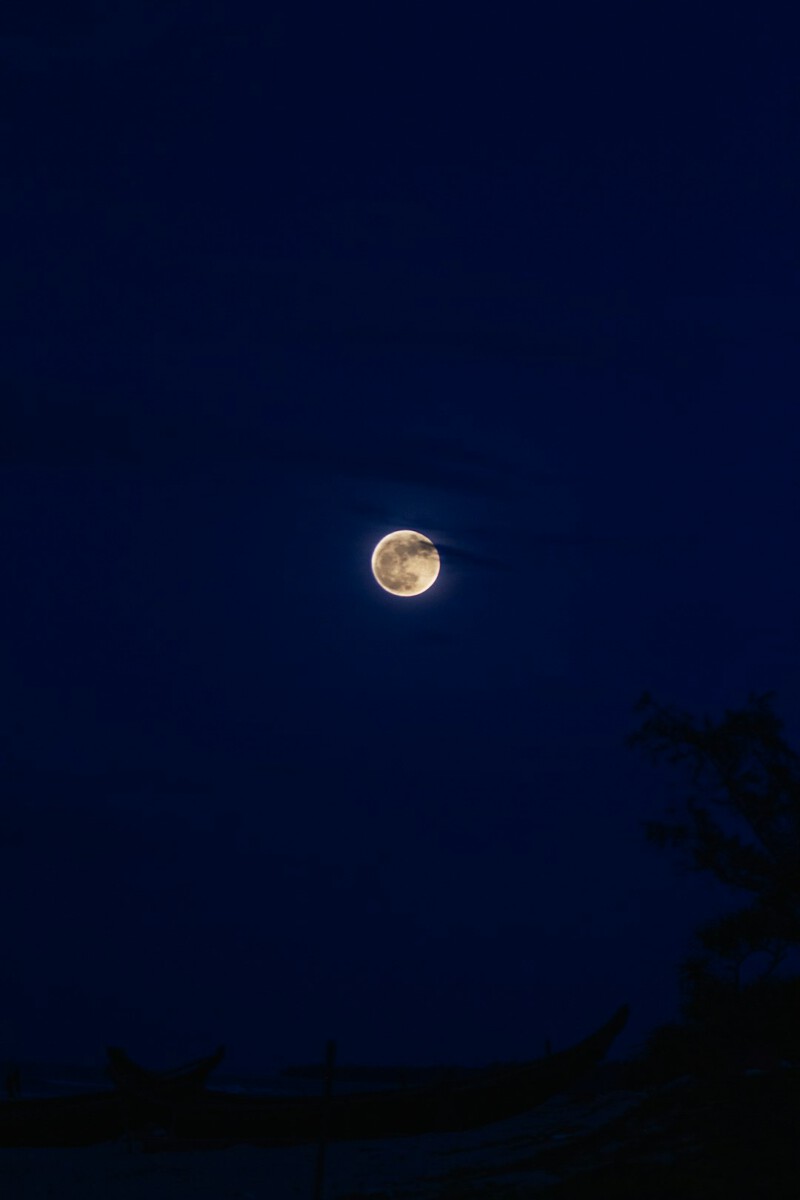
Moon’s Cluster Close-Up and Venus’ Evening Glory (Image Credits: Unsplash)
Stargazers mark your calendars for a week rich in celestial wonders as April dawns. Tonight, March 27, the Moon drifts near the Beehive Cluster in Cancer, offering a striking view around midnight Eastern time.[1] Venus commands the western sky after sunset, its brilliance undimmed as it lingers high. The highlight arrives April 1 with the Full Pink Moon rising in Virgo, bookended by planetary displays and stellar clusters that promise memorable nights under the stars.
Moon’s Cluster Close-Up and Venus’ Evening Glory
The action begins Friday, March 27, when the Moon skirts the edges of the Beehive Cluster, also known as M44, in the constellation Cancer. Positioned due north of the cluster’s heart around midnight Eastern time, this open star cluster resembles a swarm of bees through binoculars or a small telescope.[1]
Earlier that evening, Venus steals the show low in the west. Nearly 20 degrees above the horizon at sunset, the planet remains visible until around 9 p.m. local daylight time, glowing at magnitude –3.9. Telescopes reveal its nearly fully illuminated disk, spanning 11 arcseconds and sitting 1.58 astronomical units from Earth. At 75 percent illuminated, the waxing gibbous Moon adds to the spectacle.
Stellar Neighbors: From Corvus to Regulus and Vega
Saturday, March 28, spot the constellation Corvus the Crow opposite the Sun, visible all night. Around 10 p.m., it rises 20 degrees high in the southeast, positioned below the larger Virgo.[1] The Moon reaches 84 percent illumination, enhancing the scene.
On Sunday, March 29, the Moon passes just 0.3 degrees north of Regulus, Leo’s brightest star, at 4 p.m. EDT. By nightfall, it sits 3.5 degrees east of this magnitude 1.4 beacon on the ecliptic, forming part of the Sickle asterism. Monday, March 30, brings Vega in Lyra above the northeastern horizon by midnight, shining at magnitude 0.0 as part of the future Summer Triangle. The Moon nears full at 96 percent.
Unveiling Monoceros and the Pink Moon’s Rise
Tuesday, March 31, turns attention to Monoceros east of Orion. After dark, find it upper left of Orion’s Belt around 9 p.m. local time. The Great Bird Cluster, NGC 2301, glows at 6th magnitude, spanning 12 arcminutes with 80 stars, located 16 degrees southeast of Betelgeuse and 5.1 degrees northwest of Delta Monocerotis.[1]
Wednesday, April 1, delivers the Full Pink Moon at 10:12 p.m. EDT, nestled in Virgo. This traditional name evokes spring wildflowers rather than color. Nearby, the double star Izar in Boötes, 10.3 degrees northeast of magnitude –0.1 Arcturus, splits into 3rd- and 5th-magnitude components 3 arcseconds apart.
Jupiter’s Moons and Mercury’s Dawn Debut
Thursday, April 2, Jupiter hovers west of Gemini’s heads, Castor and Pollux. Ganymede’s shadow crosses the planet starting an hour before 11 p.m. EDT, lasting until after 1:22 a.m. EDT. At 11:30 p.m., Europa passes north of Callisto, 7 arcseconds apart, with Ganymede and Io west, Europa east of Callisto.[1]
Friday, April 3, Mercury hits greatest western elongation at 28 degrees from the Sun at 7 p.m. EDT. Rising around 5:45 a.m., it shines at magnitude 0.4 in Aquarius, 4 degrees high pre-sunrise with an 8-arcsecond, half-lit disk. Faint Mars lurks 9.1 degrees northeast at magnitude 1.3, barely 1 degree up. The Moon wanes to 96 percent.
Key Takeaways
- Prime viewing: Full Pink Moon April 1 and Mercury pre-dawn April 3.
- Binocular boosts: Beehive Cluster, NGC 2301, and Jupiter’s moons.
- Evening favorites: Venus now, Jupiter transits later.
This week’s skies blend lunar beauty, planetary prowess, and deep-sky delights into an accessible astronomy feast. Clear nights invite all observers, from city dwellers with binoculars to rural telescope enthusiasts. What catches your eye first this week? Share your sightings in the comments.