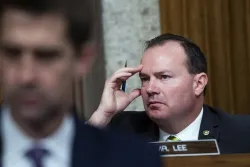
Hardliners Lead Charge on SAVE Act Passage (Image Credits: Assets.realclear.com)
Washington – Senate Republicans grappled with internal divisions this week over potential changes to filibuster rules to advance a bill mandating proof of citizenship for federal elections.[1][2]
Hardliners Lead Charge on SAVE Act Passage
Senator Mike Lee spearheaded efforts to revive the “talking filibuster,” a tactic requiring opponents to hold the Senate floor through continuous speeches.[1] This approach aims to exhaust Democrats and allow the Safeguard American Voter Eligibility Act, or SAVE Act, to proceed on a simple majority vote.
The legislation, which cleared the House earlier this month, demands documentary proof of U.S. citizenship—such as a passport or birth certificate—for voter registration in federal races.[3] It also imposes photo ID requirements for in-person voting and stricter rules for mail-in ballots. Proponents argue these measures prevent noncitizen voting and bolster election integrity ahead of the midterms.
Lee, the bill’s chief Senate sponsor, urged colleagues during a closed-door lunch to pursue this strategy.[1] Senators Josh Hawley and Ted Cruz voiced support, with Hawley declaring himself a “fan of the talking filibuster, especially as Democrats have proven more and more obstructionist.”[1] Cruz called it “exactly what we should do.”[1]
Trump Amplifies Pressure from the Outside
President Trump intensified the debate with a social media post insisting the SAVE Act pass “one way or the other,” even referencing a “Talking Filibuster, à la ‘Mr. Smith Goes to Washington.'”[4] His endorsement galvanized House conservatives, who claimed Senate assurances before passage.
Trump framed the bill as essential to counter alleged voter fraud, warning Republicans would “never lose a race” with such safeguards in place.[5] Critics, however, labeled it voter suppression that could sideline millions lacking easy access to required documents.
GOP Leadership Sounds Alarm on Risks
Senate Majority Leader John Thune expressed doubts, noting the tactic could consume weeks of floor time and invite unlimited Democratic amendments.[1] “Nobody knows” how it would unfold without upending the Senate’s agenda, he said.
Senators Thom Tillis, John Curtis, and Kevin Cramer also opposed skirting the current 60-vote threshold, fearing it erodes institutional protections.[2] Tillis warned of broader consequences, while Curtis prioritized safeguarding Senate norms. At least 50 Republicans back the SAVE Act, but procedural hurdles persist without unified support for reform.[3]
| Senator | Stance on Talking Filibuster |
|---|---|
| Mike Lee (R-Utah) | Strong advocate |
| Josh Hawley (R-Mo) | Supports |
| Ted Cruz (R-Texas) | Endorses |
| John Thune (R-S.D.) | Skeptical |
| Thom Tillis (R-N.C.) | Opposes |
Uncertain Path Forward Amid Reversed Roles
The debate marks a reversal from years past, when Republicans defended the filibuster against Democratic pushes for voting rights legislation.[1] Now, with control of the Senate, some conservatives seek to adapt rules long cherished as a minority shield.
A talking filibuster, dormant since procedural changes in the 1970s, demands physical endurance rather than a mere cloture vote.[2] Success remains elusive, as procedural votes could falter and Democrats vow fierce resistance.
Key Takeaways
- The SAVE Act mandates citizenship proof for registration and photo ID for voting, sparking suppression fears.
- Hardline senators push talking filibuster; leadership worries about Senate gridlock.
- Trump’s demands heighten stakes, but GOP unity fractures on filibuster sanctity.
This filibuster crossroads tests Republican resolve between election security goals and procedural traditions. As midterms loom, the outcome could reshape Senate dynamics for years. What do you think about the balance between voter safeguards and access? Tell us in the comments.